
What These Uttarakhand Travel Tips India Actually Change
The four things that most change an Uttarakhand trip are season timing, mountain-road buffers, altitude pacing and permit checks. Get these right and Haridwar, Rishikesh, Mussoorie, Nainital, Corbett and Auli become far easier to sequence across a single itinerary.
Uttarakhand divides into two distinct travel zones. Garhwal covers Haridwar, Rishikesh, Mussoorie, Auli and the Char Dham routes. Kumaon covers Nainital, Corbett and the eastern hill belt. Each zone has its own gateways, weather patterns and road conditions, so mixing both zones in one trip requires careful sequencing rather than a single linear drive.
Season choice matters more than hotel class. March to June and September to November are the most versatile periods; October and November typically offer the clearest post-monsoon skies. Monsoon months bring landslide risk on hill highways, while winter snow can close high passes and limit access to Auli and Valley of Flowers.
Altitude is the second variable. Valley of Flowers is a summer alpine destination and access is limited to the snow-free visitor season, so it cannot be visited year-round. Trekking areas, protected forests, pilgrimage registrations and helicopter sectors may require separate online registration, permits or medical documentation — confirm with the relevant district administration or forest department before travel.
Mountain journeys are slow. Allow buffers for traffic, weather and road work on every intercity leg. Any single-day plan that stacks three hill towns is unrealistic on Uttarakhand roads.
At a glance
Uttarakhand, in brief
Uttarakhand essentials for travellers are straightforward: no visa or inner-line permit for normal tourism, rupee-only spending, Hindi and English widely understood, and government photo ID carried at all times. Trekking zones, protected forests and pilgrimage sectors may need separate registration or permits.
Uttarakhand.
Planned around you.
- Currency
- Indian Rupee (INR)Cards work in cities; carry cash for hill towns and small vendors.
- Languages
- Hindi, Garhwali, Kumaoni, EnglishEnglish is understood in hotels and larger restaurants.
- Plug type
- Type C, D and M230V, 50Hz; carry a universal adapter for older properties.
- SIM / eSIM
- Indian SIM or eSIM recommendedCoverage drops on high trekking routes and remote Char Dham stretches.
- Time zone
- IST (UTC+5:30)No time change within India.
- Emergency numbers
- 112 (all-India), 108 (ambulance)Save both before travelling to remote areas.
Before You Go to Uttarakhand
Before travelling to Uttarakhand, lock in transport, accommodation and any trek or pilgrimage registration, because hill-season inventory tightens fast in May–June and October–November. Carry printed and digital copies of ID, bookings and insurance, and download offline maps for stretches where mobile coverage drops.
Government photo ID
Aadhaar, driving licence or passport; carry the original and at least one photocopy.
Where to get it: Personal documentsCommon mistake: Relying on a single digital copy when network is unavailable at checkpoints.
Confirmed accommodation details
Print or screenshot hotel confirmations for every night of the trip.
Where to get it: Hotel or Tripstor booking confirmationCommon mistake: Arriving in a hill town without a confirmed stay during peak season.
Trek or forest permit
Register online where required for trekking areas and protected forests such as Valley of Flowers.
Where to get it: District administration or forest departmentCommon mistake: Assuming a general tour booking covers trek or forest entry.
Travel insurance
Cover should include medical evacuation, trip cancellation and adventure activities.
Where to get it: Insurer or travel agentCommon mistake: Buying a policy that excludes trekking above a stated altitude.
INR cash and cards
Carry sufficient cash and at least two cards; notify your bank of travel dates.
Where to get it: Bank or ATMCommon mistake: Depending on a single card that may fail in low-network areas.
Offline maps and apps
Download offline maps, weather radar, IRCTC, state transport and ride-hailing apps before departure.
Where to get it: App storeCommon mistake: Not downloading offline maps before leaving the plains.
Emergency contacts
Save 112, 108, hotel numbers and local taxi contacts; keep an offline record.
Where to get it: Personal phoneCommon mistake: Having no offline record of emergency numbers when network fails.
Book rail or air into Dehradun, Haridwar, Rishikesh or Kathgodam early for the May–June and October–November windows. Jolly Grant Airport near Dehradun is the principal airport for Garhwal, while Pantnagar serves Kumaon destinations. Delhi is the main rail and road gateway, with frequent nonstop flights to Dehradun.
The most common planning mistake is treating Uttarakhand like a plains destination and scheduling three hill towns in one day. Mountain journeys are slow; build buffer days for traffic, weather and road work on every leg, particularly on the Char Dham corridor and the Rishikesh–Badrinath highway.
Money and Payments in Uttarakhand
Money and payments in Uttarakhand work best with a cash-first approach outside Dehradun, Haridwar, Rishikesh and Nainital. UPI and cards are accepted in cities and larger hotels, but hill towns, small vendors and remote stretches still run largely on cash, so withdraw before heading higher.
- Withdraw cash before heading uphill
ATMs are limited outside Dehradun, Haridwar, Rishikesh and Nainital. Withdraw sufficient INR at a bank ATM in these towns before continuing to smaller hill destinations.
Money - UPI works in cities and larger hotels
UPI and cards are accepted at larger hotels and restaurants in Dehradun, Mussoorie and Nainital, but small vendors, shared jeep operators and remote dhabas may have no network or terminal.
Money - Keep small denominations
Shared jeeps, tea stalls and temple counters often cannot break large notes. Keep a supply of ₹10, ₹20 and ₹50 notes for daily transactions.
Money - Download offline maps before leaving coverage
Mobile coverage drops on high trekking routes and remote Char Dham stretches. Save routes, hotel addresses and contact numbers while still in a covered area.
Connectivity - Carry a charged power bank
Power cuts can occur in hill towns, particularly during monsoon. A power bank keeps phones and cameras operational on long drives and treks.
Connectivity - Check roaming on your plan
Confirm your mobile plan covers Uttarakhand circles, especially for calls and data in Chamoli, Uttarkashi and Pithoragarh districts where coverage is patchy.
Connectivity
Withdraw INR from bank ATMs in Dehradun, Haridwar, Rishikesh and Nainital before heading to smaller hill towns. Keep small denominations for tea stalls, shared jeeps and temple offerings, where change for large notes is rarely available.
Mobile coverage is reliable in the plains and main hill towns but weak or absent on high trekking routes and remote Char Dham stretches. Download offline maps and save hotel numbers before leaving coverage, and carry a power bank for long drives where charging points are scarce.
Cultural Tips for Uttarakhand
Cultural tips for Uttarakhand begin with temple etiquette: dress modestly, remove shoes and follow posted rules at Haridwar, Rishikesh and Char Dham sites. Tipping is discretionary, and asking before photographing people or rituals is expected at every religious site.
- Dress for temples and ghats
Cover shoulders and knees at Haridwar, Rishikesh and all Char Dham sites. Remove shoes before entering any temple premises and follow signage on restricted areas.
Etiquette - Avoid leather items at temple premises
Many temples in Haridwar and Rishikesh prohibit leather belts, bags and footwear inside the complex. Leave leather items at the entrance or in your vehicle.
Etiquette - Photography rules
Ask before photographing people or rituals. Some temple interiors prohibit cameras entirely; look for signage at the entrance and respect restrictions.
Etiquette - Tipping
Tipping is discretionary. Round up taxi fares, leave small change for porters and check whether a service charge is already included on hotel and restaurant bills.
Etiquette - Char Dham queues and registration
Expect registration checks and long queues during the Char Dham season. Keep ID and booking confirmations accessible at all times, as checks can occur at multiple points on the route.
Culture - Respect local customs in villages
In smaller Garhwali and Kumaoni villages, greet locals respectfully, avoid loud music near temples or during prayer times, and ask permission before entering private courtyards or farms.
Culture
At Haridwar and Rishikesh, avoid leather items inside temple premises and follow signage on photography. During Char Dham season, expect registration checks and long queues; keep ID and booking confirmations accessible at multiple points on the route.
Tipping is not mandatory. Round up taxi fares, leave small change for porters, and check whether a service charge is already added at hotels and restaurants before tipping additionally.
Uttarakhand Food Tips
Uttarakhand food tips start with local Garhwali and Kumaoni dishes, which are largely vegetarian and easy to find across the state. Rishikesh is pure vegetarian by law, while Haridwar, Mussoorie and Nainital offer broader menus including non-vegetarian options.
- Garhwal region
Garhwali thali
A regional plate featuring kafuli, bhatt ki churkani, aloo ke gutke and mandua roti. Widely available in local dhabas and mid-range restaurants across Garhwal.
Best forTrying regional Garhwali cuisine
Ask for less chilli if you prefer mild food; spice levels vary by cook.
- Kumaon region
Kumaoni thali
Kumaoni staples including bhatt, gahat dal and local greens served with rice. Available in Nainital and Almora-area eateries.
Best forRegional Kumaoni flavours
Gahat dal is a local lentil with a distinct earthy flavour; worth trying at least once.
- Rishikesh
Rishikesh vegetarian restaurants
Pure vegetarian town; most central restaurants serve no meat or alcohol. Cafes near Laxman Jhula and Ram Jhula offer Indian, continental and health-food menus.
Best forVegetarian and sattvic meals
Check whether a restaurant is inside a temple zone with stricter rules before ordering.
- Haridwar
Haridwar street food
Chaat, kachori and sweets near the ghats and main bazaar. Har Ki Pauri area has the highest concentration of street vendors.
Best forQuick snacks near the ghats
Eat freshly cooked food and drink packaged or filtered water to avoid stomach issues.
Try Garhwali and Kumaoni staples such as kafuli, bhatt ki churkani, aloo ke gutke and mandua roti at local dhabas. Rishikesh is a vegetarian town, so expect no meat or alcohol in most central restaurants; this applies to the area around Laxman Jhula and Ram Jhula.
Standard North Indian thalis and South Indian breakfasts are widely available in Haridwar, Rishikesh, Mussoorie and Nainital. Carry basic snacks for long drives where highway dhabas may be the only option, and always drink packaged or filtered water rather than tap water on the road.
Safety in Uttarakhand
Safety in Uttarakhand depends on season, altitude and road conditions. Monsoon landslides, river currents, altitude illness and mountain-road driving are the main risks, and each has a practical prevention that should be planned before departure rather than managed on the road.
- Monsoon landslides and road closures
How to avoid itCheck weather and road status daily on the Uttarakhand government portal, keep buffer days in the itinerary, and avoid night driving on hill highways during July and August.
- River currents and unsafe swimming
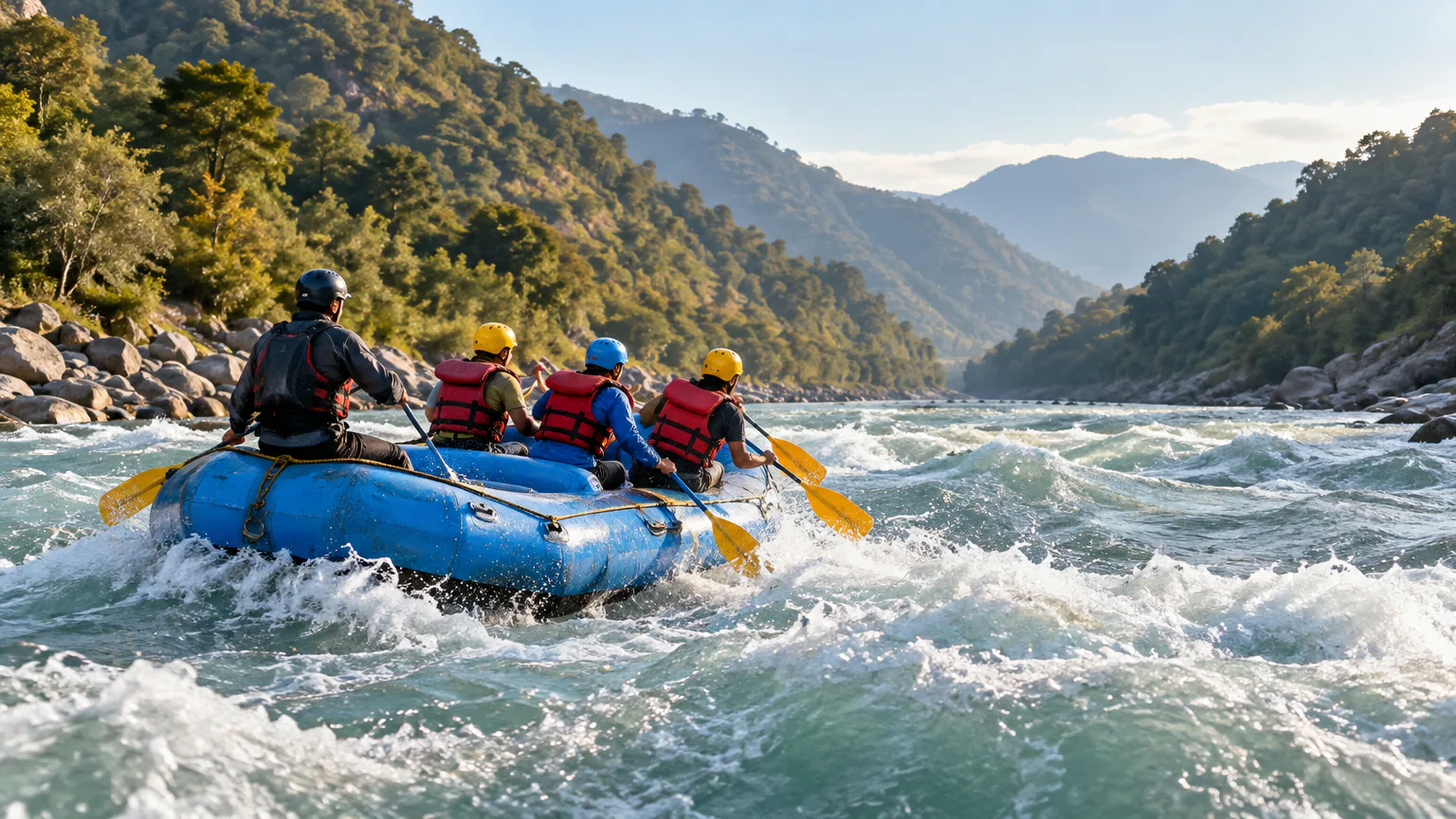
How to avoid itSwim only at designated spots and raft only with licensed operators who provide and require life jackets. The Ganges at Rishikesh and Haridwar has strong currents even in dry season.
- Altitude illness on treks and high passes
How to avoid itAscend gradually, hydrate consistently, avoid alcohol at altitude, and descend immediately if symptoms such as headache, nausea or disorientation worsen.
- Mountain-road driving risk
How to avoid itUse experienced local drivers familiar with hill gradients, avoid night driving on single-lane mountain roads, and ensure vehicles are maintained for steep climbs.
- Weather-dependent helicopter services
How to avoid itTreat helicopter slots on Char Dham routes as optional and keep a road alternative ready; services are separately regulated and can be cancelled at short notice.
- Overcrowding at peak pilgrimage sites
How to avoid itBook Char Dham registrations well in advance, arrive at ghats and temples early in the morning, and avoid peak weekends in May and June when footfall is highest.
Check weather and road status before every hill leg, especially during monsoon. Avoid river swimming and rafting outside licensed operators, and pace your ascent to reduce altitude illness on routes to Valley of Flowers, Auli and Char Dham passes.
Helicopter services operate on selected pilgrimage routes but are weather-dependent and separately regulated. Never treat a helicopter slot as a guaranteed backup for a road plan, and always carry the road option as your primary route.
Packing by Season for Uttarakhand
Packing for Uttarakhand means layers, rain protection and sun protection regardless of month. Summer needs light cottons plus a warm layer for higher elevations, monsoon needs waterproofs, post-monsoon needs fleece for cold mornings, and winter needs insulated jackets for hill towns and snow areas such as Auli.
Summer (March–June)
Light cottons, sun hat, sunscreen SPF 50+, sunglasses, one warm fleece or jacket for higher elevations such as Mussoorie, Auli and Valley of Flowers.
Where to get it: Personal packingCommon mistake: Assuming hill towns are as warm as the plains; temperatures drop sharply after sunset.
Monsoon (July–September)
Waterproof jacket, quick-dry clothing, waterproof footwear, dry bag for electronics and documents.
Where to get it: Personal packingCommon mistake: Carrying only cotton, which stays wet and cold in persistent hill rain.
Post-monsoon (October–November)
Layers, light fleece, comfortable walking shoes, sun protection for clear days; mornings and evenings are cold even at Nainital and Mussoorie.
Where to get it: Personal packingCommon mistake: Underestimating cold mornings and evenings in October at altitude.
Winter (December–February)
Insulated jacket, thermals, gloves, woollen cap, warm socks for hill towns and snow areas including Auli and Munsiyari.
Where to get it: Personal packingCommon mistake: Packing for plains winter and expecting the same conditions in Mussoorie or Auli.
Documents and medicines
ID copies, booking confirmations, insurance documents, prescriptions in original packaging, basic first-aid kit.
Where to get it: Personal documentsCommon mistake: Carrying medicines loose without prescription labels, which can cause issues at checkpoints.
Reusable water bottle and snacks
Carry a reusable bottle for filtered water and basic snacks for long drives where highway dhabas may be the only option.
Where to get it: Personal packingCommon mistake: Relying entirely on roadside vendors on remote stretches.
Pack layered clothing, rain protection, walking shoes, sun protection, personal medicines and a warm layer even in summer for higher elevations. Valley of Flowers is a summer alpine destination, so plan that trek only in the snow-free visitor season and pack accordingly.
Carry a reusable water bottle, basic first-aid and any prescription medicines in original packaging. Power banks and offline maps are practical essentials for hill travel, particularly on the Char Dham corridor and remote Kumaon routes where charging and connectivity are limited.
Best Time to Visit Uttarakhand
The best time to visit Uttarakhand is March to June for summer travel and September to November for post-monsoon clarity. Each season suits different zones: Char Dham pilgrimage runs April to November, Valley of Flowers opens in summer, and Auli is best for snow in January and February.
January
Good time to goCold to very cold; snow at Auli, Munsiyari and high passes
Best for snow at Auli; Char Dham closed; plains towns accessible
February
Good time to goCold; snow continues at higher elevations
Good for Auli skiing; Rishikesh and Haridwar pleasant
March
Best time to goWarming; rhododendrons bloom in Kumaon and Garhwal hills
Season opens; good for Rishikesh, Mussoorie and Nainital
April
Best time to goWarm and clear; Char Dham season begins
Char Dham pilgrimage starts; book early
May
Best time to goWarm to hot in valleys; pleasant at hill stations
Peak season for Mussoorie, Nainital and Char Dham
June
Good time to goPre-monsoon heat in valleys; Valley of Flowers opens
Valley of Flowers accessible; monsoon arrives late June
July
Not recommendedHeavy monsoon rain; landslide risk on hill highways
Avoid hill driving; Char Dham routes prone to closure
August
Shoulder seasonMonsoon continues; Valley of Flowers at peak bloom
Valley of Flowers peak bloom but road risk remains
September
Good time to goMonsoon recedes; roads reopen gradually
Good for Valley of Flowers late season; improving roads
October
Best time to goClear and cool; excellent visibility across Himalayan ranges
Best post-monsoon month; Char Dham closes late October
November
Good time to goCool to cold; clear skies; Char Dham closes for winter
Good for Kumaon and Rishikesh; Char Dham season ends
December
Shoulder seasonCold; snow at higher elevations; hill passes may close
Quiet season; good for Rishikesh and Haridwar; cold at altitude
- BestMar, Apr, May, Oct
- GoodJan, Feb, Jun, Sep, Nov
- FairAug, Dec
- AvoidJul
March to June suits Char Dham pilgrimage, Mussoorie, Nainital and Valley of Flowers. October and November offer the clearest post-monsoon skies and are the most reliable months for photography and trekking across both Garhwal and Kumaon.
July and August carry the highest landslide risk on hill highways, particularly on the Rishikesh–Badrinath and Rishikesh–Kedarnath corridors. Valley of Flowers reaches peak bloom in August, but road conditions require daily checks and flexible plans.
How to Reach Uttarakhand
Uttarakhand is accessible by air, rail and road from Delhi, Mumbai, Kolkata and Chennai. Jolly Grant Airport near Dehradun is the main air gateway for Garhwal; Kathgodam is the nearest railhead for Nainital and Kumaon. Road travel from Delhi to Dehradun or Haridwar takes roughly five to six hours on the expressway.
Delhi
Jolly Grant Airport, Dehradun
Most frequent air connection; multiple daily flights; Garhwal gateway
Delhi
Dehradun or Haridwar railway station
Shatabdi and Jan Shatabdi services; book on IRCTC well in advance for peak season
Delhi
NH58 or Yamuna Expressway to Haridwar or Dehradun
Expressway reduces time; hill sections after Haridwar or Rishikesh add time
Delhi
Kathgodam railway station
Main railhead for Nainital, Corbett and Kumaon; taxis available at station
Mumbai
Jolly Grant Airport, Dehradun
Direct flights available; connect to hill destinations by road
Kolkata
Jolly Grant Airport, Dehradun
Direct and connecting flights; Pantnagar also serves eastern Kumaon
Chennai
Jolly Grant Airport, Dehradun
Connecting flights via Delhi common; plan layover time
Travelling from your city?
Tell us where you start. A specialist can plan connections around your stay.
Plan my journeyDehradun is the most connected entry point for Garhwal, with Jolly Grant Airport receiving flights from Delhi, Mumbai, Kolkata and Chennai. From Dehradun, road transfers reach Rishikesh in about one hour and Haridwar in about 45 minutes.
For Kumaon, Kathgodam is the nearest railhead for Nainital and Corbett. Pantnagar Airport also serves eastern Kumaon. From Kathgodam, shared taxis and private cabs reach Nainital in about 35 kilometres of hill road.
Holiday ideas to start from
Reviewed itineraries for this destination — personalise with a specialist, never an instant booking.
Char Dham Road Circuit 10 Nights: 2026 Uttarakhand Pilgrimage Package
From₹50,000per adult, twin sharing, land only

From idea to itinerary, with a real person.
- Share your plan
Dates, departure city, travellers and the moments you’d love. It only takes a minute.
- Shape it with a specialist
A real person refines the route, stays and pace with you. Change anything.
- Review your quote
A clear, personalised quote with confirmed inclusions. No payment to enquire.
From our travel specialists
What our team sees when planning these trips, beyond what the guidebooks say.
Confirmed 11 Oct 2026
Local transport is the issue most clearly reported: shared taxis and buses generally operate from morning to evening, fill quickly in peak season and may not be comfortable for families carrying luggage. Outside major towns, hill roads may lack street lighting, so late-night driving is best avoided.
Families learn that private road travel is usually more convenient than public buses when carrying luggage, but that hill roads, limited lighting and long drives require an unhurried schedule. Couples and families also benefit from choosing one region rather than crossing between Kumaon and Garhwal, since the journey between the two sides can take much of a day.
Travellers commonly wish they had understood how long hill-road journeys take and that Uttarakhand is too large to cover comfortably in one trip. Reports also stress allowing buffer time, starting drives early, and expecting limited transport or crowds in peak periods.
Travellers often replace rigid package plans with local buses or shared taxis and add extra time in a base such as Rishikesh, Joshimath or Ghangharia. For the Valley of Flowers, travellers commonly add the Hemkund Sahib trek after reaching Ghangharia.
Before you go
Straight answers to help you plan — then personalise the trip with a specialist.
10 answered belowAsk a specialist anything about this trip — there’s no obligation.
Ask a specialistWhat is the best time to visit Uttarakhand?
March to June and September to November are the most versatile periods; October and November usually offer the clearest post-monsoon views. Monsoon months bring landslide risk on hill highways, while winter snow can close high passes and limit access to Auli and Valley of Flowers.
How many days are enough for Uttarakhand?
Five to seven days suit a focused circuit such as Haridwar, Rishikesh, Mussoorie and Corbett; ten or more days are better for adding Kumaon or trekking. Mountain journeys are slow, so allow buffer days for traffic, weather and road work on every leg.
How much does a Uttarakhand tour package cost?
A typical land-only twin-sharing package ranges from around INR 18,000 per person for budget travel to INR 95,000 or more for luxury travel. These are indicative planning ranges, not confirmed offers, and vary with duration, hotel class and inclusions.
Is Uttarakhand safe for tourists?
Uttarakhand is broadly suitable for tourism, but monsoon landslides, river conditions, altitude illness and mountain-road driving require active precautions. Check weather and road status daily, use licensed operators for rafting, and pace your ascent on treks above Rishikesh and Haridwar.
Which airport is nearest to Uttarakhand tourist destinations?
Jolly Grant Airport near Dehradun is the principal airport for Garhwal destinations including Rishikesh, Mussoorie and Char Dham routes. Pantnagar Airport is useful for Kumaon destinations such as Nainital and Corbett. Delhi is also the main rail and road gateway.
What are the best places to visit in Uttarakhand?
Common highlights include Rishikesh, Haridwar, Mussoorie, Nainital, Corbett, Auli, Valley of Flowers and selected Char Dham sites. Each zone has its own gateways and weather patterns, so sequence Garhwal and Kumaon separately for a smoother itinerary.
Is Uttarakhand good for a family holiday?
Rishikesh, Mussoorie, Nainital, Corbett and Haridwar work well for families, provided transfers are paced and high-altitude treks are kept optional. Choose hotels with reliable heating in winter and avoid night driving on hill highways regardless of season.
What should I pack for a trip to Uttarakhand?
Pack layered clothing, rain protection, walking shoes, sun protection, personal medicines and a warm layer even in summer for higher elevations. Carry ID copies, booking confirmations, a power bank and offline maps for low-network stretches on Char Dham and trekking routes.
Do I need any permits to visit Uttarakhand?
Normal tourism in Uttarakhand requires no visa, RAP or ILP. However, trekking areas, protected forests such as Valley of Flowers and Char Dham pilgrimage routes require separate online registration or permits. Verify current requirements with the relevant district administration or forest department before travel.
What are the dos and don'ts in Uttarakhand?
Do carry government photo ID, book accommodation in advance for peak season, dress modestly at temples and check road conditions daily. Do not drive on hill highways at night, swim in rivers outside designated spots, or assume a single-day plan covering multiple hill towns is achievable.