
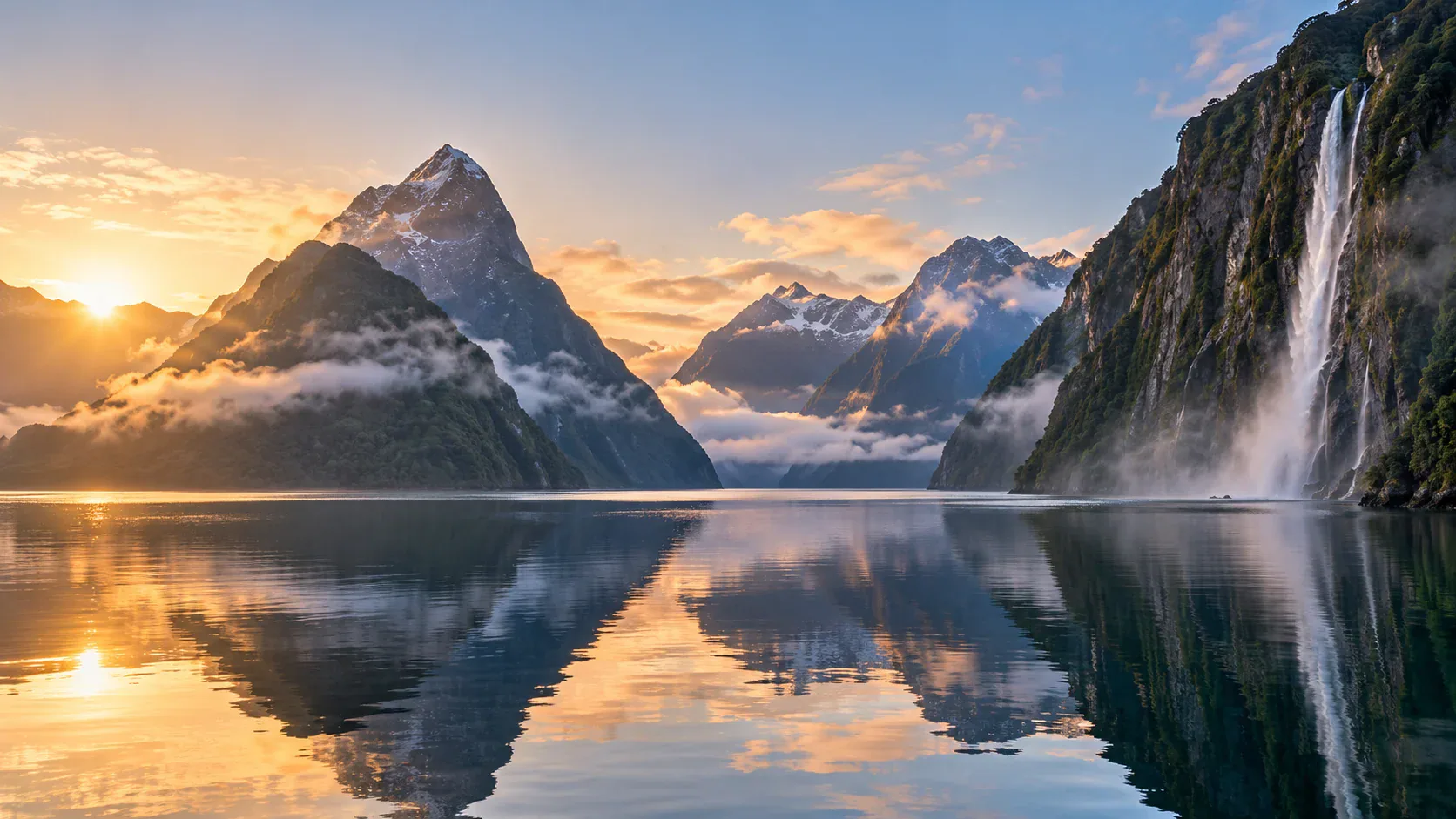
What Most Changes a New Zealand Trip
Five factors decide how well a New Zealand trip goes: securing the Visitor Visa before booking non-refundable fares, choosing the right season, accepting left-hand driving, budgeting for domestic flights and activities, and packing for four seasons in one day.
At a glance
New Zealand, in brief
New Zealand uses the New Zealand dollar, English and te reo Māori, and Type I plugs. Indian passport holders generally need a Visitor Visa before travel; the NZeTA is not normally sufficient. The visitor visa fee is NZD 441, plus the NZD 100 International Visitor Conservation and Tourism Levy for most visitors.
New Zealand.
Planned around you.
- Currency
- New Zealand Dollar (NZD)Cards widely accepted; carry some cash for small towns.
- Language
- English and te reo MāoriEnglish is sufficient for all tourist areas.
- Plug type
- Type I (three-pin)Same as Australia; bring an adapter if your devices use Indian pins.
- SIM or eSIM
- Local SIM or eSIM availableCompare data packs on arrival at Auckland Airport or buy an eSIM before departure.
- Time difference
- New Zealand is 6.5–7.5 hours ahead of ISTVaries with daylight saving; check before calling home.
- Emergency number
- 111Police, fire and ambulance.
Before You Go to New Zealand
Before booking flights, secure your Visitor Visa, arrange travel insurance that covers adventure activities, and carry a mix of forex and cards. Apply through Immigration New Zealand or a New Zealand Visa Application Centre in India, and keep digital and printed copies of every document.
Passport valid for at least three months beyond departure
Check blank pages and validity before applying.
Where to get it: Passport officeCommon mistake: Applying with a passport expiring within six months.
New Zealand Visitor Visa
Apply online via Immigration New Zealand or a Visa Application Centre in India.
Where to get it: Immigration New ZealandCommon mistake: Assuming NZeTA is sufficient for Indian citizens.
Travel insurance covering adventure activities
Ensure cover for hiking, bungee and driving; check exclusions.
Where to get it: Insurance providerCommon mistake: Buying basic cover that excludes adventure sports.
Forex and international cards
Carry NZD cash for small towns and a no-foreign-transaction-fee card.
Where to get it: Bank or forex dealerCommon mistake: Relying only on UPI, which is not widely accepted in New Zealand.
International Driving Permit or approved English translation
Required or advisable alongside your valid Indian licence.
Where to get it: Regional Transport Office or authorised agencyCommon mistake: Driving without an approved translation.
Accommodation and itinerary printouts
Keep copies for immigration and car rental pickup.
Where to get it: Your bookingsCommon mistake: Having only digital copies when phone battery dies.
Useful apps
Maps offline, weather, transport and banking apps.
Where to get it: App storeCommon mistake: Not downloading offline maps before leaving India.
Money and Payments in New Zealand
New Zealand runs mostly on cards, with EFTPOS and credit cards accepted almost everywhere. UPI is not widely accepted, so carry a no-foreign-transaction-fee card and some NZD cash. ATMs are common in cities and towns, but fewer in remote areas.
- Cards over cash
Use a no-foreign-transaction-fee card for most purchases; keep NZD 100–200 cash for small towns and markets.
Money - ATM strategy
Withdraw larger amounts less often to reduce per-transaction fees; use bank ATMs rather than standalone machines.
Money - UPI reality
UPI is not widely accepted in New Zealand; do not rely on it for daily spending.
Money - SIM or eSIM
Buy a local SIM at Auckland Airport or an eSIM before departure; compare data packs for your trip length.
Connectivity - Offline maps
Download offline maps for your driving routes; mobile coverage can drop in national parks and remote areas.
Connectivity
Cultural Tips for New Zealand
New Zealand is informal but respectful. Dress modestly at marae and religious sites, remove shoes when asked, and always ask before photographing people. Tipping is not expected but appreciated for good service. A simple 'Kia ora' greeting goes a long way.
- Greetings
Use 'Kia ora' for hello; a handshake is standard in business and formal settings.
Etiquette - Marae visits
Follow the host's instructions; remove shoes before entering and dress modestly.
Culture - Tipping
Not expected; 5–10% is appreciated for good restaurant service.
Etiquette - Photography
Ask before photographing people, especially in Māori contexts.
Etiquette - Dress code
Casual in cities; outdoor gear in Queenstown and Rotorua; modest at religious sites.
Etiquette
Food Tips for Indian Travellers
New Zealand has strong vegetarian and Indian food options in Auckland, Wellington and Christchurch. Try local dishes like fish and chips, lamb, pavlova and hāngī. In smaller towns, Indian restaurants are fewer, so plan meals around larger centres or self-cater.
- Auckland
Auckland
Widest range of Indian restaurants and vegetarian options in New Zealand.
Best forIndian food and vegetarian meals
Look in Sandringham and Papatoetoe for authentic Indian food.
- Wellington
Wellington
Good mix of cafes and Indian restaurants in the city centre.
Best forCafes and Indian food
Cuba Street has diverse dining options.
- Christchurch
Christchurch
Indian restaurants available; fewer in surrounding small towns.
Best forIndian food before South Island road trips
Stock up on snacks before driving to remote areas.
- Rotorua
Rotorua
Some Indian and vegetarian options; plan ahead in peak season.
Best forVegetarian options in a tourist town
Book dinner early as restaurants fill up.
- Queenstown
Queenstown
Limited Indian restaurants; self-catering is useful for longer stays.
Best forSelf-catering and casual dining
Supermarkets stock rice, lentils and spices.
Safety in New Zealand for Indian Tourists
New Zealand is generally safe, but weather changes fast, roads are left-hand drive, and some adventure activities carry real risk. Carry travel insurance, check weather before hikes, and never drive tired. In case of emergency, call 111.
- Left-hand driving and long distances
How to avoid itAllow more time than maps suggest; take breaks every two hours; do not drive after long-haul flights.
- Rapid weather changes
How to avoid itCheck forecasts before hikes; carry layers, rain gear and emergency supplies.
- Adventure activity risks
How to avoid itConfirm your travel insurance covers the specific activity before booking.
- Winter driving conditions
How to avoid itCarry chains where required; check road conditions before mountain routes.
- Petty theft in tourist areas
How to avoid itDo not leave valuables in cars; use hotel safes.
- Sun exposure
How to avoid itUse high-SPF sunscreen; UV levels can be high even on cloudy days.
Packing by Season
Pack layers year-round because New Zealand weather changes quickly. Summer (December–February) needs light clothing plus a rain jacket; winter (June–August) needs thermals, a warm jacket and waterproof shoes. Shoulder seasons (March–May, September–November) suit a mix of both.
Layers for all seasons
T-shirts, fleece, waterproof jacket and comfortable trousers.
Where to get it: Your wardrobeCommon mistake: Packing only for one season.
Rain jacket
Essential year-round; compact and waterproof.
Where to get it: Outdoor storeCommon mistake: Relying on an umbrella in windy conditions.
Walking shoes
Broken-in, waterproof shoes for hikes and city walks.
Where to get it: Outdoor storeCommon mistake: New shoes that cause blisters.
Winter thermals
For June–August, especially South Island.
Where to get it: Your wardrobeCommon mistake: Underestimating cold in Queenstown and Milford Sound.
Sunscreen and sunglasses
High UV levels even on cloudy days.
Where to get it: PharmacyCommon mistake: Skipping sunscreen in cooler months.
Power adapter
Type I plug; same as Australia.
Where to get it: Electronics storeCommon mistake: Assuming Indian plugs fit.
Prescription medicines
Carry enough for the trip with a doctor's note.
Where to get it: DoctorCommon mistake: Running out in remote areas.
Holiday ideas to start from
Reviewed itineraries for this destination — personalise with a specialist, never an instant booking.
Lake Tekapo and Queenstown 7 Nights Nature Tour Package 2026
From₹2,36,700per adult, twin sharing, land only
From idea to itinerary, with a real person.
- Share your plan
Dates, departure city, travellers and the moments you’d love. It only takes a minute.
- Shape it with a specialist
A real person refines the route, stays and pace with you. Change anything.
- Review your quote
A clear, personalised quote with confirmed inclusions. No payment to enquire.
From our travel specialists
What our team sees when planning these trips, beyond what the guidebooks say.
Confirmed 11 Oct 2026
Travellers commonly discover that New Zealand is best experienced slowly by self-drive, with substantial time needed between scenic stops. Reports also highlight the long flight from India and the need to plan weather flexibility, especially for Milford Sound, Tongariro and Mount Cook.
- Practical
Local transport catches visitors out because a car is particularly useful beyond Auckland and between South Island sights; one couple used public transport initially, then rented a car in Queenstown and stocked up on groceries. Reports also point to the long flight from India as a practical burden.
Before you go
Straight answers to help you plan — then personalise the trip with a specialist.
8 answered belowAsk a specialist anything about this trip — there’s no obligation.
Ask a specialistDo Indians need a visa for New Zealand?
Yes. Indian passport holders generally need a Visitor Visa before travelling; the NZeTA is not normally sufficient for Indian citizens. Apply online through Immigration New Zealand or a New Zealand Visa Application Centre in India. The visitor visa fee is NZD 441, plus the NZD 100 International Visitor Conservation and Tourism Levy for most visitors.
What is the best time to visit New Zealand?
December to February is best for warm-weather touring; March to May and September to November offer fewer crowds and moderate prices. June to August suits snow sports but brings cold and shorter days. Choose based on whether you want beaches and hiking or skiing and winter scenery.
How much does a New Zealand tour package cost from India?
Indicative land-only twin-sharing packages range from about INR 180,000 budget to INR 750,000 luxury per person, excluding international airfare. These are planning ranges, not Tripstor offers. Accommodation, car rental, fuel, domestic flights and adventure activities are major cost components.
How many days are enough for New Zealand?
Seven days can cover a compact North or South Island route; 10 to 14 days are better for both islands. Common routes include Auckland, Rotorua, Wellington, Christchurch, Queenstown, Milford Sound and Franz Josef. Allow extra time for driving and weather delays.
Is New Zealand expensive for Indian tourists?
Yes. Accommodation, car rental, fuel, domestic flights and adventure activities are major cost components. Budget travellers can self-cater and use buses; mid-range travellers should plan for NZD 50–150 per day for car rental alone. Indicative land-only packages start around INR 180,000 per person twin-sharing.
Can Indian tourists drive in New Zealand?
Yes, with a valid Indian licence and, where required or advisable, an approved English translation or International Driving Permit. Drivers must keep left. Allow more time than maps suggest and avoid driving after long-haul flights. Winter mountain routes may require chains.
Which places are included in New Zealand tour packages?
Common routes include Auckland, Rotorua, Wellington, Christchurch, Queenstown, Milford Sound and Franz Josef. Packages vary by duration and island. A 7-day trip usually covers one island; 10–14 days can combine both. Confirm inclusions before booking.
Is New Zealand good for a honeymoon?
Yes. Queenstown, Milford Sound, Lake Tekapo, Rotorua and luxury lodges support scenic and experience-led honeymoons. December to February offers warm weather; shoulder seasons offer fewer crowds. Self-drive gives flexibility, but consider a private driver if you prefer not to drive.