
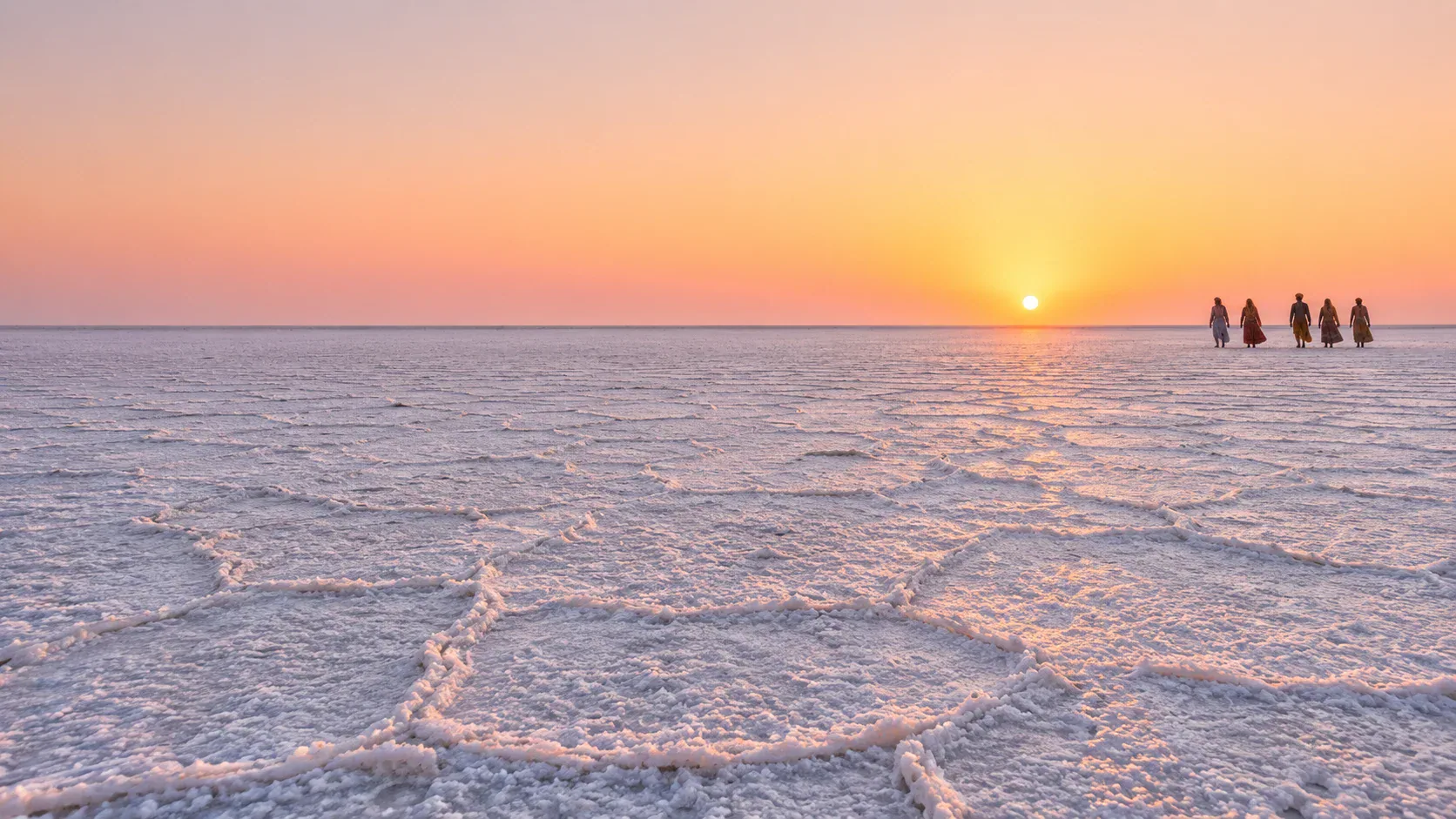
What Gujarat Travel Tips India Really Means
The handful of things that most change a Gujarat trip are timing, transport, permits, cash and dress code. October to February gives comfortable sightseeing, while April to June heat and July to September rain reshape itineraries. Pre-booked cars and advance safari or attraction tickets decide how much you actually see.
Gujarat is large and spread out, so a single mistake in sequencing costs a day. Ahmedabad works as the arrival hub, but Kutch, Gir, Somnath, Dwarka and Kevadia sit in different directions. A 5–7 night land package usually covers Ahmedabad plus one circuit; 10 nights allows two. Indicative land-only twin-sharing packages range from about INR 18,000 budget to INR 95,000 luxury per person, excluding flights. Private cars with driver are quoted at roughly INR 3,000–5,500 per day depending on vehicle and season, excluding tolls, parking and driver allowance.
- Timing: October–February is the most comfortable window for sightseeing, Rann season and wildlife travel.
- Transport: hired car with driver for multi-city circuits; rail and intercity buses link Ahmedabad, Vadodara, Rajkot, Bhuj and Surat.
- Permits: Gir safari permits and Statue of Unity tickets should be booked through their official systems.
- Cash: keep some for smaller towns even though UPI is widely accepted.
- Dress: modest clothing at temples and religious sites.
At a glance
Gujarat, in brief
Gujarat uses the Indian rupee, Gujarati and Hindi, and Indian standard plug points. Indian citizens need no visa or state permit for ordinary travel; foreign visitors need a valid passport and applicable Indian visa or e-visa. Carry government photo identification for hotel check-in, safaris and attraction tickets.
Gujarat.
Planned around you.
- Currency
- Indian rupee (INR)Cards and UPI widely accepted in cities; carry cash for smaller towns.
- Languages
- Gujarati and HindiEnglish understood in hotels and urban areas.
- Plug type
- Indian standard plug pointsBring a universal adapter if your devices use other pins.
- SIM or eSIM
- Local SIM or eSIM works across major citiesCoverage is weaker in parts of the Rann and inside Gir.
- Time difference
- Indian Standard Time (UTC+5:30)No state-level time change.
- Emergency number
- 112Single emergency number for police, fire and ambulance.
Before You Go to Gujarat
Before a Gujarat trip, lock in transport, safari and attraction bookings, keep government photo identification handy, and arrange a mix of cash and cards. The common mistake is treating Gujarat as a single-city break when Kutch, Gir and Kevadia sit far apart and need pre-booked transfers.
Government photo identification
Carry the original for hotel check-in, safaris and attraction tickets.
Where to get it: Personal documentsCommon mistake: Carrying only a photocopy or a soft copy that is not accepted.
Gir safari permit
Book through the official forest booking system and carry the identification used for the reservation.
Where to get it: Official forest booking systemCommon mistake: Arriving without a pre-booked permit during peak season.
Statue of Unity ticket
Book through the official attraction system to reduce queue time.
Where to get it: Official attraction systemCommon mistake: Assuming walk-in tickets are always available on weekends.
Private car with driver
Pre-book for multi-city circuits; indicative rates are INR 3,000–5,500 per day depending on vehicle and season, excluding tolls, parking and driver allowance.
Where to get it: Reputable local operatorCommon mistake: Booking a self-drive car without accounting for long intercity distances.
Cash and cards
Carry some cash for smaller towns; UPI and cards work in cities.
Where to get it: Bank or ATMCommon mistake: Relying only on UPI in remote areas.
Travel insurance
Choose a policy that covers medical expenses, trip delays and adventure activities if relevant.
Where to get it: Insurance providerCommon mistake: Assuming a basic policy covers safari-related incidents.
Weather-appropriate clothing
Light cotton for summer, layers for winter, rain protection for monsoon.
Where to get it: Personal packingCommon mistake: Packing only for Ahmedabad weather and ignoring Kutch temperature swings.
Medicines and first-aid
Carry prescriptions and basic medicines for heat, dehydration and motion sickness.
Where to get it: PharmacyCommon mistake: Assuming pharmacies are open late in smaller towns.
Offline maps and apps
Download maps and keep a local SIM or eSIM active.
Where to get it: App storeCommon mistake: Depending only on network coverage inside Gir or the Rann.
Rann area permit check
Visitors generally need the applicable entry permit for the restricted Rann area; requirements and fees should be checked before travel.
Where to get it: Official tourism or district authorityCommon mistake: Assuming no permit is needed for restricted zones.
Ahmedabad is the principal gateway with direct flights from major Indian cities, and Vadodara, Surat, Rajkot and Bhuj also serve selected routes. Nonstop flights to Ahmedabad take about 1.1 hours from Mumbai, 1.2 hours from Pune, 1.6 hours from Hyderabad, 1.7 hours from Delhi, 2.3 hours from Bengaluru and 2.5 hours from Chennai or Kolkata, with schedules varying by season. For multi-city circuits, a hired car with driver is the most practical option. Gir safari permits and Statue of Unity tickets should be booked through their official systems before you travel.
Money and Payments in Gujarat
Gujarat runs on a cash-plus-digital mix. UPI and cards work in Ahmedabad, Vadodara, Surat, Rajkot and Bhuj, but smaller towns, roadside stops and some safari areas still favour cash. Keep a local SIM or eSIM active and download offline maps for Gir and the Rann.
- Carry a cash buffer
Keep some cash for smaller towns, roadside stops and areas where UPI may not work.
Money - Use UPI in cities
UPI is widely accepted in Ahmedabad, Vadodara, Surat, Rajkot and Bhuj, but not guaranteed everywhere.
Money - Withdraw before long drives
ATMs are easier to find in cities and district headquarters than on remote stretches.
Money - Choose a local SIM or eSIM
Coverage is good in cities and on highways, weaker in parts of the Rann and inside Gir.
Connectivity - Download offline maps
Keep maps available offline for Gir and the Rann where signal may drop.
Connectivity - Carry a power bank
Long travel days between circuits can drain your phone battery.
Connectivity
ATMs are easy to find in cities and district headquarters, less so on remote stretches. Withdraw before long drives. UPI is widely accepted in urban Gujarat, including many shops and restaurants, but do not assume it works at every small stall. For connectivity, a local SIM or eSIM gives the best coverage across major cities; signal is weaker in parts of the Rann and inside Gir. Roaming on an existing Indian number works, but data speeds vary. Carry a power bank for long travel days.
Cultural Tips for Gujarat
Gujarat is culturally rich and generally conservative in religious settings. Dress modestly at temples and religious sites, remove footwear where required, and ask before photographing people or ceremonies. Tipping is not mandatory but appreciated for drivers, guides and hotel staff.
- Dress modestly at religious sites
Cover shoulders and knees at temples such as Somnath and Dwarka; remove footwear where required.
Etiquette - Ask before photographing people
In Kutch and smaller towns, ask before taking photos of people, homes or ceremonies.
Etiquette - Tipping is optional
Tip drivers, guides and hotel staff for good service; there is no fixed rule.
Etiquette - Check alcohol rules
Alcohol is regulated in parts of Gujarat; check local rules before planning around it.
Culture - Respect vegetarian norms
Many restaurants are pure vegetarian; avoid carrying non-vegetarian food into such places.
Culture - Use local greetings
A simple 'kem cho' is appreciated in markets and smaller towns.
Culture
Gujarat has a strong vegetarian food culture, and many restaurants are pure vegetarian. Alcohol is regulated in parts of the state, so check local rules if that matters to you. At temples such as Somnath and Dwarka, follow signage on dress and photography. In Kutch, respect local craftsperson communities by asking before taking photos and by buying directly where possible. A simple 'kem cho' greeting goes a long way.
Food Tips for Gujarat
Gujarati food is largely vegetarian, with thali culture, farsan snacks and sweet-savoury balance. Dishes to try include dhokla, khandvi, undhiyu, thepla and Gujarati kadhi. Jain and pure-vegetarian options are common, and Indian food is the default, so finding familiar meals is easy.
- Ahmedabad
Gujarati thali
A full plate with rotli, shaak, dal, kadhi, rice, farsan and sweet, usually vegetarian.
Best forFirst-time visitors
Go for lunch when thalis are freshest.
- Statewide
Dhokla and khandvi
Steamed and rolled snacks made from gram flour, common as breakfast or evening farsan.
Best forSnacking
Try them fresh from a local farsan shop.
- Surat and south Gujarat
Undhiyu
A winter mixed-vegetable dish, traditionally cooked upside down.
Best forSeasonal eating
Best in winter months when the vegetables are in season.
- Statewide
Thepla
Fenugreek flatbread that travels well, often eaten with curd or pickle.
Best forTravel food
Buy fresh thepla for long drives.
- Statewide
Gujarati kadhi
A sweet-sour yoghurt curry, usually served with rice or khichdi.
Best forComfort food
Ask for it with khichdi for a light meal.
Ahmedabad has a strong street-food and thali scene, while Kutch and Saurashtra offer regional variations. If you are vegetarian, Gujarat is one of the easiest states to eat in. If you eat non-vegetarian food, check before ordering in smaller towns, as many restaurants are pure vegetarian. Carry basic digestive aids if you are trying a lot of fried farsan. For water, stick to sealed bottles or filtered water.
Safety in Gujarat
Gujarat is generally suitable for family travel, but heat, long drives, safari rules and seasonal rain need planning. Watch for dehydration in summer, carry identification for safaris, and avoid unlicensed guides. No destination is risk-free, so use standard precautions and check local advice before remote travel.
- Heat exhaustion in summer
How to avoid itCarry water, wear a hat and avoid outdoor activity in the afternoon during April to June.
- Dehydration on long drives
How to avoid itKeep water and oral rehydration salts in the car and stop regularly.
- Safari permit issues at Gir
How to avoid itBook through the official forest booking system and carry the identification used for the reservation.
- Unlicensed guides or touts
How to avoid itUse official ticket counters and pre-booked operators; avoid unsolicited offers.
- Monsoon road conditions
How to avoid itCheck weather and road status before long drives in July to September.
- Restricted Rann area rules
How to avoid itCheck permit requirements before travel and carry identification.
- Photography restrictions at religious sites
How to avoid itFollow signage and ask before photographing people or ceremonies.
- Limited medical facilities in remote areas
How to avoid itCarry basic medicines and know the nearest hospital before heading to remote circuits.
Summer heat in April to June can be intense, especially in Kutch and Saurashtra. Monsoon from July to September brings rain and slippery roads. In Gir, follow forest rules and do not get out of the vehicle except at designated points. In the Rann, carry water and sun protection. Keep emergency number 112 saved. For health, carry oral rehydration salts and any prescription medicines.
Packing by Season for Gujarat
Packing for Gujarat depends on season. October to February needs light layers for cool mornings and warm days. March to June calls for light cotton, sun protection and extra water. July to September needs rain protection and quick-dry clothing. Comfortable walking shoes work across all seasons.
Winter layers (October–February)
Light jacket or shawl for cool mornings and evenings, especially in Kutch.
Where to get it: Personal packingCommon mistake: Packing only summer clothes and feeling cold at night.
Summer cotton (March–June)
Loose cotton clothing, wide-brimmed hat and sunscreen for intense heat.
Where to get it: Personal packingCommon mistake: Wearing dark, heavy fabrics that trap heat.
Monsoon rain gear (July–September)
Rain jacket or umbrella and footwear with grip for wet roads.
Where to get it: Personal packingCommon mistake: Carrying only an umbrella and no waterproof layer for long drives.
Modest temple clothing
Clothing that covers shoulders and knees for Somnath, Dwarka and other religious sites.
Where to get it: Personal packingCommon mistake: Arriving in shorts and sleeveless tops at temples.
Comfortable walking shoes
Useful for heritage sites, forts and long days of sightseeing.
Where to get it: Personal packingCommon mistake: Wearing new shoes that cause blisters on long walks.
Power bank and chargers
For long drives and days away from charging points.
Where to get it: Personal packingCommon mistake: Relying on car chargers that may not fit your device.
Reusable water bottle
Refill with filtered or sealed water to stay hydrated.
Where to get it: Personal packingCommon mistake: Buying single-use bottles at every stop.
Basic medicines
Oral rehydration salts, motion sickness tablets and personal prescriptions.
Where to get it: PharmacyCommon mistake: Assuming pharmacies are open late in remote areas.
For winter travel, a light jacket is useful in Kutch where nights can be cool. For summer, loose cotton, a wide-brimmed hat and sunscreen are essential. For monsoon, carry a rain jacket or umbrella and footwear with grip. Across seasons, pack modest clothing for temple visits, a power bank, and a small daypack for safaris and long drives.
Holiday ideas to start from
Reviewed itineraries for this destination — personalise with a specialist, never an instant booking.
Ahmedabad and Statue of Unity Premium 3 Nights: Gujarat Family Package 2026
From₹21,900per adult, twin sharing, land only
From idea to itinerary, with a real person.
- Share your plan
Dates, departure city, travellers and the moments you’d love. It only takes a minute.
- Shape it with a specialist
A real person refines the route, stays and pace with you. Change anything.
- Review your quote
A clear, personalised quote with confirmed inclusions. No payment to enquire.
From our travel specialists
What our team sees when planning these trips, beyond what the guidebooks say.
Confirmed 11 Oct 2026
Travellers commonly wish they had planned for Gujarat’s long intercity distances, harsh daytime heat, and the need to reserve Gir safari slots well ahead. They also report that early starts make temples and monuments more comfortable and less crowded.
- Practical
Carrying enough cash can matter in remote Kutch villages, where payment options may be limited. Intercity transport also needs checking carefully: traveller reviews report bus breakdowns, stranded passengers and uncomfortable conditions with some operators.
Before you go
Straight answers to help you plan — then personalise the trip with a specialist.
8 answered belowAsk a specialist anything about this trip — there’s no obligation.
Ask a specialistWhat is the best time to visit Gujarat?
October to February is generally best for comfortable sightseeing, the Rann season and wildlife travel. Summer from April to June is hot, and monsoon from July to September brings rain. If you plan around the Rann Utsav, check current dates as they vary each year.
How many days are enough for a Gujarat tour?
Five to seven days covers Ahmedabad, a heritage circuit and either Kutch, Gir or Kevadia. Ten days allows a broader circuit including Somnath and Dwarka. Long road distances mean you should not try to cover everything in one short trip.
How much does a Gujarat tour package cost?
Indicative land-only twin-sharing packages range from about INR 18,000 budget to INR 95,000 luxury per person, excluding flights. A practical 5–7 night land package commonly starts around INR 25,000–35,000 per person and rises with hotel class, safaris and festival stays.
Which places are famous in Gujarat?
Ahmedabad, the Great Rann of Kutch, Bhuj, Gir National Park, Somnath, Dwarka, Modhera, Patan and the Statue of Unity are major destinations. Each sits in a different part of the state, so plan your route by region rather than trying to cover all in one go.
Is Gujarat safe for family travel?
Gujarat is widely suitable for family itineraries, but long road journeys, heat, safari rules and seasonal rain require planning. Carry identification, book safaris and attraction tickets in advance, and keep emergency number 112 saved. No destination is risk-free, so use standard precautions.
How can I reach Gujarat by air?
Ahmedabad is the principal gateway with direct flights from major Indian cities. Vadodara, Surat, Rajkot and Bhuj also serve selected routes. Nonstop flights to Ahmedabad take about 1.1 hours from Mumbai, 1.7 hours from Delhi and 2.5 hours from Chennai or Kolkata, with schedules varying by season.
Is a permit required to visit the Rann of Kutch?
Visitors generally need the applicable entry permit for the restricted Rann area; requirements and fees should be checked before travel. Carry government photo identification. Rules can change, so confirm with the official tourism or district authority before heading to restricted zones.
How do I book a Gir National Park safari?
Book an authorised safari permit in advance through the official forest booking system and carry the identification used for the reservation. Permits are limited, especially in peak season. Do not rely on walk-in availability, and follow forest rules during the safari.