
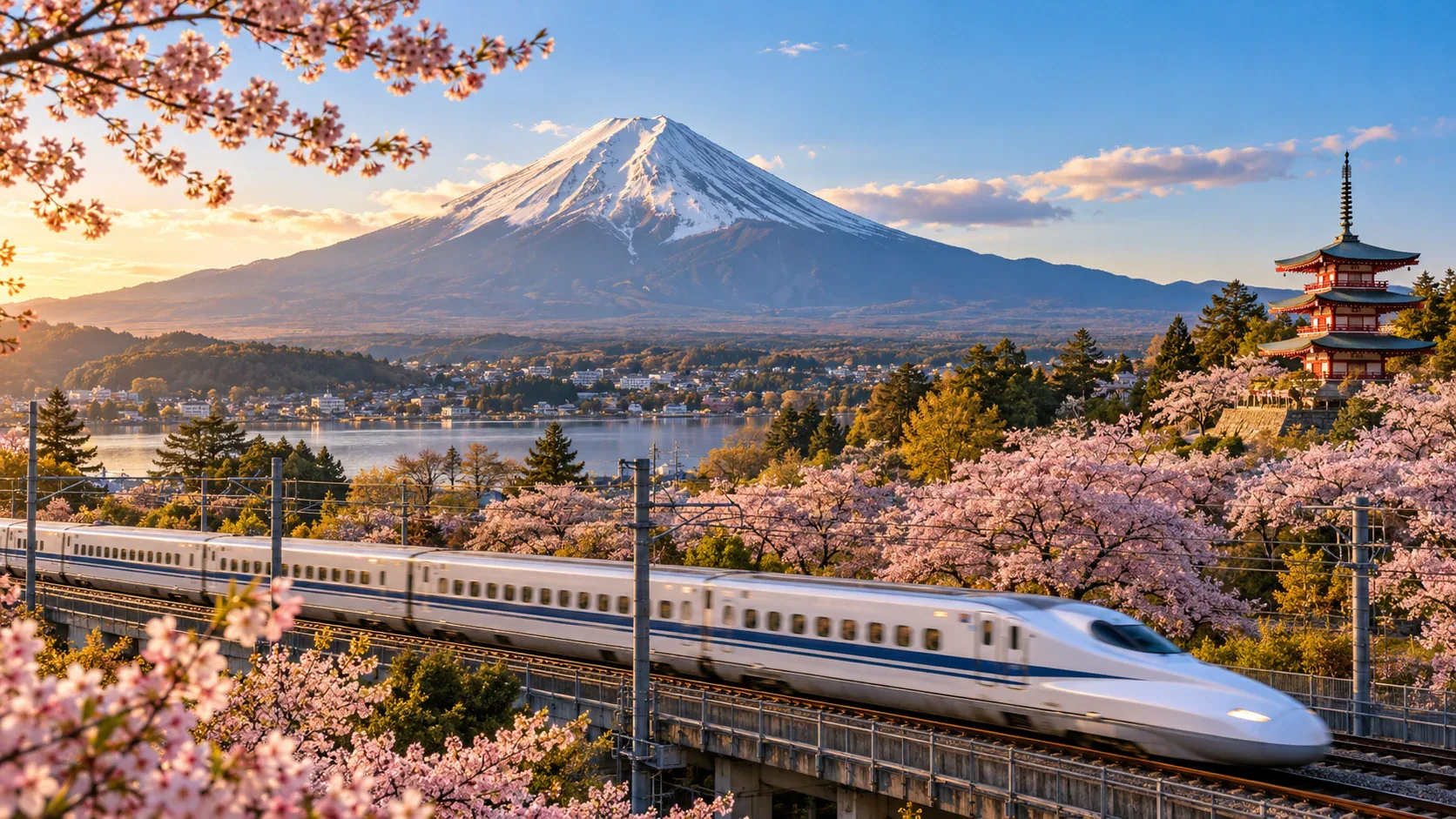
How Many Days Do You Need in Japan?
Seven to ten days is the practical range for a first Japan itinerary covering Tokyo, Mount Fuji or Hakone, Kyoto and Osaka. Three days suits a Tokyo-only stopover, five days is a fast Tokyo–Kyoto–Nara route, and fourteen days allows Hiroshima, Miyajima and one additional region.
A good route moves in one direction rather than backtracking: land in Tokyo, travel west by Shinkansen to Hakone or the Fuji area, continue to Kyoto, then finish in Osaka for departure. This keeps hotel changes to two or three and uses the rail network efficiently.
Japan's rail and subway network makes city-to-city movement predictable, but each transfer consumes half a day once you include hotel check-out, station navigation and luggage. Build arrival and departure days light, and place the Fuji viewpoint day flexibly because mountain visibility is weather-dependent.
Sample Japan Itineraries by Duration
Japan itinerary options divide cleanly by duration: three days for Tokyo only, five days for Tokyo plus Kyoto and Nara, seven days for the classic Tokyo–Fuji–Kyoto–Osaka loop, and ten days for adding Hiroshima and Miyajima. Each longer option reduces daily travel time and adds one region.
3-Day Japan Itinerary (Tokyo Only)
Best forStopovers, business travellers and short breaks with a Tokyo arrival
StrengthsNo long-distance trains; covers Asakusa, Shibuya, Meiji Shrine and one observation deck or teamLab-style attraction
Trade-offsKyoto, Osaka and Mount Fuji are not feasible; tight pacing with jet lag
5-Day Japan Itinerary (Tokyo, Kyoto, Nara)
Best forFirst-timers with limited leave who still want a Shinkansen experience
StrengthsAdds Kyoto's Gion and Kiyomizu-dera plus Nara or Osaka; one Shinkansen leg
Trade-offsOnly one full day in Tokyo; Hokkaido and Hiroshima must be skipped
7-Day Japan Itinerary (Tokyo, Fuji/Hakone, Kyoto, Osaka)
Best forThe standard first Japan trip itinerary
StrengthsBalanced coverage of modern Tokyo, a Fuji or Hakone ryokan night, Kyoto temples and Osaka food
Trade-offsStill fast; Hokkaido and Okinawa are not realistic additions
10-Day Japan Itinerary (Adds Hiroshima and Miyajima)
Best forTravellers who want heritage depth beyond the Golden Route
StrengthsAdds Peace Memorial sites and Itsukushima Shrine; more breathing room in Tokyo and Kyoto
Trade-offsRequires careful Shinkansen timing and one more hotel change
The comparison below uses indicative land-only package ranges from the research data, per person on twin sharing, excluding airfare unless stated. Treat them as planning bands, not confirmed Tripstor offers.
Japan Itinerary for 5 Days, 7 Days and 10 Days
Three workable Japan itineraries cover five, seven and ten days. The five-day route runs Tokyo to Kyoto with a Nara day; the seven-day route adds Hakone or the Fuji area; the ten-day route extends to Hiroshima and Miyajima. All assume a Tokyo arrival and Osaka departure.
Each day below names real districts and sites from the research data. Overnight bases are stated so you can book hotels in the right city. Arrival and departure days stay light.
5-Day Japan Itinerary: Tokyo, Kyoto and Nara
A five-day Japan itinerary fits Tokyo, Kyoto and Nara at a fast pace. Day 1 arrives in Tokyo, Day 2 covers Tokyo highlights, Day 3 takes the Shinkansen to Kyoto, Day 4 combines Kyoto temples with Nara or Osaka, and Day 5 departs from Osaka or Kyoto.
Day01 Stop 1 of 5Arrive Tokyo and light Asakusa sightseeing
MorningArrive at Narita or Haneda, clear immigration and transfer to your Tokyo hotel.
AfternoonWalk Asakusa and the approach to Senso-ji; keep the pace light after the flight.
EveningDinner near Asakusa or Tokyo Skytree area; early night.
Day02 Stop 2 of 5Tokyo highlights: Meiji Shrine, Harajuku, Shibuya
MorningVisit Meiji Shrine and walk through Harajuku.
AfternoonContinue to Shibuya for the crossing and a Shibuya-area observation point.
EveningDinner in Shibuya or Shinjuku.
Day03 Stop 3 of 5Shinkansen to Kyoto; Gion or Kiyomizu-dera
MorningTake the Shinkansen from Tokyo to Kyoto; drop luggage at the hotel.
AfternoonVisit Kiyomizu-dera and walk down through the Higashiyama lanes.
EveningWalk Gion; dinner in central Kyoto.
Day04 Stop 4 of 5Kyoto temples plus Nara or Osaka
MorningVisit Fushimi Inari early before crowds build.
AfternoonChoose Nara for Todai-ji and Nara Park, or Osaka for Osaka Castle and Dotonbori.
EveningReturn to Kyoto or stay in Osaka depending on Day 5 departure routing.
Day05 Stop 5 of 5Departure from Osaka or Kyoto
MorningLast-minute shopping or a short neighbourhood walk.
AfternoonTransfer to Kansai airport or Kyoto station for onward travel.
EveningDeparture.
This route suits first-timers with one week of leave. It skips Hokkaido and Hiroshima entirely.
7-Day Japan Itinerary: Tokyo, Fuji/Hakone, Kyoto, Osaka
A seven-day Japan itinerary is the standard first-trip route: three nights in Tokyo, one night in Hakone or the Fuji area, two nights in Kyoto, and a final night in Osaka. It adds a ryokan stay and a Fuji viewpoint without overloading the schedule.
Day01 Stop 1 of 7Arrive Tokyo
MorningArrive at Narita or Haneda and transfer to the hotel.
AfternoonLight walk near the hotel; pick up a Suica or Pasmo card.
EveningDinner in the neighbourhood.
Day02 Stop 2 of 7Tokyo west side: Meiji Shrine, Harajuku, Shibuya
MorningMeiji Shrine and Harajuku.
AfternoonShibuya crossing and a Shibuya observation deck.
EveningDinner in Shinjuku.
Day03 Stop 3 of 7Tokyo east side: Asakusa, Ueno, Ginza
MorningSenso-ji and Asakusa lanes.
AfternoonUeno Park museums or Tsukiji outer market for street food.
EveningGinza for dinner and shopping.
Day04 Stop 4 of 7Hakone or Fuji area with ryokan night
MorningTravel from Tokyo to Hakone or the Fuji Five Lakes area.
AfternoonLake Ashi, ropeway or an open-air museum depending on the route.
EveningCheck into a ryokan; onsen and kaiseki dinner.
Day05 Stop 5 of 7Transfer to Kyoto; evening in Gion
MorningMorning onsen or a short lake walk.
AfternoonTravel to Kyoto via Shinkansen from Odawara or Mishima.
EveningWalk Gion and the Shirakawa area; dinner in central Kyoto.
Day06 Stop 6 of 7Kyoto temples and Nara day trip
MorningFushimi Inari before 8:00.
AfternoonNara: Todai-ji, Nara Park and Kasuga Taisha.
EveningReturn to Kyoto; dinner near Kyoto Station or Pontocho.
Day07 Stop 7 of 7Osaka and departure
MorningTravel to Osaka; Osaka Castle or Kuromon Market.
AfternoonDotonbori for street food before airport transfer.
EveningDepart from Kansai airport.
This is the most balanced option for Indian travellers who want both cities and a nature night. Keep the Fuji viewpoint day flexible because visibility is weather-dependent.
10-Day Japan Itinerary: Adding Hiroshima and Miyajima
A ten-day Japan itinerary adds Hiroshima and Miyajima to the seven-day route, with more time in Tokyo and Kyoto. It suits travellers who want heritage depth and are comfortable with one additional Shinkansen leg and hotel change.
Day01 Stop 1 of 10Arrive Tokyo
MorningArrive at Narita or Haneda.
AfternoonHotel check-in and light neighbourhood walk.
EveningDinner near the hotel.
Day02 Stop 2 of 10Tokyo modern districts
MorningMeiji Shrine and Harajuku.
AfternoonShibuya and Shinjuku.
EveningDinner in Shinjuku.
Day03 Stop 3 of 10Tokyo historic districts
MorningAsakusa and Senso-ji.
AfternoonUeno or Tsukiji outer market.
EveningGinza dinner.
Day04 Stop 4 of 10Nikko or free Tokyo day
MorningDay trip to Nikko or a free Tokyo morning.
AfternoonReturn to Tokyo; shopping or a teamLab-style attraction.
EveningDinner in Tokyo.
Day05 Stop 5 of 10Fuji or Hakone
MorningTravel to Hakone or the Fuji area.
AfternoonLake Ashi, ropeway or Fuji viewpoints.
EveningRyokan stay with onsen.
Day06 Stop 6 of 10Transfer to Kyoto
MorningMorning onsen or lake walk.
AfternoonShinkansen to Kyoto; hotel check-in.
EveningGion walk and dinner.
Day07 Stop 7 of 10Kyoto east
MorningKiyomizu-dera and Higashiyama.
AfternoonGion and Nishiki Market.
EveningDinner in Pontocho.
Day08 Stop 8 of 10Kyoto north and west
MorningKinkaku-ji and Ryoan-ji.
AfternoonArashiyama bamboo grove and Tenryu-ji.
EveningReturn to central Kyoto.
Day09 Stop 9 of 10Nara and Osaka
MorningNara: Todai-ji and Nara Park.
AfternoonTravel to Osaka; Osaka Castle or Kuromon Market.
EveningDotonbori street food.
Day10 Stop 10 of 10Hiroshima and Miyajima or departure
MorningOption A: Shinkansen to Hiroshima for the Peace Memorial Park. Option B: depart from Kansai airport.
AfternoonOption A: ferry to Miyajima for Itsukushima Shrine. Option B: airport transfer.
EveningOption A: return to Osaka or overnight in Hiroshima. Option B: departure.
This route keeps the same west-bound direction and finishes in Osaka. Check ferry and tide timings for Miyajima because Itsukushima Shrine's visual character changes between high and low tide.
Where to Base Yourself in Japan
Tokyo, Kyoto and Osaka are the three practical bases for a first Japan itinerary. Tokyo suits arrival and modern-city sightseeing, Kyoto suits temples and Nara day trips, and Osaka suits street food, Universal Studios Japan and Kansai airport departures. Hakone or the Fuji area works as a one-night nature stop.
- Kanto region
Tokyo
Combines modern districts, historic Asakusa, teamLab-style attractions and exceptional dining in one hub. Three nights is the practical minimum for a first visit.
Best forFirst-timers, families, food-focused travellers
Do not schedule Tokyo Disney Resort and central Tokyo sightseeing on the same day; each requires substantial transit time.
- Kansai region
Kyoto
Concentrated access to Fushimi Inari, Kiyomizu-dera, Gion, temples and gardens. Two nights covers the highlights; three nights allows Arashiyama and a Nara day trip.
Best forHeritage-focused travellers, photographers, honeymooners
Visit major temples before 8:00 or after 16:00; midday crowds and bus congestion can significantly reduce the experience.
- Kansai region
Osaka
Street food, Dotonbori nightlife, Osaka Castle and convenient access to Nara and Universal Studios Japan. Two nights works well as the final base before departure.
Best forFood travellers, families with teenagers, Kansai airport departures
Use Osaka as a base for day trips, but avoid combining Universal Studios with Kyoto because both need a full day.
- Kanagawa and Yamanashi
Mount Fuji and Hakone
Combines Fuji viewpoints, hot-spring ryokan, lake scenery and ropeway access near Tokyo. One night is enough for a first trip.
Best forCouples, ryokan seekers, nature breaks between Tokyo and Kyoto
Fuji visibility is weather-dependent; keep the viewpoint day flexible rather than guaranteeing a clear mountain view.
- Kansai region
Nara
Nara Park, Todai-ji, Kasuga Taisha and free-roaming deer fit efficiently into a day from Kyoto or Osaka. Most travellers visit as a day trip rather than overnighting.
Best forDay-trippers from Kyoto or Osaka, families with children
Treat Nara as a walking day; deer crackers do not guarantee deer behaviour and visitors should protect maps and food.
- Chugoku region
Hiroshima and Miyajima
Pairs the Peace Memorial sites with Itsukushima Shrine and Miyajima's tidal scenery. Two nights allows both without rushing.
Best forRepeat visitors, heritage travellers, 10-day itineraries
Check ferry and tide timings; the shrine's visual character changes substantially between high and low tide.
- Northern Japan
Hokkaido
Adds powder snow, national parks, seafood and lavender landscapes, with a cooler climate distinct from Honshu. Four nights is the practical minimum.
Best forRepeat visitors, winter sports travellers, summer escapes
Do not add Hokkaido to a first Japan trip under seven days; domestic travel distances make the itinerary inefficient.
Choose bases by the number of nights you can give each city, not by hotel price alone. Central locations near a JR or subway station reduce daily transit time more than a cheaper hotel two stations away.
Japan Travel Plan: Transfers, Pacing and Advance Bookings
A workable Japan travel plan uses trains and subways in cities, Shinkansen between major regions, buses where rail does not reach, and domestic flights for long routes such as Tokyo to Hokkaido. Book peak-season hotels, popular ryokan and Shinkansen seats early, and keep arrival and departure days light.
- Use the Shinkansen for Tokyo to Kyoto, not flights
The Shinkansen connects Tokyo and Kyoto directly and drops you in the city centre, avoiding airport transfers at both ends. Reserve seats for peak travel periods such as cherry blossom season and Golden Week.
Transfers - Buy a Suica or Pasmo card on arrival
These rechargeable cards work on Tokyo subways, Kyoto buses and Osaka trains, and reduce ticket-machine time. They are useful even if you also hold a rail pass.
Transfers - Compare a Japan Rail Pass with individual tickets
Eligible foreign visitors can purchase applicable rail passes, but the nationwide pass may not offer value on every itinerary. Compare its current price with the sum of your actual Shinkansen and limited-express legs before buying.
Bookings - Keep one flexible day for Fuji visibility
Fuji views depend on weather. Place the Hakone or Fuji day mid-itinerary so you can swap it with a city day if cloud cover is heavy.
Pacing - Start Kyoto temples before 8:00
Fushimi Inari and Kiyomizu-dera are far calmer early morning. Midday bus congestion in Kyoto can cut a two-temple afternoon down to one.
Pacing - Reserve peak-season hotels and ryokan early
Cherry blossom season, Golden Week, Obon and autumn foliage fill hotels and popular ryokan months ahead. Book Universal Studios or Disney entry products and sought-after restaurants in advance too.
Bookings - Limit hotel changes to two or three
Each hotel change costs half a day with check-out, luggage and check-in. A Tokyo–Hakone–Kyoto–Osaka route already has three changes; adding more cities reduces sightseeing time.
Pacing - Combine Japan with a nearby Asian stopover only if you have 12+ days
Adding another country to a seven-day Japan trip leaves too little time in Japan itself. If you want a combined trip, start with ten days in Japan and add the second destination after Osaka.
Combining
The tips below cover transfers, pacing, advance bookings and combining Japan with nearby destinations. They apply to any of the itineraries above.
First-Timer vs Repeat Visitor Itinerary
First-time visitors should follow the Tokyo–Fuji/Hakone–Kyoto–Osaka route because it covers the country's most recognisable cities in one west-bound line. Repeat visitors can skip Tokyo's headline districts and add Kanazawa, Takayama, Hiroshima, Miyajima or Hokkaido instead.
The first-timer route uses three bases and one ryokan night. A repeat-visitor route might land in Osaka, spend three nights in Kyoto, two in Kanazawa or Takayama, two in Hiroshima and Miyajima, and finish in Tokyo for departure. Both keep hotel changes to three or fewer.
If you have ten days or more and have already seen the Golden Route, Hokkaido needs four nights minimum and is best reached by domestic flight from Tokyo. Do not combine Hokkaido and Okinawa with Honshu in a single short trip.
What to Skip on a Short Japan Trip
On a three-day Japan itinerary, skip Kyoto and Osaka unless Tokyo is only a stopover, and skip Hokkaido and Hiroshima entirely. On a five-day trip, skip Hokkaido and Hiroshima unless you replace Kyoto or Tokyo. On a seven-day trip, skip Hokkaido, Okinawa and too many rural regions.
Short trips fail when they try to cover too many regions. A three-day trip that adds Kyoto means two travel half-days and almost no sightseeing. A five-day trip that adds Hiroshima leaves one rushed day each in Tokyo and Kyoto.
Also skip combining Tokyo Disney Resort with central Tokyo sightseeing on the same day, and skip combining Universal Studios Japan with Kyoto on the same day. Each of those pairs needs a full day on its own.
Holiday ideas to start from
Reviewed itineraries for this destination — personalise with a specialist, never an instant booking.
Tokyo Kyoto Osaka Premium 7 Nights: 2026 Luxury Japan Itinerary
From₹2,51,100per adult, twin sharing, land only
From idea to itinerary, with a real person.
- Share your plan
Dates, departure city, travellers and the moments you’d love. It only takes a minute.
- Shape it with a specialist
A real person refines the route, stays and pace with you. Change anything.
- Review your quote
A clear, personalised quote with confirmed inclusions. No payment to enquire.
Before you go
Straight answers to help you plan — then personalise the trip with a specialist.
8 answered belowAsk a specialist anything about this trip — there’s no obligation.
Ask a specialistHow many days are enough for Japan?
Seven days covers Tokyo, Mount Fuji or Hakone, Kyoto and Osaka at a fast pace. Ten to fourteen days allows a more comfortable multi-region itinerary with Hiroshima, Miyajima or one additional region. Three days suits a Tokyo-only stopover, and five days fits Tokyo, Kyoto and Nara.
What is the best time to visit Japan?
March to May and October to November are the most broadly favourable periods. Late March to early April is popular for cherry blossoms, and November for autumn foliage. These peak windows also raise hotel prices and fill popular ryokan, so book months ahead if your dates fall in them.
Do Indians need a visa to visit Japan?
Yes. Indian ordinary passport holders generally need to obtain a Japanese visa before travel; visa on arrival is not generally available. Apply through the designated application centre with your itinerary, hotel bookings and financial documents. Approval is not guaranteed and processing times vary by season.
How much does a Japan tour package cost from India?
Indicative land-only twin-sharing package bands are approximately ₹95,000 per person at budget level, ₹145,000 standard, ₹230,000 premium and ₹425,000 luxury, excluding or varying by airfare and inclusions. These are planning ranges from research data, not confirmed Tripstor offers, and peak-season dates cost more.
Is Japan expensive for Indian tourists?
Japan can be expensive for transport, attractions and centrally located hotels, but convenience-store meals, local restaurants, business hotels and advance bookings can control costs. The biggest variable is airfare from India and whether you travel in cherry blossom or autumn foliage season, when hotel rates rise.
Which cities should first-time visitors include in Japan?
Tokyo, Kyoto, Osaka and either Mount Fuji/Hakone or Nara are the most practical first-trip combination. Hiroshima or Hokkaido can be added with more time. A seven-day route covers the first four comfortably; a ten-day route adds Hiroshima and Miyajima without rushing.
How do tourists travel within Japan?
Use trains and subways in cities, Shinkansen between major regions, buses in areas without rail coverage, and domestic flights for long-distance routes such as Tokyo to Hokkaido. A Suica or Pasmo card covers city transport, and Shinkansen seat reservations are advisable during peak travel periods.
Can Indian tourists use a Japan Rail Pass?
Eligible foreign visitors can purchase applicable rail passes, but the nationwide pass may not offer value on every itinerary. Compare its current price with the sum of your actual Shinkansen and limited-express tickets before buying. Regional passes can be better value on shorter routes.