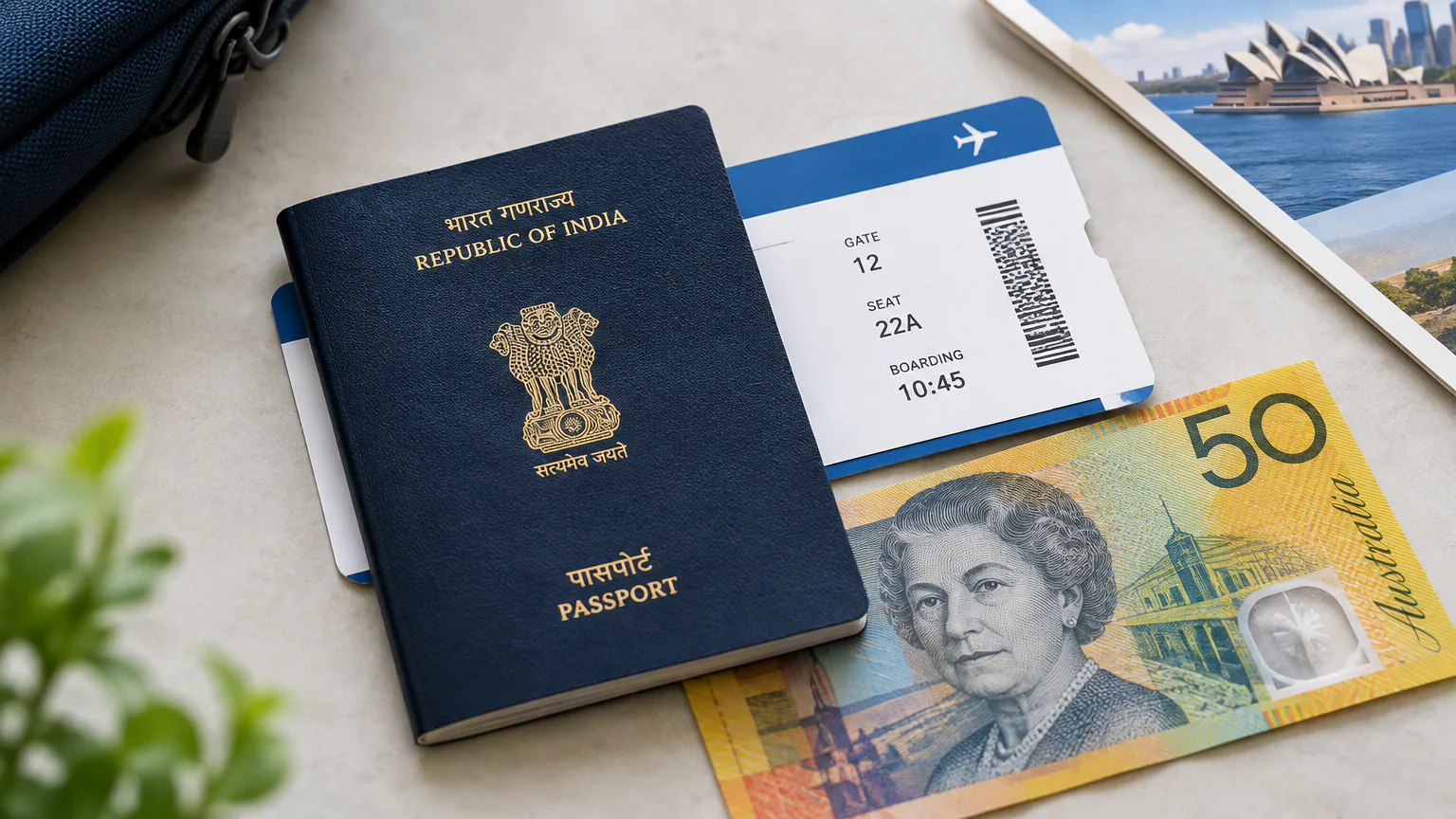
What Reaching Australia from India Involves
Australia has no direct flights from India in current schedules, so every itinerary uses a one-stop routing through an Asian or Gulf hub. The fastest option is a one-stop flight from Chennai or Mumbai, typically around 10–12 hours total, while Delhi, Ahmedabad and Pune itineraries run about 13 hours. Sydney and Melbourne are the usual first Australian gateways.
Australia is served from India through hub airports rather than non-stop routes. Singapore, Kuala Lumpur, Doha and Dubai are the common transit points named in current airline schedules. Sydney and Melbourne are the usual first Australian gateways, with Brisbane, Cairns, Perth and Darwin reached by domestic connections after landing.
Because every itinerary involves at least one stop, the practical question is not whether you can fly direct but which hub gives you the best combination of connection time, baggage rules and total journey duration. Airlines named in the research include Singapore Airlines, Malaysia Airlines, Qantas, Emirates, Qatar Airways, Thai Airways and SriLankan Airlines.
India is not generally eligible for Australia's Electronic Travel Authority subclass 601 or eVisitor subclass 651, which are faster online options available to some other nationalities. Indian passport holders must apply for the Visitor visa subclass 600 through the Australian Department of Home Affairs before booking non-refundable flights.
At a glance
Australia Travel Guide for Indians: Plan Your 2026 Trip, in brief
The nearest Australian gateway airports for most India-origin itineraries are Sydney and Melbourne, reached via Singapore, Kuala Lumpur, Doha or Dubai. Flying is the only realistic option for leisure travel; there is no scheduled passenger train or ferry connecting India to Australia. Indian passport holders need a Visitor visa subclass 600 before departure.
Australia Travel Guide for Indians: Plan Your 2026 Trip.
Planned around you.
- Main gateway airports
- Sydney and MelbourneMost India-origin itineraries land at one of these before domestic connections.
- Common transit hubs
- Singapore, Kuala Lumpur, Doha, DubaiNamed in current airline schedules for India–Australia routes.
- Fastest routing
- One-stop flight from Chennai or Mumbai, about 10–12 hours totalCompare total journey time against fare, not fare alone.
- Longest routing
- One-stop flight from Delhi, Ahmedabad or Pune, about 13 hours totalAllow a substantial connection buffer at the transit airport.
- Entry document required
- Australian Visitor visa subclass 600Apply online through the Department of Home Affairs before travel.
- Not eligible for
- ETA subclass 601 or eVisitor subclass 651India is not generally eligible for these faster visa options.
Flights to Australia from India
Flights to Australia from India are one-stop from all major metros, with total journey times of roughly 10–13 hours depending on origin city and hub. Singapore is the most common transit point, followed by Kuala Lumpur, Doha and Dubai. Airlines named in current schedules include Singapore Airlines, Malaysia Airlines, Qantas, Emirates, Qatar Airways, Thai Airways and SriLankan Airlines.
Delhi
Singapore
Typical fareIndicative economy return fares vary by season; compare at booking
Airlines named in research: Qantas, Singapore Airlines, Malaysia Airlines. Allow a substantial connection buffer at the transit airport.
Mumbai
Singapore or Kuala Lumpur
Typical fareIndicative economy return fares vary by season; compare at booking
Airlines named in research: Singapore Airlines, Malaysia Airlines, Qantas. Compare one-stop schedules against overnight connections and baggage rules.
Bengaluru
Singapore
Typical fareIndicative economy return fares vary by season; compare at booking
Airlines named in research: Singapore Airlines, Malaysia Airlines, Thai Airways. Singapore often provides the simplest one-stop routing.
Chennai
Colombo or Singapore
Typical fareIndicative economy return fares vary by season; compare at booking
Airlines named in research: SriLankan Airlines, Singapore Airlines, Malaysia Airlines. Check whether separate tickets require baggage collection and transit permission.
Kolkata
Singapore
Typical fareIndicative economy return fares vary by season; compare at booking
Airlines named in research: Singapore Airlines, Malaysia Airlines, Thai Airways. Check domestic positioning options if the international fare begins in another Indian city.
Hyderabad
Singapore or Kuala Lumpur
Typical fareIndicative economy return fares vary by season; compare at booking
Airlines named in research: Singapore Airlines, Malaysia Airlines, Qatar Airways. Avoid tight connections when travelling with checked baggage.
Ahmedabad
Singapore or Doha
Typical fareIndicative economy return fares vary by season; compare at booking
Airlines named in research: Singapore Airlines, Emirates, Qatar Airways. One-stop fares may be more competitive than positioning to Mumbai when baggage is included.
Pune
Mumbai then Singapore, or Doha
Typical fareIndicative economy return fares vary by season; compare at booking
Airlines named in research: Singapore Airlines, Emirates, Qatar Airways. Price the domestic feeder and international ticket together where possible to protect against missed connections.
Travelling from your city?
Tell us where you start. A specialist can plan connections around your stay.
Plan my journeyFares vary by season, booking window and baggage allowance, so treat any figure as an indicative planning range rather than a confirmed price. The routes block below shows the typical routing pattern from each Indian city named in the research. When comparing options, factor in connection buffer time, checked-baggage rules and whether separate tickets require you to collect and re-check bags at the transit airport.
For travellers considering a stopover, Kuala Lumpur and Singapore both offer straightforward transit visa arrangements for Indian passport holders on many routings, but confirm the current rules for your nationality and ticket type before booking. Explore [Australia tour packages](/australia-tour-packages/) once your routing is confirmed.
How to Reach Australia from Major Indian Cities
Each major Indian departure city has a preferred hub and a typical total journey time. Chennai and Mumbai offer the shortest one-stop routings at around 10–12 hours, while Delhi, Ahmedabad and Pune sit at around 13 hours. Choosing the right hub for your origin city reduces connection risk and can improve baggage handling.
Delhi travellers most commonly route through Singapore with Qantas, Singapore Airlines or Malaysia Airlines, arriving in Sydney or Melbourne after about 13 hours total. Mumbai offers a slightly shorter option at around 12 hours via Singapore or Kuala Lumpur, with Singapore Airlines, Malaysia Airlines and Qantas all named in the research.
Chennai benefits from a Colombo routing via SriLankan Airlines in addition to Singapore, making it the shortest India-origin journey at around 10 hours. Bengaluru, Kolkata and Hyderabad all sit around 11 hours via Singapore, with Thai Airways adding a further option for the first two cities.
Ahmedabad and Pune travellers can use Gulf hubs — Doha via Qatar Airways or Dubai via Emirates — as an alternative to Singapore, which can be competitive on price when baggage is included. Pune travellers should price the domestic feeder to Mumbai alongside the international ticket to protect against missed connections.
If your Australian itinerary includes Cairns for the Great Barrier Reef, Brisbane for Queensland, or Perth for Western Australia, add a domestic Australian flight after your international arrival in Sydney or Melbourne. Domestic connections add time and cost, so factor them into your total journey plan. [Malaysia tour packages](/malaysia-tour-packages/) and [Hong Kong tour packages](/hong-kong-tour-packages/) are worth considering if you want to build a stopover into your routing.
Australia from India Travel Options: Rail, Road and Sea
Rail, road and sea routes from India to Australia are not practical for leisure travel. No scheduled passenger train or ferry connects the two countries, and overland travel through multiple countries is not a realistic option for a standard holiday. Flying is the only sensible way to reach Australia from India; rail and road become relevant only once you have landed.
India
Not applicable
Typical fareNot applicable
No scheduled passenger ferry route connects India to Australia.
India
Not applicable
Typical fareNot applicable
No passenger rail link connects India to Australia.
Sydney
Interstate rail
Typical fareVaries by route and class
Useful for scenic or regional legs within Australia, but domestic flights are faster for long interstate hops.
Major Australian cities
Highways
Typical fareRental car rates vary
Rental cars suit regional routes but distances are large; plan fuel and rest stops carefully.
Travelling from your city?
Tell us where you start. A specialist can plan connections around your stay.
Plan my journeyWithin Australia, interstate trains and long-distance coach services exist, but for most itineraries domestic flights are faster and more practical given the distances between Sydney, Melbourne, Brisbane, Cairns, Darwin and Perth. Rental cars suit regional routes, but plan for long driving days and fuel stops — Australian distances are large by any standard.
The routes block below clarifies the position on each mode for planning purposes.
From the Airport to Your Stay
From Sydney or Melbourne airport, taxis, app cabs, airport trains and shuttle buses connect to the city centre. Indicative urban public transport fares in Australian cities are AUD 3–6 per trip, with contactless bank cards and local transit smartcards widely accepted. If you land at an international terminal and need a domestic connection, allow time to transfer between terminals.
Sydney Airport
Airport rail link
Typical fareIndicative urban fares AUD 3–6 per trip
Contactless bank cards and local transit smartcards are widely accepted.
Sydney Airport
Taxi or app cab
Typical fareHigher than public transport; varies by distance
Use the official taxi rank or designated app cab pickup zone.
Melbourne Airport
Taxi, app cab or shuttle bus
Typical fareHigher than public transport; varies by distance
Shuttle buses can be economical for solo travellers; taxis suit groups with luggage.
Australian domestic terminals
Terminal transfer
Typical fareVaries by airport
Check whether your domestic connection leaves from the same terminal or a different one.
Travelling from your city?
Tell us where you start. A specialist can plan connections around your stay.
Plan my journeySydney Airport's rail link connects directly to the city centre and is the fastest option for solo travellers with manageable luggage. Melbourne Airport does not have a rail link as of this 2026 guide edition, so taxis, app cabs and shuttle buses are the main options; shuttle buses can be economical for solo travellers, while taxis suit groups with multiple suitcases.
At Brisbane, Cairns and Perth airports, taxis and app cabs are the most straightforward options from the terminal. Check whether your domestic connection departs from the same terminal as your international arrival, as some Australian airports require a terminal transfer that adds time.
Step-by-Step Journey Plan for India to Australia
Plan your Australia journey in this order: visa first, then international flights, then domestic connections and stays. Applying for the Visitor visa subclass 600 before booking non-refundable flights reduces the risk of losing money if the application takes longer than expected. Keep passport, financial, employment and travel-purpose documents ready when requested.
- Confirm your visa pathway
Indian passport holders generally need an Australian Visitor visa subclass 600. India is not generally eligible for ETA subclass 601 or eVisitor subclass 651. Apply online through the Australian Department of Home Affairs.
- Prepare supporting documents
Keep passport, financial, employment, travel-purpose and genuine-temporary-visitor evidence ready. Fees and processing times can change, so verify the current amount and document list before submission.
- Choose your Indian departure city
Compare total journey time and baggage rules from Delhi, Mumbai, Bengaluru, Chennai, Kolkata, Hyderabad, Ahmedabad or Pune. Chennai and Mumbai currently offer the shortest typical total flight times at around 10–12 hours.
- Book the international flight
Select a one-stop itinerary through Singapore, Kuala Lumpur, Doha or Dubai. Allow a substantial connection buffer, especially if you are checking baggage or travelling with family.
- Add domestic Australian flights if needed
If your itinerary includes Cairns for the Great Barrier Reef, Brisbane, Perth or Darwin, book domestic connections after your international arrival. Leave enough time to clear immigration and transfer terminals.
- Arrange your arrival transfer
Decide between airport train, taxi, app cab or shuttle bus before you land. Contactless bank cards and local transit smartcards are widely accepted for public transport, with indicative urban fares of AUD 3–6 per trip.
- Plan local transport within Australia
Use trains, trams and buses within major cities including Sydney, Melbourne and Brisbane. Rental cars suit regional routes, but Australian distances are large, so plan driving days carefully.
Follow these steps to move from planning to arrival without avoidable gaps. Fees and processing times for the subclass 600 visa can change, so verify the current amount and document list with the Australian Department of Home Affairs before submission.
Getting Around in Australia on Arrival
Getting around Australia after landing means choosing between domestic flights for long interstate hops and city transport for local movement. Trains, trams and buses are practical within Sydney, Melbourne, Brisbane and other major cities, with indicative urban fares of AUD 3–6 per trip. Rental cars suit regional routes, but distances between Australian cities are large.
- Use domestic flights for interstate travel
Flying is the practical option between Sydney, Melbourne, Brisbane, Cairns, Darwin and Perth. Domestic fares vary substantially by route and booking date; book early for fixed dates.
Transport - Tap on with contactless cards
Contactless bank cards and local transit smartcards are widely accepted on urban public transport across Sydney, Melbourne and Brisbane. Indicative urban fares are AUD 3–6 per trip.
Payment - Rent a car for regional routes
Rental cars suit regional routes beyond the main cities, but Australian distances are large. Plan fuel stops and avoid driving immediately after a long-haul flight.
Road - Check terminal transfers at Australian airports
If you connect from an international to a domestic flight at Sydney, Melbourne or Brisbane, confirm whether you need to change terminals and allow extra time before the domestic departure.
Airport - Book Cairns for the Great Barrier Reef
Cairns is the main gateway for the Great Barrier Reef and is reached by domestic flight from Sydney or Melbourne. Factor the domestic leg into your total journey time and cost.
Itinerary
Domestic flights are the practical choice between Sydney, Melbourne, Brisbane, Cairns, Darwin and Perth. Domestic fares vary substantially by route and booking date, so book early if your dates are fixed. For the Great Barrier Reef, Cairns is the main gateway and is reached by domestic flight from Sydney or Melbourne.
Within cities, contactless bank cards and local transit smartcards are widely accepted on trains, trams and buses. Taxis and app cabs are more comfortable for groups with multiple suitcases. If you plan to drive regionally, allow for long driving days and plan fuel stops in advance, particularly in less-populated areas.
Best Time to Travel from India to Australia
April to May and September to October are broadly comfortable across Australia for India-origin travellers. May to October is especially suitable for the Great Barrier Reef and northern Australia, where the wet season runs roughly November to April. Australia's seasons are opposite to India's, so plan around the specific region you are visiting rather than a single national season.
January
Shoulder seasonSummer in southern Australia; wet season in Darwin and Cairns
Good for Sydney and Melbourne beaches; avoid northern Australia due to wet season.
February
Shoulder seasonSummer continues in south; wet season peaks in north
Similar to January; cyclone risk in northern Queensland.
March
Good time to goLate summer in south; wet season easing in north
Shoulder season begins; comfortable for Sydney and Melbourne.
April
Good time to goAutumn in south; dry season approaching in north
Comfortable across most regions; good for the Great Ocean Road.
May
Best time to goMild autumn in south; dry season begins in north
Dry season starts in Cairns and Darwin; pleasant in Sydney and Melbourne.
June
Best time to goWinter in south; dry season in north
Ideal for northern Australia and the Great Barrier Reef; cooler in Melbourne.
July
Best time to goMid-winter in south; peak dry season in north
Peak season for Cairns and Darwin; school holidays drive demand.
August
Best time to goLate winter in south; dry season continues in north
Excellent for the Great Barrier Reef; comfortable in Sydney.
September
Good time to goSpring in south; dry season ending in north
Spring flowers in south; last comfortable month before wet season in north.
October
Good time to goSpring in south; pre-wet season in north
Good for Sydney and Melbourne; avoid northern Australia as humidity rises.
November
Shoulder seasonEarly summer in south; wet season begins in north
Warming up in south; wet season starts in Darwin and Cairns.
December
Shoulder seasonSummer in south; wet season in north
Festive season drives high prices; avoid northern Australia due to wet season.
- BestMay, Jun, Jul, Aug
- GoodMar, Apr, Sep, Oct
- FairJan, Feb, Nov, Dec
Sydney and Melbourne have a temperate climate year-round, making them accessible in most months. The northern regions — Darwin, Cairns and Queensland — are best visited during the dry season from May to October, when humidity and rainfall are lower and outdoor activities including reef tours are more comfortable.
The school holiday periods in India (April–May and October–November) align reasonably well with comfortable travel windows for most Australian regions, making them popular booking periods. Request a personalised quote for your preferred travel dates from [Australia tour packages](/australia-tour-packages/).
Australia Tour Package Costs from India
Indicative land-only twin-sharing Australia packages range from about ₹1.25 lakh for budget travel to ₹5 lakh or more for luxury travel, excluding international airfare and visa fees. These are planning ranges, not confirmed Tripstor offers. The actual cost depends on the number of cities, duration, hotel tier and travel season.
Budget
Travellers prioritising value, flexible on hotel tier and city count
- Hostel or budget hotel accommodation
- Self-managed city transport using public transit
- Fewer cities or shorter duration
Mid-range
Couples and families wanting comfortable hotels and guided elements
- 3-star or 4-star hotel accommodation
- Mix of guided tours and independent time
- Sydney and Melbourne as core cities, with one regional add-on
Luxury
Travellers wanting premium hotels, private transfers and curated itineraries
- 5-star hotel accommodation in Sydney, Melbourne or Cairns
- Private transfers and guided experiences
- Great Barrier Reef tours and Great Ocean Road inclusions
International airfare and the Australian Visitor visa subclass 600 application fee are additional costs to factor into your total budget. Airfare varies significantly by season, booking window and baggage allowance. Request a personalised quote for your specific dates, cities and group size.
For a combined Australia and New Zealand trip, see [New Zealand tour packages](/new-zealand-tour-packages/) alongside your Australia planning.
Mistakes to Avoid When Travelling to Australia from India
The most common mistakes are booking flights before the visa is granted, choosing a tight transit connection and assuming India is eligible for the faster ETA or eVisitor options. Indian passport holders generally need the Visitor visa subclass 600, which takes time to process. Build buffer time into every connection and verify current entry rules before departure.
- Booking non-refundable flights before the visa is granted
How to avoid itApply for the Visitor visa subclass 600 first, or book flexible fares until the visa is approved. Processing times can vary, so apply well in advance of your intended travel date.
- Assuming India is eligible for ETA subclass 601 or eVisitor subclass 651
How to avoid itIndia is not generally eligible for these options. Apply for the Visitor visa subclass 600 through the Australian Department of Home Affairs.
- Choosing a tight transit connection at Singapore, Kuala Lumpur, Doha or Dubai
How to avoid itAllow a substantial connection buffer, especially with checked baggage or family travellers. A missed connection can mean an overnight delay.
- Booking separate tickets without checking baggage rules
How to avoid itConfirm whether separate tickets require baggage collection and transit permission at the hub airport. Price the domestic feeder and international ticket together where possible.
- Underestimating Australian domestic distances
How to avoid itUse domestic flights for long interstate hops between Sydney, Melbourne, Brisbane, Cairns, Darwin and Perth. Reserve rental cars for regional routes with realistic driving days.
- Arriving without a plan for the last mile
How to avoid itDecide between airport train, taxi, app cab or shuttle bus before landing. Contactless bank cards and transit smartcards are widely accepted, with indicative urban fares of AUD 3–6 per trip.
Each warning below pairs a common issue with a practical fix. Reviewing these before you book can prevent avoidable costs and delays.
Holiday ideas to start from
Reviewed itineraries for this destination — personalise with a specialist, never an instant booking.
Gold Coast Family Holiday: 6 Nights Australia Package for Indian Families
From₹1,50,000per adult, twin sharing, land only; standard duration bucket; within destination research bandGold Coast Family Holiday Premium 6 Nights: Australia 6N7D Tour Package 2026
From₹2,31,100per adult, twin sharing, land only; premium duration bucket; within destination research bandSydney and Melbourne Premium 7 Nights: 2026 Australia Tour Package Guide
From₹2,61,900per adult, twin sharing, land only; premium interpolated duration; within destination research band
From idea to itinerary, with a real person.
- 01Share your plan
Dates, departure city, travellers and the moments you’d love. It only takes a minute.
- 02Shape it with a specialist
A real person refines the route, stays and pace with you. Change anything.
- 03Review your quote
A clear, personalised quote with confirmed inclusions. No payment to enquire.
From our travel specialists
What our team sees when planning these trips for travellers, beyond what the guidebooks say.
Travellers commonly wish they had allowed more time for Australia’s distances, budgeted for higher food and transport costs than in Southeast Asia, and understood that driving involves strict parking and road rules. They also recommend staying near public transport rather than choosing accommodation mainly for the view.
Money and food costs are the clearest recurring surprises: travellers warn against budgeting as if Australia were Southeast Asia and against eating out for every meal. Public-transport access, parking costs and strict driving enforcement also affect the budget and daily plans.
Confirmed by Killol Desai, Travel Consultation Expert · 11 Oct 2026
Before you go
Straight answers to help you plan — then personalise the trip with a specialist.
10 answered belowAsk a specialist anything about this trip — there’s no obligation.
Ask a specialist01Do Indian citizens need a visa for Australia?
Yes. Indian passport holders generally need an Australian Visitor visa subclass 600 before travel. Apply online through the Australian Department of Home Affairs and provide passport, financial, employment and travel-purpose evidence when requested. India is not generally eligible for ETA subclass 601 or eVisitor subclass 651, which are faster options for some other nationalities.
02What is the best way to reach Australia from India?
The best way to reach Australia from India is a one-stop flight through Singapore, Kuala Lumpur, Doha or Dubai. Chennai and Mumbai offer the shortest typical total flight times at around 10–12 hours. Compare total journey time, baggage rules and connection buffers rather than fare alone when choosing your routing.
03Are there direct flights from India to Australia?
Current schedules show no direct flights from India to Australia. Most itineraries use one stop through Singapore, Kuala Lumpur, Doha or Dubai. Airlines named in the research include Singapore Airlines, Malaysia Airlines, Qantas, Emirates, Qatar Airways, Thai Airways and SriLankan Airlines. Check schedules for your specific travel date.
04How long does it take to fly from India to Australia?
Typical total flight times range from about 10 hours from Chennai to about 13 hours from Delhi, Ahmedabad or Pune. Mumbai, Bengaluru, Kolkata and Hyderabad fall around 11–12 hours. These are indicative planning ranges and vary by routing, connection time and airline schedule.
05Which Australian city should I fly into from India?
Sydney and Melbourne are the usual first Australian gateways for India-origin itineraries. Brisbane, Cairns, Perth and Darwin are reached by domestic connections after landing. Choose your entry point based on your itinerary: Cairns for the Great Barrier Reef, Melbourne for the Great Ocean Road, or Sydney for a first-trip mix of city and coast.
06How much does an Australia tour package cost from India?
Indicative land-only twin-sharing packages range from about ₹1.25 lakh for budget travel to ₹5 lakh or more for luxury travel, excluding international airfare and visa fees. These are planning ranges, not confirmed Tripstor offers. Request a personalised quote for your specific dates, cities and group size.
07What is the best time to visit Australia from India?
April to May and September to October are broadly comfortable across Australia. May to October is especially suitable for the Great Barrier Reef and northern Australia, where the wet season runs roughly November to April. Australia's seasons are opposite to India's, so plan around the specific region you are visiting rather than a single national season.
08Can I travel to Australia from India by train or sea?
No. There is no scheduled passenger train or ferry route connecting India to Australia. Flying is the only practical option for leisure travel. Within Australia, trains and rental cars are useful for regional routes, but domestic flights are faster for long interstate hops between Sydney, Melbourne, Brisbane, Cairns, Darwin and Perth.
09Which airlines fly from India to Australia?
Airlines named in current research for India–Australia routings include Singapore Airlines, Malaysia Airlines, Qantas, Emirates, Qatar Airways, Thai Airways and SriLankan Airlines. All operate one-stop itineraries via hubs including Singapore, Kuala Lumpur, Doha, Dubai and Colombo. Compare schedules and baggage allowances for your departure city before booking.
10Do I need a stopover visa when transiting through Singapore or Dubai?
Transit visa requirements depend on your nationality, ticket type and the hub airport. Indian passport holders should confirm current transit rules for Singapore, Kuala Lumpur, Doha or Dubai before booking, particularly if booking separate tickets that require leaving the transit zone to collect and re-check baggage.