
Georgia Travel Guide for Indians: Complete 2026 Planning Resource
Georgia sits at the crossroads of Europe and Asia, offering Indian travellers a rare combination of ancient history, dramatic Caucasus mountain scenery, Black Sea beaches, and one of the world's oldest winemaking traditions — all at a cost that compares favourably with most European destinations. This guide covers everything you need to plan a Georgia trip from India in 2026: the best season for your travel style, a realistic budget breakdown, the top ten places to visit, where to stay, what to eat, and the practical details that matter most — from visa requirements to local currency. Whether you have seven days or ten, Georgia rewards careful planning with experiences that range from hiking to Gergeti Trinity Church above the clouds to sipping amber wine in a Kakheti cellar.
- No booking feeRequesting a quote is free with no obligation.
- Expert-planned itineraryRoutes and stays shaped around your dates and pace.
- Reply within 24 hoursA travel expert gets back to you with ideas.
- Refine before you decideAdjust the plan until it feels right for you.
Why Georgia Appeals to Indian Travellers
Georgia has become one of the fastest-growing long-haul destinations for Indian tourists, and the reasons are practical as well as experiential. The cost of accommodation, food, and local transport is significantly lower than in Western Europe, meaning a similar budget stretches further. A mid-range meal in Tbilisi costs a fraction of what the same quality would in Paris or London, and guesthouses in mountain villages offer genuine hospitality at very accessible prices.
The country's spiritual and historical depth resonates strongly with Indian visitors. Ancient cave cities, UNESCO-listed cathedrals, and monasteries perched on cliff edges provide the kind of layered history that rewards curious travellers. At the same time, Georgia's landscape diversity — from subtropical Black Sea coast to snow-capped Greater Caucasus peaks — means a single trip can include beach days, mountain hikes, and vineyard visits without covering enormous distances.
Connectivity has improved steadily, with one-stop flights from Delhi, Mumbai, Bengaluru, and Chennai via Dubai, Doha, Istanbul, and Sharjah keeping total journey times manageable. A growing number of Georgian restaurants and hotels are also aware of Indian dietary preferences, making it easier to find vegetarian options and to communicate food requirements.
Best Time to Visit Georgia from India
Georgia offers year-round travel opportunities, but the right season depends on what you want to do. Spring (April to early June) and autumn (September to late November) are the most broadly suitable periods for Indian tourists: weather is generally warm and comfortable, crowds are lighter than in peak summer, and prices for accommodation are often more moderate. Summer (late June to early September) is the season for Black Sea beaches and high-altitude mountain hikes, but it is also the busiest and most expensive period. Winter (December to March) is the dedicated ski season at resorts such as Gudauri and Bakuriani.
Spring brings mild temperatures and blooming vegetation to urban centres like Tbilisi, Telavi, and Sighnaghi — ideal for cultural and historical touring. Autumn is harvest season in the Kakheti wine region, associated with the traditional Rtveli grape harvest from mid-September onwards, and the mountain and valley landscapes turn vivid with colour. Autumn also gives access to forests, lakes, waterfalls, and caves in comfortable walking conditions.
For Batumi specifically, July to mid-September is the peak beach season, when water temperatures reach 27–28°C and precipitation is at its lowest. The shoulder periods of mid-April to mid-June and late September to late October are quieter and cheaper, though occasional rainstorms are more likely. Water temperatures at Batumi drop to around 21°C in October and as low as 14°C in early spring.
| Month | Weather | Crowd Level | Price Index | Best For |
|---|---|---|---|---|
| January | Cold; heavy snow in mountains | Low | Low–Moderate | Skiing at Gudauri and Bakuriani; fewer tourists in Tbilisi and Kutaisi |
| February | Cold; snow in mountains | Low | Low–Moderate | Skiing; budget city breaks |
| March | Cool; transition to spring | Low–Moderate | Moderate | Late skiing in early March; cities begin to warm up |
| April | Mild; blooming vegetation | Moderate | Moderate | City touring (Tbilisi, Telavi, Sighnaghi); pleasant walking weather |
| May | Warm and pleasant | Moderate | Moderate | Ideal for cultural exploration and day trips; comfortable temperatures |
| June | Warm to hot; long days | Moderate–High | Moderate–High | Black Sea coast opens; mountain hiking season begins |
| July | Hot and sunny | High | High | Peak Batumi beach season (water 27–28°C); mountain hikes including Tusheti |
| August | Hot and sunny | High | High | Peak Batumi beach season; Svaneti and Kazbegi hiking |
| September | Warm and comfortable | Moderate–High | Moderate–High | Rtveli grape harvest in Kakheti; excellent for cultural touring |
| October | Mild; colourful autumn foliage | Moderate | Moderate | Autumn landscapes; Batumi shoulder season (water ~21°C); fewer crowds |
| November | Cool and crisp | Low–Moderate | Moderate | City breaks; caves, waterfalls and forests accessible |
| December | Cold; ski season opens | Low–Moderate | Moderate | Gudauri and Bakuriani ski season; festive atmosphere in Tbilisi |
Top 10 Places to Visit in Georgia
Georgia packs an extraordinary range of experiences into a relatively compact country. The ten destinations below cover the highlights most relevant to Indian travellers, from the capital's layered urban culture to remote mountain monasteries and wine-country villages.
1. Tbilisi — The Capital
Tbilisi is the natural starting point for any Georgia trip. The city is bisected by the Mtkvari River and built across a series of hills, giving it a dramatic topography that rewards exploration on foot. The Old Town (Kala) is a UNESCO World Heritage site candidate, characterised by narrow cobblestone alleys, ornate wooden balconies, and centuries-old churches sitting alongside wine bars and contemporary galleries.
Key landmarks include Narikala Fortress, which offers panoramic views over the city and river, and the Abanotubani sulphur bathhouse district, where domed brick bathhouses have operated for centuries. The Rustaveli Avenue corridor connects the National Museum, the Opera House, and the Parliament building, providing a walkable introduction to the city's civic and cultural life. Tbilisi is also the best base for day trips to Mtskheta, Uplistsikhe, and the Alazani Valley.
2. Mtskheta — Ancient Capital and UNESCO Heritage
Mtskheta, located approximately 20 kilometres north of Tbilisi at the confluence of the Mtkvari and Aragvi rivers, is one of Georgia's oldest continuously inhabited cities and its former capital. It is home to two UNESCO World Heritage sites that are essential visits for any traveller interested in history or architecture.
The Svetitskhoveli Cathedral, built in the 11th century on the site of Georgia's first church, is considered the spiritual heart of the country and a masterpiece of Georgian ecclesiastical architecture. According to tradition, Christ's robe is buried beneath the cathedral. The Jvari Monastery, perched on a hilltop above the town, dates to the 6th century and offers sweeping views of the river confluence below — a scene that has inspired Georgian poets and painters for centuries. Mtskheta is easily visited as a half-day trip from Tbilisi.
3. Kazbegi (Stepantsminda) — Mountain Icon
Kazbegi, officially named Stepantsminda, is the most visited mountain destination in Georgia and one of the most photographed places in the entire Caucasus. The town sits in the Greater Caucasus at roughly 1,740 metres above sea level, and the surrounding landscape is dominated by the 5,047-metre Mount Kazbek.
The Gergeti Trinity Church, a 14th-century Georgian Orthodox church situated at approximately 2,170 metres on a rocky spur above the town, is the defining image of Georgian mountain tourism. The hike to the church takes two to three hours from the town and rewards visitors with views of both the church and Mount Kazbek. Summer (June to September) is the most accessible season, though the drive along the Georgian Military Highway from Tbilisi — passing the Friendship Monument and the Dariali Gorge — is dramatic in any season.
4. Batumi — Black Sea Coast
Batumi is Georgia's principal coastal city and its second-largest urban centre, situated on the Black Sea in the Adjara region. The city combines a subtropical climate, a lively modern waterfront, and a compact historic old town, making it one of the most versatile destinations in the country.
Batumi's main beach extends for approximately 7 kilometres and supports swimming, sunbathing, and water activities. Peak beach season runs from July to mid-September, when water temperatures reach 27–28°C and precipitation is at its lowest. Batumi Boulevard, a roughly 7-kilometre seaside promenade, runs alongside the beach and connects parks, cafés, and public recreational areas. Nearby landmarks include the Alphabetic Tower, Europe Square, and the Dancing Fountains. The Batumi Botanical Garden at Mtsvane Kontskhi is approximately a 45-minute drive from the Old Boulevard and is worth the trip for its diverse subtropical plant collections. The shoulder periods of mid-April to mid-June and late September to late October offer a quieter, less expensive Batumi experience, though occasional rainstorms are more likely.
5. Uplistsikhe — Ancient Rock-Hewn City
Uplistsikhe is one of the oldest urban settlements in Georgia, a rock-hewn city carved into a volcanic plateau above the Mtkvari River near the town of Gori. Occupation of the site dates to the Early Iron Age, and at its peak the complex housed thousands of people across a network of temples, dwellings, a theatre, and a basilica — all carved directly into the rock.
The site served as a major pagan religious centre before the Christianisation of Georgia and later became a significant medieval town. Walking through the carved corridors and chambers gives a vivid sense of ancient Georgian urban life. Uplistsikhe is approximately 80 kilometres from Tbilisi and is typically combined with a visit to Gori, the birthplace of Joseph Stalin, as a day trip.
6. Gudauri — Premier Ski Resort
Gudauri is Georgia's best-known ski resort, located on the southern slopes of the Greater Caucasus at elevations between approximately 1,990 and 3,279 metres. The resort offers a range of pistes suitable for beginners through to advanced skiers and snowboarders, with reliable snow cover from December to March. Heli-skiing is also available for experienced skiers seeking off-piste terrain.
Gudauri is approximately 120 kilometres from Tbilisi along the Georgian Military Highway, making it accessible as a day trip or a multi-night stay. Outside the ski season, the area is used for paragliding and mountain biking, and the drive through the Caucasus foothills is scenic year-round.
7. Kakheti — Georgia's Wine Country
Kakheti, in eastern Georgia, is the country's principal wine region and the heartland of a winemaking tradition that archaeologists have traced back approximately 8,000 years. The region is characterised by rolling vineyards, the Alazani River valley, and the backdrop of the Greater Caucasus to the north and the Gombori Range to the south.
Key towns include Telavi, the regional capital, and Sighnaghi, a walled hilltop town known as the 'City of Love' for its romantic setting and panoramic views. Autumn, from mid-September to November, is the Rtveli grape harvest season — a culturally significant period when families and communities gather to press grapes using traditional qvevri (clay vessel) methods. Visiting Kakheti during Rtveli offers a unique insight into Georgian culture and hospitality. The region is approximately two to three hours from Tbilisi by road.
8. Vardzia — Medieval Cave Monastery
Vardzia is a cave monastery complex carved into the southern face of Erusheti Mountain in the Samtskhe-Javakheti region of southern Georgia. Founded in the 12th century under Queen Tamar, the complex originally comprised hundreds of rooms across multiple levels, including chapels, living quarters, a throne room, and a sophisticated irrigation system fed by a natural spring.
A significant earthquake in 1283 destroyed the outer face of the mountain, exposing many of the chambers that are now visible. Today Vardzia remains an active monastery and one of Georgia's most impressive historical monuments. The site is approximately 70 kilometres from the town of Akhaltsikhe and is often combined with a visit to Rabati Castle on a southern Georgia itinerary.
9. Svaneti — UNESCO Mountain Province
Svaneti is a historic highland province in northwestern Georgia, renowned for its medieval defensive towers, ancient Svan culture, and some of the most dramatic mountain scenery in the Caucasus. The Upper Svaneti region, including the village of Ushguli, is a UNESCO World Heritage site. Ushguli, at approximately 2,200 metres, is one of the highest continuously inhabited settlements in Europe.
Summer (June to September) is the primary season for visiting Svaneti, when the mountain passes are open and the hiking trails are accessible. The trek from Mestia to Ushguli is one of the most celebrated multi-day hikes in Georgia, passing through glacial valleys and traditional Svan villages. The regional centre of Mestia has a small airport with connections to Tbilisi, making the region accessible without a long road journey.
10. Borjomi — Mineral Springs and National Park
Borjomi is a resort town in the Samtskhe-Javakheti region of central Georgia, best known for its naturally carbonated mineral water springs, which have been bottled and exported internationally for well over a century. The town sits in a forested gorge of the Mtkvari River and retains much of its 19th-century spa-town character.
The Borjomi-Kharagauli National Park, which borders the town, is one of the largest protected areas in Europe and offers extensive hiking trails through mixed forest, alpine meadows, and diverse wildlife habitats. Visitors can drink directly from the mineral springs in the town's central park. Borjomi is approximately 150 kilometres from Tbilisi and is often combined with a visit to the cave fortress of Khertvisi or the town of Akhaltsikhe on a southern Georgia itinerary.
Georgia Trip Cost from India: 2026 Budget Estimates
The figures below are general indicative estimates for a 7-day, 6-night trip per person, assuming double occupancy and round-trip flights from a major Indian city. Flight costs are the most variable element and depend heavily on booking lead time, airline, and departure city. All figures are in Indian Rupees (INR). These are travel budget estimates, not Tripstor package prices.
A budget trip is achievable by staying in guesthouses and hostels, eating at local restaurants, and using marshrutkas (shared minibuses) for intercity travel. A mid-range trip adds more comfortable hotels, private transfers for some legs, and guided excursions. A luxury trip incorporates design hotels such as Rooms Hotel Tbilisi or Rooms Hotel Kazbegi, private vehicle hire throughout, and premium dining.
| Category | Budget (INR) | Mid-Range (INR) | Luxury (INR) |
|---|---|---|---|
| Flights (round-trip) | 35,000 – 50,000 | 50,000 – 75,000 | 75,000 – 1,20,000+ |
| Accommodation (6 nights) | 12,000 – 20,000 | 20,000 – 40,000 | 40,000 – 80,000+ |
| Food and drinks | 8,000 – 15,000 | 15,000 – 25,000 | 25,000 – 50,000+ |
| Local transport | 3,000 – 6,000 | 6,000 – 10,000 | 10,000 – 20,000+ |
| Activities and sightseeing | 5,000 – 10,000 | 10,000 – 20,000 | 20,000 – 40,000+ |
| Visa and travel insurance | 5,000 – 8,000 | 5,000 – 8,000 | 5,000 – 8,000 |
| Miscellaneous | 3,000 – 5,000 | 5,000 – 10,000 | 10,000 – 20,000+ |
| Total estimated per person | 71,000 – 1,14,000 | 1,11,000 – 1,88,000 | 1,85,000 – 3,38,000+ |
How to Reach Georgia from India
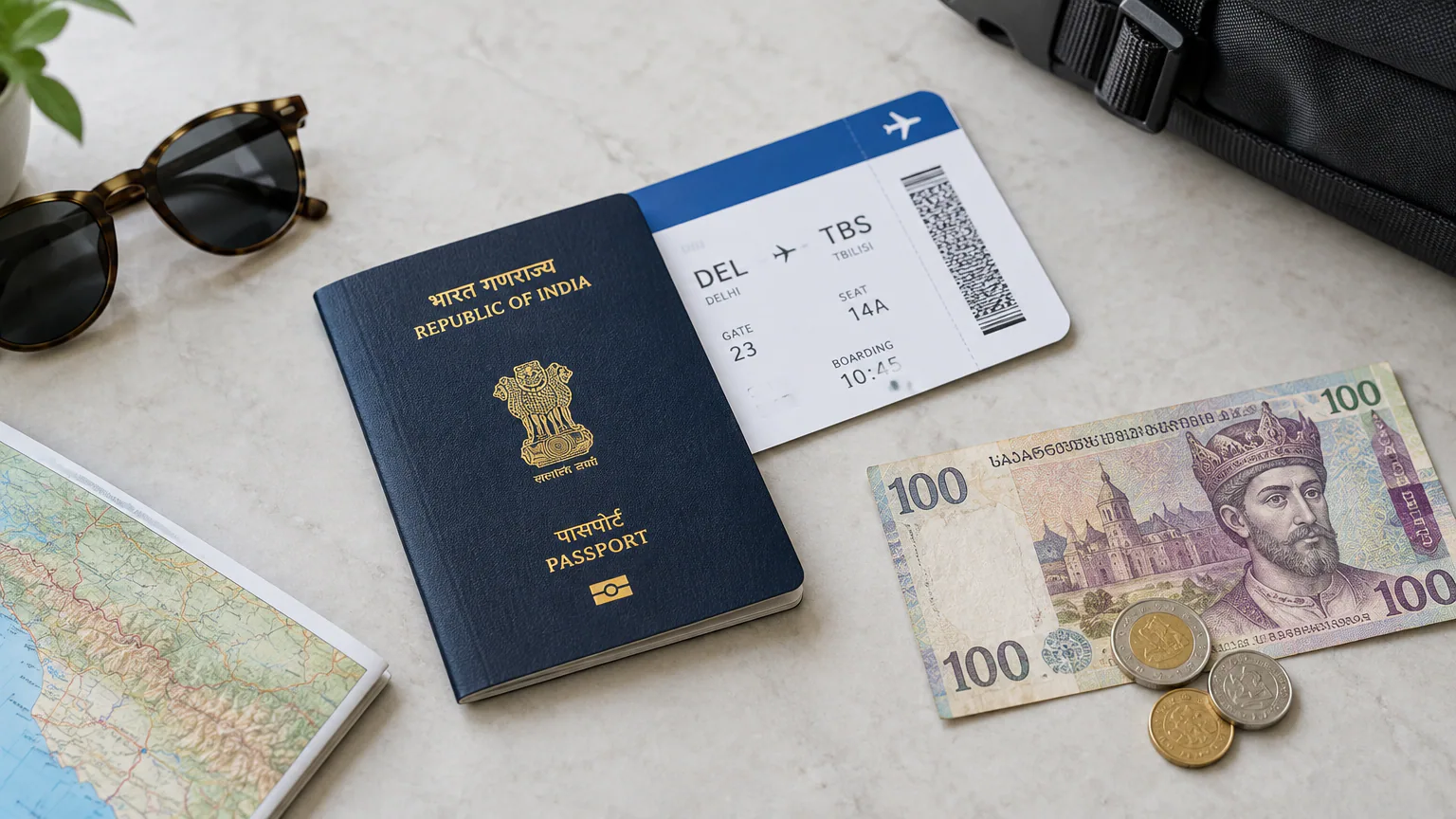
All practical routes from India to Georgia involve air travel. The main international gateway is Tbilisi International Airport (IATA: TBS). There are currently no direct non-stop flights between India and Georgia; all routes involve at least one connection.
From major Indian cities — Delhi (DEL), Mumbai (BOM), Bengaluru (BLR), and Chennai (MAA) — travellers can connect through Dubai (Emirates), Doha (Qatar Airways), Istanbul (Turkish Airlines), or Sharjah (Air Arabia). Total journey time including the layover typically ranges from approximately 8 to 15 hours depending on the connection. Booking well in advance and comparing prices across airlines and booking platforms is advisable, as fares vary considerably by season and lead time.
Batumi International Airport (IATA: BUS) is an alternative entry point if your itinerary focuses on western Georgia or the Black Sea coast. Some travellers also enter Georgia overland from Turkey or Armenia, but this is not a practical option for most Indian tourists travelling directly from India.
Step-by-Step: Planning Your Georgia Journey from India
- Choose your departure city: Select the most convenient international airport in India — Delhi, Mumbai, Bengaluru, or Chennai all have connecting options.
- Book flights early: Search for flights to Tbilisi International Airport (TBS) with one-stop connections via Dubai, Doha, Istanbul, or Sharjah. Compare fares across airlines and booking platforms.
- Check visa requirements: Verify the current visa policy for Indian passport holders on the official Georgian consular portal (geoconsul.gov.ge) well before your travel date. Requirements can change.
- Arrange airport transfers: Pre-book a taxi or hotel transfer from Tbilisi Airport to your accommodation, particularly if arriving late at night.
- Plan intercity transport: Research marshrutkas (shared minibuses), trains, taxis, and private car hire options based on your itinerary. Marshrutkas are the most cost-effective option for budget travellers.
- Purchase a local SIM or eSIM: Buy a Georgian SIM card on arrival at the airport from providers such as MagtiCom, Silknet, or Beeline, or activate an eSIM before departure if your phone supports it.
- Carry mixed payment options: Bring USD or EUR to exchange for Georgian Lari (GEL) at city exchange offices. Cards are widely accepted in cities; cash is useful in rural areas and smaller vendors.
Where to Stay in Georgia
Georgia offers accommodation across a wide spectrum, from family-run guesthouses in mountain villages to internationally branded hotels in Tbilisi and Batumi. The indicative nightly rates below are for a standard double room and are general market estimates, not guaranteed prices. Actual rates vary by season, availability, and booking platform.
Tbilisi: Where to Stay
The Old Town (Kala) and Sololaki districts are ideal for travellers who want to be close to historic attractions and the Abanotubani bathhouse area. The Rustaveli Avenue corridor suits those who prefer upscale hotels and easy access to museums and shopping. The Vera district is quieter and popular with design-conscious travellers.
- Budget (approx. INR 2,500–4,000/night, room only): Fabrika Hostel and Suites — a converted Soviet-era sewing factory in the Chugureti district, popular for its private rooms, courtyard social scene, and central location.
- Mid-range (approx. INR 6,000–9,000/night, breakfast included): Hotel Costé — a boutique hotel in Old Tbilisi offering comfortable rooms and easy walking access to major attractions.
- Luxury (approx. INR 12,000–20,000+/night, breakfast included): Rooms Hotel Tbilisi — a design hotel in the Vera district known for its industrial-chic aesthetic, well-regarded restaurant, and attentive service.
Batumi: Where to Stay
Staying near Batumi Boulevard gives easy access to the beach and the city's main attractions. The Old Batumi area offers a more historic atmosphere, while newer developments along the northern coast feature modern high-rise hotels with sea views.
- Budget (approx. INR 2,000–3,500/night, room only): Hotel N16 — a well-rated option offering clean, comfortable rooms close to the city centre and beach.
- Mid-range (approx. INR 5,000–8,000/night, breakfast included): Hotel Aisi — located near the beach and boulevard, with good amenities and sea views from selected rooms.
- Luxury (approx. INR 10,000–18,000+/night, breakfast included): Radisson Blu Hotel Batumi — a prominent boulevard hotel with spa, pool, and Black Sea views.
Kazbegi: Where to Stay
Accommodation in Kazbegi (Stepantsminda) ranges from family guesthouses offering authentic local hospitality to a celebrated design hotel. Most properties are oriented towards mountain views, and proximity to hiking trailheads is a practical consideration.
- Budget (approx. INR 1,500–3,000/night, room only): Guest House Tamar — a family-run guesthouse offering basic, comfortable rooms with mountain views and home-cooked meals.
- Mid-range (approx. INR 4,000–7,000/night, breakfast included): Hotel Stancia — a charming property with a rustic feel and panoramic views of Mount Kazbek.
- Luxury (approx. INR 10,000–18,000+/night, breakfast included): Rooms Hotel Kazbegi — a renowned design hotel with direct views of Gergeti Trinity Church and Mount Kazbek, considered one of the best mountain hotels in the Caucasus.
Georgian Food: What Indian Travellers Need to Know
Georgian cuisine is one of the most compelling reasons to visit the country. It draws on fresh herbs, walnuts, pomegranate, and a range of spices to create flavours that are distinct from both European and Middle Eastern cooking, yet accessible to Indian palates accustomed to bold, layered tastes. Communal dining is central to Georgian culture, and the traditional Supra (feast) — presided over by a Tamada (toastmaster) — is an experience in itself.
Indian travellers will find a genuinely good range of vegetarian options, though it is always advisable to confirm ingredients, particularly in broths and sauces, as meat stock is sometimes used in dishes that appear vegetarian.
Must-Try Georgian Dishes
- Khachapuri: Georgia's iconic cheese-filled bread, available in several regional varieties. Adjaruli Khachapuri is boat-shaped and topped with a raw egg and butter; Imeruli Khachapuri is round with cheese baked inside. Widely considered the country's national dish.
- Khinkali: Large, pleated dumplings traditionally filled with seasoned meat (pork, beef, or lamb), but also available with potato, cheese, or mushroom fillings — suitable for vegetarians. The correct technique is to hold the knot, bite a small hole, sip the broth inside, then eat the rest.
- Mtsvadi: Georgian shashlik — marinated meat (pork, beef, or lamb) grilled on skewers over an open flame, typically served with fresh onions and pomegranate sauce.
- Badrijani Nigvzit: Fried aubergine (eggplant) rolls filled with a spiced walnut paste and garnished with pomegranate seeds. A popular vegetarian appetiser.
- Lobio: A hearty bean stew cooked in a clay pot and seasoned with herbs and spices. A staple vegetarian dish, typically served with Mchadi (cornbread) and pickles.
- Pkhali: Compact vegetable pâtés made from spinach, beetroot, or cabbage blended with walnut paste and spices. Served cold as an appetiser and naturally vegetarian.
- Ajapsandali: A Georgian vegetable stew of aubergine, tomatoes, peppers, and herbs — similar in concept to ratatouille and entirely plant-based.
Vegetarian and Dietary Considerations
Georgian cuisine is more vegetarian-friendly than many travellers expect. Khachapuri, Pkhali, Badrijani Nigvzit, Lobio, Ajapsandali, and vegetable-filled Khinkali are all naturally meat-free. However, some dishes that appear vegetarian may use meat-based stock or contain small amounts of animal fat, particularly in rural areas. Always ask about ingredients when ordering, especially if you follow a strict vegetarian or vegan diet.
In Tbilisi and Batumi, dedicated vegetarian and vegan restaurants have become more common, and most mid-range and upscale restaurants can accommodate dietary requests with advance notice. In smaller towns and mountain villages, the range of vegetarian options is narrower, so it is worth carrying snacks and being prepared to rely on bread, cheese, and bean dishes.
Restaurant Recommendations
In Tbilisi, Shavi Lomi (Black Lion) offers a modern interpretation of traditional Georgian dishes in a characterful setting in the Vera district. PurPur, in the Old Town, is known for its charming atmosphere and reliable classic Georgian cooking. For Khinkali specifically, Pasanauri — a chain with multiple Tbilisi locations — is a consistently popular choice among locals and visitors alike.
In Batumi, Restaurant San Remo is well regarded for seafood and Black Sea views. Chacha Time provides a lively atmosphere with traditional food and the option to try Chacha, Georgia's grape-based spirit. Always check recent reviews before visiting, as restaurant quality and ownership can change.
Essential Travel Tips for Indian Tourists in Georgia
The practical details below cover the aspects of Georgia travel that most frequently require advance preparation for Indian citizens: visa requirements, currency management, connectivity, safety, and local etiquette.
Visa and Entry Requirements for Indian Citizens
Indian citizens generally require a visa to enter Georgia. The authoritative and current source for visa requirements, application procedures, required documents, permitted length of stay, and applicable fees is the official Georgian consular portal at geoconsul.gov.ge. Requirements can change, and the portal directs applicants to select their citizenship and the relevant consular office for specific guidance.
Some Indian passport holders may be eligible for an e-Visa or for visa-free entry if they hold a valid visa or residence permit from certain countries, but this must be verified directly through the official consular portal before making any travel arrangements. Ensure your passport has at least six months of validity beyond your intended date of departure from Georgia. Do not rely on third-party summaries for visa information; always check the official source close to your travel date.
Currency and Money Management
The local currency is the Georgian Lari (GEL). Credit and debit cards are widely accepted in hotels, restaurants, supermarkets, and larger shops in Tbilisi, Batumi, and other cities. Cash is advisable for smaller vendors, local markets, marshrutka fares, and in rural or mountain areas where card terminals may not be available.
ATMs are readily available in urban centres. For the best exchange rates, bring USD or EUR from India and exchange to GEL at licensed exchange offices in the city rather than at the airport, where rates are typically less favourable. Avoid exchanging Indian Rupees directly, as INR is not widely traded in Georgia.
SIM Cards and Internet Connectivity
Staying connected in Georgia is straightforward. Local SIM cards are available from telecommunications providers including MagtiCom, Silknet, and Beeline at Tbilisi International Airport and in shops across major cities. Prepaid data packages are affordable and offer good coverage in urban areas and along main tourist routes.
If your phone supports eSIM, you can activate a Georgian data plan digitally before or immediately upon arrival, which is convenient for navigating from the airport. Mobile internet coverage becomes patchy in remote mountain areas such as Tusheti and parts of Svaneti, so download offline maps before heading into the highlands.
Getting Around Georgia
Marshrutkas (shared minibuses) are the most cost-effective way to travel between cities and towns and run on fixed routes from central bus stations in Tbilisi, Batumi, Kutaisi, and other hubs. They are inexpensive but depart when full rather than on a fixed timetable, which requires some flexibility.
Taxis and ride-hailing apps (Bolt and Yandex Go operate in Tbilisi and Batumi) are convenient for urban travel and short intercity trips. Always agree on a fare before getting into an unmarked taxi, or use the app to avoid overcharging. Private car hire with a driver is the most comfortable option for multi-day itineraries covering Kazbegi, Kakheti, and southern Georgia, and can be arranged through hotels or local agencies. Train services connect Tbilisi with Batumi, Kutaisi, and Zugdidi, offering a comfortable and scenic alternative to road travel on certain routes.
Safety in Georgia
Georgia is generally considered safe for tourists, including solo travellers. Georgians are widely known for their hospitality, and violent crime against tourists is uncommon. Standard urban precautions apply: keep valuables secure in crowded areas, avoid walking alone in poorly lit streets at night, and use official taxis or ride-hailing apps rather than unmarked vehicles.
In mountainous regions, weather conditions can change rapidly. Always check forecasts before hiking, inform your accommodation of your planned route and expected return time, and carry appropriate clothing and supplies. Emergency services in Georgia can be reached by dialling 112.
Local Etiquette and Cultural Tips
When visiting churches and monasteries — which are active places of worship — dress modestly: cover shoulders and knees, and women should cover their heads. Scarves are often available at entrances to major sites. Photography inside churches may be restricted; look for signs or ask before shooting.
Tipping is appreciated in restaurants and for personal services; approximately 10% of the bill is customary. Learning a few basic Georgian phrases — 'Gamarjoba' (hello), 'Madloba' (thank you), and 'Rogor khar?' (how are you?) — is warmly received and reflects well on visitors. If invited to a traditional Supra (feast), be prepared for multiple toasts led by the Tamada (toastmaster); wine plays a central ceremonial role and declining gracefully is acceptable if you do not drink alcohol.
Georgia vs Armenia: Which Should Indian Travellers Choose?
Indian travellers planning a Caucasus trip frequently compare Georgia and Armenia. Both countries offer rich history, ancient Christian heritage, and dramatic mountain landscapes, but they suit different travel priorities.
Georgia is more developed for international tourism, with a wider range of accommodation, a more diverse landscape (Black Sea coast, high Caucasus, wine country, and cave cities in a single country), a more varied cuisine, and a livelier urban scene in Tbilisi. It is the stronger choice for travellers who want variety, outdoor activities, and a mix of beach, mountain, and cultural experiences in one trip.
Armenia offers a more concentrated focus on ancient Christian monasteries and churches — many predating those in Georgia — a more rugged and austere mountain landscape, and a strong sense of national identity expressed through its food, music, and crafts. Armenia is particularly well suited to travellers with a deep interest in early Christian history and archaeology. While Georgia is celebrated for its wine, Armenia is known for its brandy.
Many travellers combine both countries in a single trip, as Tbilisi and Yerevan are connected by regular flights and bus services. Visa requirements for Indian citizens differ between the two countries and should be checked independently for each destination before booking.
Good questions. Clearer plans.
What is the best time to visit Georgia from India?
Spring (April to early June) and autumn (September to late November) are the most broadly suitable seasons for Indian tourists visiting Georgia. Both offer comfortable temperatures, manageable crowds, and moderate prices. Spring is ideal for city touring in Tbilisi, Telavi, and Sighnaghi. Autumn coincides with the Rtveli grape harvest in Kakheti and brings vivid foliage to mountain and valley landscapes. Summer (July to early September) is best for Black Sea beaches at Batumi and high-altitude hikes in Svaneti, Kazbegi, and Tusheti, but is the busiest and most expensive period. Winter (December to March) is the season for skiing at Gudauri and Bakuriani.
How many days are enough for a Georgia trip from India?
Seven to ten days is the generally recommended duration for Indian travellers visiting Georgia for the first time. Seven days allows you to cover Tbilisi, a day trip to Mtskheta, Kazbegi, and either Kakheti or Batumi without feeling rushed. Ten days gives you time to add Svaneti, Vardzia, or a more relaxed pace across all the main regions. Shorter trips of four to five days are feasible if you focus on Tbilisi, Mtskheta, and Kazbegi only.
What is the approximate cost of a Georgia trip from India?
For a 7-day, 6-night trip per person (double occupancy, including round-trip flights from a major Indian city), indicative estimates are: budget INR 71,000–1,14,000; mid-range INR 1,11,000–1,88,000; luxury INR 1,85,000–3,38,000+. Flight costs are the most variable element. These are general travel budget estimates, not guaranteed package prices.
Do Indian citizens need a visa to visit Georgia?
Indian citizens generally require a visa to enter Georgia. The authoritative source for current requirements — including application procedures, required documents, fees, and permitted length of stay — is the official Georgian consular portal at geoconsul.gov.ge. Some Indian passport holders may qualify for an e-Visa or visa-free entry under specific conditions (for example, if they hold a valid visa or residence permit from certain countries), but this must be verified directly through the official portal before making travel arrangements. Requirements can change, so always check close to your travel date.
Is Georgian food suitable for Indian palates?
Yes, Georgian food is generally well received by Indian travellers. The cuisine uses fresh herbs, walnuts, pomegranate, and a range of spices to create bold, layered flavours. Popular dishes include Khachapuri (cheese bread), Khinkali (dumplings), Badrijani Nigvzit (aubergine with walnut paste), Lobio (bean stew), and Pkhali (walnut-based vegetable pâtés). The flavour profiles are distinct but accessible, and the emphasis on communal, generous dining resonates with Indian food culture.
Are there vegetarian food options in Georgia?
Yes. Georgian cuisine has a good range of naturally vegetarian dishes: Khachapuri, Pkhali, Badrijani Nigvzit, Lobio, Ajapsandali (vegetable stew), and Khinkali with potato, cheese, or mushroom fillings are all meat-free. In Tbilisi and Batumi, dedicated vegetarian restaurants are available. In smaller towns and mountain villages, options are more limited. Always confirm ingredients when ordering, as some dishes may use meat-based stock even when they appear vegetarian.
How can I travel within Georgia?
The main options for getting around Georgia are: marshrutkas (shared minibuses) — the most affordable intercity option, departing from central bus stations when full; taxis and ride-hailing apps (Bolt and Yandex Go in Tbilisi and Batumi) for urban and short intercity travel; trains connecting Tbilisi with Batumi, Kutaisi, and Zugdidi; and private car hire with or without a driver, which offers the most flexibility for multi-destination itineraries. In cities, always use metered taxis or ride-hailing apps to avoid overcharging.
Which cities should I include in a first-time Georgia itinerary?
For a first visit, the essential stops are Tbilisi (the capital, 2–3 nights), Mtskheta (half-day trip from Tbilisi), and Kazbegi/Stepantsminda (1–2 nights for mountain scenery and Gergeti Trinity Church). Depending on your interests and available time, add Kakheti (wine region, 1–2 nights) for culture and harvest experiences, or Batumi (1–2 nights) for the Black Sea coast. Svaneti and Vardzia are rewarding additions for longer trips of nine days or more.
Is Georgia safe for solo Indian female travellers?
Georgia is generally considered safe for solo female travellers. Georgians are known for their hospitality, and violent crime against tourists is uncommon. Standard precautions apply: avoid walking alone in isolated or poorly lit areas at night, use official taxis or ride-hailing apps, keep valuables secure in crowded areas, and inform your accommodation of hiking plans in mountain regions. Emergency services can be reached by dialling 112.
What currency is used in Georgia and how should I manage money?
The local currency is the Georgian Lari (GEL). Cards are widely accepted in hotels, restaurants, and supermarkets in cities. Cash is useful for marshrutkas, local markets, and rural areas. For the best exchange rates, bring USD or EUR from India and exchange to GEL at licensed exchange offices in the city rather than at the airport. ATMs are available in urban centres. Indian Rupees are not widely traded in Georgia, so convert to USD or EUR before departure.
Keep exploring
A little inspiration for your journey
Practical reads for this destination — timing, places, costs and tips before you plan.
 Travel journalGeorgia Visa for Indians 2026: Complete e-Visa Guide
Indian citizens require a visa to enter Georgia. The Georgia e-Visa is the standard route for short-stay travel: the entire process — application, payment, and receipt — is completed online…
Read the guide- Travel journalGeorgia Travel Guide for Indians: Your Ultimate 2026 Planning Edition
Georgia, a captivating country at the crossroads of Europe and Asia, offers Indian travellers a unique blend of ancient history, stunning natural landscapes, and warm hospitality. This guide provides essential…
Read the guide
A little inspiration.
A holiday made yours.
Share your dates and departure city — a travel expert replies with ideas within 24 hours.
Plan my holidayLet’s make it personal.
Tell us about your dates, departure city and the moments you’d love to include.
What happens next?
Discuss your preferences, review a tailored proposal and refine the details before you decide.