
Hong Kong + Macau Travel Guide for Indians: Best Time to Visit, Costs and Planning Tips (2026)
October and November are the best months for Indian travellers to visit Hong Kong and Macau. Both destinations officially identify this autumn window as their most comfortable period: Hong Kong's tourism authority highlights sunshine, pleasant breezes and mild temperatures, while the Macao Government Tourism Office describes October and November as mild and relatively dry. This guide covers everything Indian travellers need to plan a 2026 trip — from visa requirements and estimated budgets to top attractions, local food, and how to travel between the two cities.
- No booking feeRequesting a quote is free with no obligation.
- Expert-planned itineraryRoutes and stays shaped around your dates and pace.
- Reply within 24 hoursA travel expert gets back to you with ideas.
- Refine before you decideAdjust the plan until it feels right for you.
Hong Kong + Macau: What to Expect
Hong Kong is a Special Administrative Region of China known for its dramatic skyline, Victoria Harbour, efficient public transport, and a food scene that ranges from Michelin-starred restaurants to street-side wonton noodle stalls. Macau, the other SAR, is often called the 'Vegas of Asia' for its casino resorts, but it also holds a UNESCO-listed historic centre that reflects four centuries of Portuguese colonial architecture.
Together, the two destinations sit within roughly an hour of each other by high-speed ferry, making a combined itinerary practical and rewarding. Most international flights from India land at Hong Kong International Airport (HKG), from where travellers connect to Macau by ferry or bus. The pairing suits families, couples, solo travellers, and groups looking for a mix of urban energy, cultural heritage, and entertainment.
Why Hong Kong + Macau Appeals to Indian Travellers
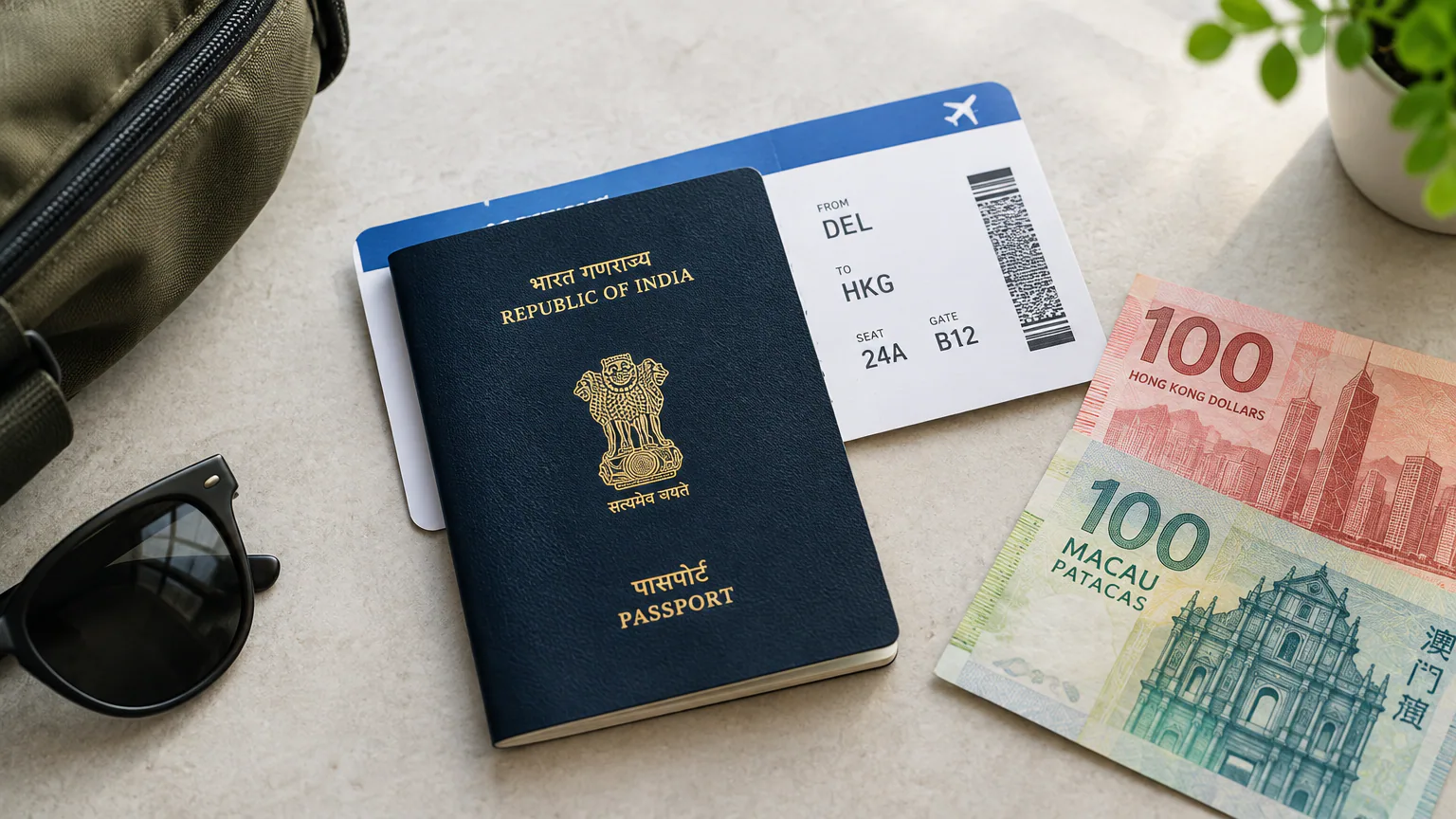
Several practical factors make this pairing popular with travellers from India. Entry to Hong Kong requires only a free online pre-arrival registration — no visa fee, no embassy appointment. Indian citizens typically receive a visa-on-arrival for Macau. Direct flights operate from Mumbai, Delhi, and Bengaluru, with journey times of roughly five to six hours.
Beyond logistics, the destinations offer genuine variety. Hong Kong Disneyland and Ocean Park cater to families; the Ladies' Market and luxury malls in Central satisfy shoppers; Buddhist temples and colonial ruins appeal to culture seekers. Macau adds casino entertainment, Portuguese-Cantonese cuisine, and a compact historic district that can be explored on foot. Vegetarian Indian restaurants and Buddhist vegetarian eateries are available in both cities, reducing dietary concerns for Indian visitors.
Best Time to Visit Hong Kong and Macau from India
October and November are the strongest months for a combined Hong Kong–Macau trip. Hong Kong's official tourism guidance describes autumn (September to November) as characterised by comfortable temperatures, sunshine, and pleasant breezes. The Macao Government Tourism Office independently identifies October and November as ideal because temperatures are mild and weather is relatively dry. The alignment of both destinations' best weather in the same two-month window makes planning straightforward.
December through February is a viable secondary window for travellers who prefer cooler conditions. Hong Kong has a mild climate from mid-September to late February. Macau is often sunny during December to March, though winter can feel cold. This period also coincides with Chinese New Year (late January or February), which brings festive atmosphere but higher prices and larger crowds.
May through September is the least dependable period for a tightly scheduled itinerary. Both destinations are hot, humid, and wet during these months, and Macau's rainy season officially runs from May to September, with the risk of tropical-storm disruption to outdoor sightseeing and cross-border transport. Travellers who must visit during this period should monitor official weather advisories and build flexibility into their plans.
The table below summarises conditions month by month to help Indian travellers choose their travel window.
| Month | Weather Summary | Crowd Level | Price Pressure | Verdict for Indian Travellers |
|---|---|---|---|---|
| January | Mild in HK; sunny but can be cold in Macau | Moderate | Moderate | Good — comfortable sightseeing, fewer crowds |
| February | Mild; Chinese New Year brings festive energy | High around CNY | High around CNY | Good weather; book early if travelling over CNY |
| March | Mild, humidity beginning to rise | Moderate | Moderate | Comfortable; humidity increases toward month-end |
| April | Warm; temperatures rising in Macau | Moderate | Moderate | Acceptable; go early in the month for best comfort |
| May | Hot, humid; Macau rainy season begins | Moderate–High | Moderate | Less ideal — heat and rain likely |
| June | Hot, very humid, heavy rain, typhoon risk | Moderate | Moderate | Avoid if possible — weather unreliable |
| July | Hot, very humid, heavy rain, typhoon risk | Moderate | Moderate | Avoid — highest typhoon risk period |
| August | Hot, very humid, heavy rain, typhoon risk | Moderate | Moderate | Avoid — challenging conditions |
| September | Warm, humid; weather improving late in month | Moderate | Moderate | Transition month — late September is acceptable |
| October | Mild, sunny, pleasant breezes (both cities) | Moderate–High | Moderate–High | Excellent — officially recommended by both tourism boards |
| November | Mild, sunny, comfortable (both cities) | Moderate | Moderate | Excellent — best overall balance of weather and crowds |
| December | Cool to mild; festive season in both cities | High | High | Good weather; expect higher prices and crowds |
Top 10 Places to Visit in Hong Kong and Macau
The following attractions represent the most visited and most distinctive sites across both destinations. A 5-to-7-day itinerary can comfortably cover all ten.
1. Victoria Peak, Hong Kong
Victoria Peak is the highest point on Hong Kong Island at 552 metres and offers the most photographed panoramic view of the city's skyline, Victoria Harbour, and the surrounding islands. The historic Peak Tram funicular railway climbs steeply to the summit and is itself a memorable experience. Visiting at dusk captures both the golden-hour skyline and the illuminated city at night.
2. Hong Kong Disneyland, Lantau Island
Located on Lantau Island, Hong Kong Disneyland features seven themed lands including Adventureland, Fantasyland, and Tomorrowland, along with live shows and seasonal parades. It is a practical choice for families travelling from India, with dedicated dining options and manageable park size compared to larger Disney properties.
3. Tian Tan Buddha and Po Lin Monastery, Lantau Island
The Tian Tan Buddha — commonly called the Big Buddha — is a 34-metre bronze statue seated on the Ngong Ping plateau on Lantau Island. The adjacent Po Lin Monastery is an active Buddhist sanctuary. The Ngong Ping 360 cable car provides a scenic approach with views over the South China Sea and surrounding hills. Vegetarian meals are available at the monastery's dining hall.
4. Tsim Sha Tsui Promenade and Avenue of Stars, Hong Kong
The Tsim Sha Tsui waterfront in Kowloon faces Hong Kong Island's skyline directly across Victoria Harbour. The Avenue of Stars celebrates Hong Kong's film industry with handprints and tributes to local cinema legends. Every evening, the 'Symphony of Lights' multimedia show illuminates the harbour skyline — it is free to watch from the promenade.
5. Mong Kok Markets, Hong Kong
Mong Kok is one of Hong Kong's densest and most energetic districts. The Ladies' Market on Tung Choi Street sells clothing, accessories, and souvenirs at negotiable prices. Nearby, the Goldfish Market, Flower Market, and Bird Garden offer a distinctly local shopping experience. Street food stalls throughout the area serve egg waffles, curry fish balls, and other Cantonese snacks.
6. Ruins of St. Paul's, Macau
The Ruins of St. Paul's are the preserved stone facade of the 17th-century Church of Mater Dei and its associated college, destroyed by fire in 1835. The facade is Macau's most recognisable landmark and forms part of the Historic Centre of Macau, a UNESCO World Heritage Site inscribed in 2005. The site is free to visit and is most atmospheric in the early morning before crowds arrive.
7. Senado Square, Macau
Senado Square is the historic civic heart of Macau, paved with a distinctive wave-pattern Portuguese mosaic and flanked by pastel-coloured neoclassical buildings. It is a UNESCO World Heritage Site and a practical base for exploring the surrounding historic district on foot. Cafés, bakeries selling Macanese egg tarts, and souvenir shops line the square and adjacent lanes.
8. Macau Tower
The Macau Tower stands 338 metres tall and offers observation decks with views across Macau, the Pearl River Delta, and on clear days toward Hong Kong. For adventure travellers, the tower hosts bungee jumping and an open-air skywalk around the outer rim of the observation deck. The indoor observation level suits visitors who prefer a less exposed experience.
9. A-Ma Temple, Macau
The A-Ma Temple on Barra Hill is one of Macau's oldest places of worship, traditionally dated to 1488 and dedicated to Mazu, the goddess of seafarers. It is a UNESCO World Heritage Site and an active place of worship, with incense coils hanging from the ceiling and devotees visiting throughout the day. The temple's name is widely cited as the origin of the name 'Macau' itself.
10. The Venetian Macao, Cotai Strip
The Venetian Macao on the Cotai Strip is one of the largest casino resort complexes in the world, replicating Venetian canals, piazzas, and architecture at an enormous scale. Indoor gondola rides, a large shopping mall, a concert arena, and diverse dining options make it a destination in its own right, even for non-gamblers. It is a useful base for exploring the Cotai Strip's other integrated resorts.
Estimated Trip Cost from India (2026)
The figures below are indicative estimates per person for a 5-night/6-day trip from a major Indian city such as Mumbai or Delhi, assuming double occupancy. These are not confirmed Tripstor package prices. Actual costs vary significantly depending on airline, booking lead time, season, hotel category, and individual spending habits. Official sources do not publish verified package prices or hotel rates, so treat these ranges as planning benchmarks only.
Flight costs are the largest variable. Booking three to four months in advance and travelling in shoulder months (March–April or November) typically yields lower fares than peak periods around Chinese New Year or the October Golden Week holiday.
| Category | Budget (INR) | Mid-Range (INR) | Luxury (INR) |
|---|---|---|---|
| Round-trip flights from India | 30,000 – 45,000 | 45,000 – 70,000 | 70,000 – 1,20,000+ |
| Accommodation (5 nights) | 15,000 – 25,000 | 25,000 – 50,000 | 50,000 – 1,50,000+ |
| Food and drinks | 10,000 – 15,000 | 15,000 – 25,000 | 25,000 – 50,000+ |
| Local transport | 3,000 – 5,000 | 5,000 – 8,000 | 8,000 – 15,000 |
| Activities and sightseeing | 7,000 – 10,000 | 10,000 – 20,000 | 20,000 – 40,000+ |
| Miscellaneous (shopping, etc.) | 5,000 – 10,000 | 10,000 – 20,000 | 20,000 – 50,000+ |
| Total estimated per person | 70,000 – 1,10,000 | 1,10,000 – 1,93,000 | 1,93,000 – 4,25,000+ |
How to Reach Hong Kong and Macau from India
Most travellers from India fly into Hong Kong International Airport (IATA: HKG), which receives direct flights from Mumbai (BOM), Delhi (DEL), and Bengaluru (BLR). Airlines including Cathay Pacific and Air India operate these routes. Typical flight duration is five to six hours. Direct commercial flights from India to Macau International Airport (MFM) are not widely available, making HKG the standard entry point for a combined itinerary.
From Hong Kong International Airport, there are two main ways to reach Macau without first entering Hong Kong. The SkyPier at HKIA operates direct ferry services to Macau's ferry terminals, allowing travellers to transfer without clearing Hong Kong immigration — useful if your Hong Kong stay begins in Macau. Alternatively, travellers can clear Hong Kong immigration, travel to the city, and then take a ferry from the Hong Kong–Macau Ferry Terminal in Sheung Wan or the Tuen Mun Ferry Terminal. The Hong Kong–Zhuhai–Macau Bridge (HZMB) also connects the two cities by bus, offering a scenic crossing over the Pearl River Delta. Journey time by ferry or bus is approximately one hour.
Step-by-Step Journey Planning
- Book round-trip flights to Hong Kong International Airport (HKG) from your nearest Indian city. Compare fares across Cathay Pacific, Air India, and connecting-flight options.
- Complete Hong Kong's free online pre-arrival registration before departure. Each approved registration is valid for six months and permits multiple visits of up to 14 days each.
- Check the latest Macau entry requirements for Indian passport holders before travel, as visa-on-arrival conditions can change. Confirm your passport has at least six months of validity beyond your return date.
- Decide how you will travel between Hong Kong and Macau — SkyPier ferry from HKIA, city ferry terminal, or HZMB bus — and factor the journey into your day-by-day itinerary.
- Pre-book accommodation in both cities, especially for October, November, and Chinese New Year, when availability tightens and rates rise.
- Download the MTR Mobile app for Hong Kong transport navigation and research Macau's bus routes in advance to reduce transit time on arrival.
Where to Stay in Hong Kong and Macau
Both cities offer accommodation across all price points, from compact budget guesthouses to landmark luxury hotels. In Hong Kong, Tsim Sha Tsui (Kowloon) is the most practical base for first-time visitors — it sits close to the Star Ferry, the MTR, and the Tsim Sha Tsui Promenade. Central and Causeway Bay on Hong Kong Island suit those prioritising shopping and business districts. In Macau, the Cotai Strip concentrates the large integrated resorts, while the Macau Peninsula places guests within walking distance of the UNESCO historic sites. Indicative nightly rate ranges below are for general planning guidance only; actual rates vary by season, availability, and booking platform.
Hong Kong: Accommodation by Category
Budget options (indicative from INR 3,000–6,000 per night): Compact guesthouses and capsule hotels in Mong Kok and Jordan offer clean, functional stays with MTR access. Mini Hotel Central provides a modern budget option in a central location.
Mid-range options (indicative from INR 6,000–12,000 per night): The Salisbury YMCA of Hong Kong in Tsim Sha Tsui offers reliable comfort and harbour views at competitive rates. Hotel ICON in Tsim Sha Tsui East is a design-forward property with strong service.
Luxury options (indicative from INR 15,000+ per night): The Peninsula Hong Kong in Tsim Sha Tsui is one of Asia's most storied hotels, known for its colonial grandeur and Rolls-Royce fleet. The Ritz-Carlton, Hong Kong occupies the upper floors of the International Commerce Centre and holds some of the highest hotel rooms in the world. Four Seasons Hotel Hong Kong in Central offers direct access to IFC Mall and the Airport Express.
Macau: Accommodation by Category
Budget to mid-range options (indicative from INR 4,000–15,000 per night): Hotel Sintra on the Macau Peninsula is well-located for the historic district and Senado Square. Grand Emperor Hotel offers a central Peninsula location with distinctive décor. Holiday Inn Express Macau City Centre provides reliable, straightforward accommodation.
Luxury options (indicative from INR 15,000+ per night): The Venetian Macao on the Cotai Strip is the flagship integrated resort, with Venetian-themed canals, a large shopping mall, and extensive entertainment. Galaxy Hotel, part of the Galaxy Macau complex, features a wave pool and diverse dining. MGM Cotai is known for its striking architectural design and art installations.
Food and Dining: What Indian Travellers Should Know
Hong Kong's food scene is anchored in Cantonese cuisine, with dim sum being the most iconic meal format — small portions of dumplings, buns, and pastries served from trolleys or ordered by tick-sheet, typically at breakfast or lunch. Macau's cuisine is a distinct fusion of Cantonese and Portuguese cooking, producing dishes that are unique to the territory.
Indian travellers, including vegetarians, will find workable options in both cities. Hong Kong has a notable number of Buddhist vegetarian restaurants, particularly near temples, as well as Indian restaurants concentrated in Tsim Sha Tsui and Chungking Mansions. In Macau, the large Cotai Strip resorts typically include international dining options with vegetarian menus. Smaller local eateries may have fewer dedicated vegetarian dishes, but rice and noodle dishes can often be adapted. Communicating dietary needs clearly — in writing if necessary — is advisable.
Must-Try Dishes
- Dim Sum (Hong Kong): The quintessential Cantonese meal — steamed dumplings, char siu bao (barbecue pork buns), and cheung fun (rice noodle rolls) served in bamboo steamers. Vegetarian dim sum including steamed vegetable dumplings and spring rolls is widely available.
- Wonton Noodles (Hong Kong): Thin egg noodles in a clear broth with delicate shrimp or pork wontons. A staple of Hong Kong street-food culture, available at dedicated noodle shops throughout the city.
- Egg Tarts (Hong Kong and Macau): A sweet pastry with a smooth egg custard filling. Hong Kong-style uses a flaky shortcrust pastry; the Macanese version (pastel de nata) has a caramelised top. Both are widely available from bakeries and street stalls.
- Pork Chop Bun (Macau): A marinated, pan-fried pork chop served in a crisp Portuguese-style roll. An iconic Macanese street snack, most famously associated with the bakeries near Senado Square.
- Minchi (Macau): A traditional Macanese dish of seasoned minced meat with diced potatoes, soy sauce, and Worcestershire sauce, typically served with steamed rice and a fried egg. Some fusion restaurants offer plant-based versions.
Vegetarian and Indian Dietary Guidance
Hong Kong has a well-established Buddhist vegetarian restaurant scene. Look for restaurants displaying the Chinese character for vegetarian (素) or search for 'sut-sik' (Cantonese for vegetarian) options. The Tsim Sha Tsui and Chungking Mansions area has multiple Indian restaurants serving familiar vegetarian dishes. Major supermarkets stock vegetarian instant meals and snacks.
In Macau, the large integrated resorts on the Cotai Strip — including The Venetian Macao and Galaxy Macau — typically have multiple dining outlets with vegetarian options. For the historic Macau Peninsula, international cafés and Portuguese-style restaurants are more common than dedicated vegetarian eateries, but staff in tourist areas generally understand dietary requests in English.
Essential Travel Tips for Indian Visitors
The sections below cover the practical details that most affect Indian travellers: entry requirements, currency, connectivity, and local etiquette.
Visa and Entry Requirements
Hong Kong: Indian nationals generally need to complete Hong Kong's online pre-arrival registration successfully before making a visa-free visit. The registration is free, processed entirely online, and each approved registration is valid for six months, permitting multiple visits of up to 14 days each, subject to applicable immigration rules. Always verify the current requirements on the Hong Kong Immigration Department's official website before booking.
Macau: Indian citizens typically receive a visa-on-arrival for stays of up to 30 days. However, entry conditions can change, and travellers should confirm the current requirements with official Macau immigration sources before travel.
General: Ensure your passport has at least six months of validity beyond your intended return date. Carry printed copies of your pre-arrival registration approval, accommodation bookings, and return flight details when passing through immigration.
Currency and Payments
Hong Kong uses the Hong Kong Dollar (HKD), which is pegged to the US Dollar. Macau uses the Macanese Pataca (MOP), which is pegged to the HKD. In practice, HKD is widely accepted in Macau at close to a 1:1 rate with MOP, making it convenient to carry HKD for use in both cities. MOP is generally not accepted in Hong Kong, so avoid accumulating excess MOP before crossing back.
Credit and debit cards are accepted at most hotels, restaurants, and larger shops in both cities. ATMs are widely available. For smaller street-food stalls and local markets, cash is often preferred. Multi-currency travel cards or a zero-forex-fee debit card can reduce conversion costs compared to airport exchange counters.
SIM Cards, eSIMs, and Wi-Fi
Local SIM cards are available at Hong Kong International Airport arrivals hall and at convenience stores (7-Eleven, Circle K) throughout both cities. eSIMs compatible with both Hong Kong and Macau can be purchased and activated digitally before departure, which is convenient for travellers with unlocked smartphones. Free Wi-Fi is available in MTR stations, shopping malls, hotels, and many public spaces in Hong Kong. Macau's larger resorts and public areas also offer free Wi-Fi. A regional data plan covering both destinations avoids the need to switch SIMs mid-trip.
Safety and Local Etiquette
Both Hong Kong and Macau have low violent crime rates and are considered safe for tourists. Standard precautions apply: keep valuables secure in crowded areas such as markets and ferry terminals, and be aware of your surroundings.
Etiquette notes for Indian travellers: queue patiently at MTR stations and bus stops — queue-jumping is frowned upon; keep voices at a moderate level on public transport; remove headphones when speaking to service staff; and avoid eating or drinking on the MTR, where it is prohibited. Tipping is not mandatory in either city but is appreciated for good restaurant service (typically 10% if a service charge is not already included). When visiting temples such as A-Ma Temple or Po Lin Monastery, dress modestly and follow any posted guidelines about photography.
Hong Kong + Macau vs. Singapore: A Practical Comparison for Indian Travellers
Indian travellers often compare Hong Kong + Macau with Singapore when planning an Asian city break. The two options have meaningfully different characters.
Hong Kong + Macau offers a rawer, more layered urban experience: dense street markets, a world-class harbour, Portuguese colonial ruins, and casino entertainment within a one-hour ferry ride of each other. The entry process for Hong Kong requires a free online pre-arrival registration rather than a visa. Singapore, by contrast, offers visa-free entry for Indian nationals for up to 30 days, a meticulously planned urban environment, and attractions such as Gardens by the Bay and Sentosa Island that are particularly well-suited to families with young children.
For shopping, Hong Kong's combination of luxury malls in Central and Causeway Bay with street markets in Mong Kok offers more variety across price points. Singapore's Orchard Road and Marina Bay Sands are polished but less diverse in the budget-to-mid-range segment. Both cities have excellent public transport: Hong Kong's MTR and Singapore's MRT are among the most efficient metro systems in Asia.
The choice ultimately depends on travel priorities. Hong Kong + Macau suits travellers who want historical depth, a distinctive food culture, and entertainment variety. Singapore suits those who prefer a cleaner, more predictable environment with strong family-friendly infrastructure.
Good questions. Clearer plans.
What is the best time to visit Hong Kong and Macau from India?
October and November are the best months. Both destinations' official tourism bodies identify this period as their most comfortable: Hong Kong's tourism authority highlights autumn sunshine, pleasant breezes, and mild temperatures, while the Macao Government Tourism Office describes October and November as mild and relatively dry. December through February is a good secondary window for cooler-weather travellers. Avoid May through September if possible, as both cities are hot, humid, and affected by the rainy season, with typhoon risk in Macau.
Do Indian citizens need a visa for Hong Kong and Macau?
For Hong Kong, Indian nationals need to complete a free online pre-arrival registration before arrival. Each approved registration is valid for six months and permits multiple visa-free visits of up to 14 days each. No visa fee or embassy appointment is required. For Macau, Indian citizens typically receive a visa-on-arrival for up to 30 days. Always verify the current requirements on official immigration websites before booking, as conditions can change.
How long should I spend in Hong Kong and Macau?
A 5-to-7-day trip is generally recommended. Allocate 3 to 4 days for Hong Kong to cover Victoria Peak, the Big Buddha, Tsim Sha Tsui, and Mong Kok without rushing. Spend 2 to 3 days in Macau for the UNESCO historic district, the Cotai Strip resorts, and the Macau Tower. The one-hour ferry or bus connection between the two cities makes the combined itinerary practical.
How do I travel between Hong Kong and Macau?
The most common options are high-speed ferry and bus via the Hong Kong–Zhuhai–Macau Bridge (HZMB). Ferries depart from the SkyPier at Hong Kong International Airport (useful for arriving passengers who want to go directly to Macau), the Hong Kong–Macau Ferry Terminal in Sheung Wan, and the Tuen Mun Ferry Terminal. The HZMB bus crosses the bridge over the Pearl River Delta. Both options take approximately one hour. Check current schedules and fares with official operators before travel, as these are not confirmed by this guide.
What is the approximate budget for a Hong Kong and Macau trip from India in 2026?
For a 5-night/6-day trip from a major Indian city, a mid-range budget is approximately INR 1,10,000 to INR 1,93,000 per person, covering round-trip flights, accommodation, food, local transport, and activities at double occupancy. Budget travellers may manage INR 70,000 to INR 1,10,000, while luxury travel can exceed INR 4,25,000 per person. These are indicative estimates, not confirmed package prices. Actual costs depend on airline, booking timing, season, and personal spending.
Are there vegetarian food options in Hong Kong and Macau?
Yes. Hong Kong has a well-established Buddhist vegetarian restaurant scene, and the Tsim Sha Tsui area has multiple Indian restaurants. Look for restaurants displaying the Chinese character for vegetarian (素) or ask for 'sut-sik' options. In Macau, the large Cotai Strip resorts typically include international dining with vegetarian menus. Smaller local eateries may have fewer dedicated options, but rice and noodle dishes can often be adapted. Communicating dietary requirements clearly in English is generally effective in tourist areas.
What are the main airports for Hong Kong and Macau?
Hong Kong International Airport (IATA: HKG) on Lantau Island is the primary entry point for travellers from India. Direct flights operate from Mumbai, Delhi, and Bengaluru. Macau International Airport (IATA: MFM) exists but does not receive widely available direct commercial flights from India. Most travellers fly into HKG and connect to Macau by ferry or bus.
What public transport is available in Hong Kong and Macau?
Hong Kong has one of the world's most comprehensive urban transport networks, including the MTR (metro), light rail, buses, trams (on Hong Kong Island), ferries, and taxis. The Octopus card is a rechargeable contactless card accepted across all modes. Macau's public transport is served primarily by buses, which cover the main tourist areas including the Macau Peninsula, Taipa, and the Cotai Strip. Taxis are also available in both cities.
Is Hong Kong or Macau better for shopping?
Hong Kong offers more variety across all price points. Luxury brands are concentrated in Central, Causeway Bay, and Tsim Sha Tsui malls, while Mong Kok's street markets cater to budget shoppers. Macau has luxury retail within its Cotai Strip integrated resorts — The Venetian Macao's mall is particularly large — but the overall range is narrower than Hong Kong. For a mix of high-end and street-level shopping, Hong Kong is the stronger destination.
Is Hong Kong + Macau a good family trip from India?
Yes. Hong Kong Disneyland and Ocean Park are well-established family attractions. The Big Buddha and Ngong Ping 360 cable car appeal to children and adults alike. In Macau, the large integrated resorts have family-friendly entertainment beyond the casino floors, including gondola rides at The Venetian Macao. The efficient public transport in both cities and the availability of diverse food options, including vegetarian and Indian cuisine, make the combination practical for families travelling from India.
Keep exploring
A little inspiration for your journey
Practical reads for this destination — timing, places, costs and tips before you plan.
 Travel journalHong Kong + Macau Visa for Indians 2026: A Comprehensive Guide
For Indian passport holders planning a trip to Hong Kong and Macau in 2026, understanding the visa and entry requirements is crucial for a smooth journey. While Hong Kong offers…
Read the guide- Travel journalHong Kong + Macau Travel Guide for Indians: Complete 2026 Planning Edition
Hong Kong and Macau together offer one of Asia's most rewarding short-haul trips for Indian travellers: a dramatic harbour skyline, UNESCO-listed Portuguese colonial streets, world-class dim sum, and a ferry…
Read the guide
A little inspiration.
A holiday made yours.
Share your dates and departure city — a travel expert replies with ideas within 24 hours.
Plan my holidayLet’s make it personal.
Tell us about your dates, departure city and the moments you’d love to include.
What happens next?
Discuss your preferences, review a tailored proposal and refine the details before you decide.