
Greece Travel Guide for Indians: Your Complete 2026 Holiday Planner
Greece is one of the most rewarding long-haul destinations for Indian travellers in 2026. The country combines UNESCO-listed ancient ruins, Cycladic island scenery, and a Mediterranean climate that suits travel from spring through autumn. This guide covers everything an Indian traveller needs: Schengen visa requirements and processing times sourced from the Greek Embassy, the best months to visit by weather and crowd level, top destinations from Athens to Crete, indicative costs in INR, and practical tips on food, safety, and getting around. Read each section in order for a full trip plan, or jump directly to the topic you need.
- No booking feeRequesting a quote is free with no obligation.
- Expert-planned itineraryRoutes and stays shaped around your dates and pace.
- Reply within 24 hoursA travel expert gets back to you with ideas.
- Refine before you decideAdjust the plan until it feels right for you.
What Is Greece? A Quick Destination Overview
Greece is a country in Southeast Europe bordered by the Aegean Sea to the east, the Ionian Sea to the west, and the Mediterranean Sea to the south. It is home to more than 6,000 islands, of which roughly 230 are inhabited. The capital, Athens, is the primary international gateway and the site of the Acropolis, one of the world's most recognised ancient monuments.
Greece's island destinations span the Aegean and Ionian seas and extend south to Crete, the country's largest island. The Cyclades — including Mykonos, Paros, and Naxos — are known for whitewashed houses, beaches, and blue seas. Mainland highlights include the archaeological site of Delphi and the rock monasteries of Meteora.
For Indian travellers, Greece offers a rare combination: deep historical and mythological heritage, postcard-perfect island scenery, a warm Mediterranean climate from early spring through late autumn, and a cuisine that accommodates vegetarian diets. A Schengen visa is required; details are in the visa section below.
Why Greece Appeals to Indian Travellers
Indian travellers are increasingly choosing Greece for three core reasons: historical depth, island scenery, and value relative to other Western European destinations.
Historical and mythological resonance: Sites like the Acropolis in Athens and the sanctuary of Delphi offer a direct encounter with classical civilisation. The parallels between Greek and Indian mythological traditions — pantheons of gods, epic narratives, oracle traditions — add a layer of cultural familiarity that many Indian visitors find compelling.
Island scenery and romantic appeal: Santorini and Mykonos are among the most photographed destinations on earth, making them popular choices for honeymoons and anniversary trips. The Cyclades, including Mykonos, Paros, and Naxos, are renowned for whitewashed villages, azure waters, and spectacular sunsets. Families find more relaxed options on Crete, Rhodes, and the Ionian islands.
Climate and cuisine: Greece has a warm Mediterranean climate, with sea-and-sun conditions generally extending from early spring through late autumn. Greek food — built around olive oil, fresh vegetables, legumes, seafood, and grilled meats — includes a wide range of naturally vegetarian dishes, which is a practical advantage for many Indian travellers.
Best Time to Visit Greece from India
The short answer: April–May and September–October offer the best balance of pleasant weather, manageable crowds, and lower prices. July and August are peak season — ideal for beach holidays but expensive and crowded. Winter months suit city breaks to Athens.
Greece has a warm Mediterranean climate, with sea-and-sun conditions generally extending from early spring through late autumn. Spring in Greece runs from March through May and is associated with warm weather, blue skies, and sunshine. September and October are known for pleasant temperatures, making early autumn suitable for sightseeing and coastal travel. April and October are both recognised shoulder-season months with generally smaller crowds than peak season. Travelling before the peak tourism season can mean fewer visitors at beaches, museums, and archaeological sites.
| Month | Weather | Crowd Level | Price Level | Best For |
|---|---|---|---|---|
| January | Cool, occasional rain | Very low | Low | Athens city breaks, mountain areas |
| February | Cool, occasional rain | Very low | Low | Cultural exploration, quiet museums |
| March | Mild, warming up | Low | Low | Early sightseeing, spring wildflowers |
| April | Pleasant, sunny | Moderate | Moderate | Sightseeing, early beach visits, fewer crowds |
| May | Warm, sunny | Moderate | Moderate | Island hopping before peak heat and prices |
| June | Hot, very sunny | High | High | Beach holidays; book well in advance |
| July | Very hot, sunny | Very high | Very high | Beach lovers; expect crowds and peak prices |
| August | Very hot, sunny | Very high | Very high | Peak season; highest prices and busiest islands |
| September | Warm, sunny | Moderate | Moderate | All activities; pleasant temperatures, fewer crowds |
| October | Mild, pleasant | Low–Moderate | Moderate | Sightseeing, coastal travel, shoulder-season value |
| November | Cooler, some rain | Low | Low | City tours, cultural sites, quiet travel |
| December | Cool, winter | Low | Low | Athens Christmas atmosphere, very quiet islands |
Top 10 Places to Visit in Greece
Greece rewards travellers who combine at least one mainland destination with one or two islands. The ten destinations below cover the full range of the country's appeal, from ancient ruins to volcanic beaches.
1. Athens — Ancient Capital and Modern Gateway
Athens is the starting point for almost every Greece trip from India, as Athens International Airport (ATH) handles the majority of international arrivals. The city's defining landmark is the Acropolis, a UNESCO World Heritage Site that houses the Parthenon, the Erechtheion, and the Temple of Athena Nike. The Acropolis Museum at its base provides essential context.
Beyond the Acropolis, the Plaka neighbourhood offers narrow streets, traditional tavernas, and a relaxed pace. Syntagma Square is the commercial and transport hub. The National Archaeological Museum holds one of the world's most important collections of ancient Greek artefacts. Allow at least two full days in Athens before heading to the islands.
2. Santorini — Caldera Views and Volcanic Beaches
Santorini is Greece's most iconic island, formed by a volcanic eruption that created a dramatic caldera. The villages of Oia and Fira cling to the caldera rim, offering views across the Aegean that have made the island synonymous with Greek island travel. Oia is particularly famous for its sunsets.
The island's volcanic geology also produces distinctive red and black sand beaches at Akrotiri and Perissa. Santorini is a popular honeymoon and anniversary destination for Indian couples. Accommodation ranges from budget guesthouses near the black-sand beaches to luxury cave hotels in Oia with private infinity pools. Book well in advance for summer travel.
3. Mykonos — Cosmopolitan Island with Iconic Windmills
Mykonos is a cosmopolitan island in the Cyclades, known for its vibrant nightlife, beautiful beaches, and the charming Chora (Mykonos Town) with its iconic windmills and Little Venice quarter. The Cyclades, including Mykonos, Paros, and Naxos, are island destinations known for whitewashed houses, beaches, and blue seas.
The island attracts a diverse international crowd. Beaches range from the lively Paradise and Super Paradise to the quieter Agios Sostis in the north. Day trips to the nearby sacred island of Delos — an important ancient sanctuary — are a worthwhile addition for history-minded travellers.
4. Crete — Greece's Largest Island
Crete is Greece's largest island and one of its most diverse destinations. Greece's island destinations span the Aegean and Ionian seas and extend south to Crete. The island offers a wide range of experiences: the Minoan Palace of Knossos near Heraklion is one of Europe's oldest archaeological sites; the Samaria Gorge in the White Mountains is one of Europe's longest gorges; and beaches range from the famous pink-sand Elafonissi to the palm-lined Vai.
Crete is well suited to families and independent travellers. It has its own distinct cuisine, dialect, and musical tradition. The island is large enough to warrant a dedicated trip of five or more days rather than a brief stop.
5. Rhodes — Medieval Old Town and Sun-Drenched Beaches
Rhodes, the largest island in the Dodecanese group, is known for its remarkably well-preserved medieval Old Town, a UNESCO World Heritage Site that was once the stronghold of the Knights of St. John. The Street of the Knights and the Palace of the Grand Master are the centrepieces of the Old Town.
The island also offers excellent beaches, particularly on the east coast, and the ancient acropolis of Lindos, perched above a picturesque village. The Colossus of Rhodes, one of the Seven Wonders of the Ancient World, once stood at the harbour entrance. Rhodes combines history, beach holidays, and family-friendly resorts effectively.
6. Delphi — The Ancient Oracle Site
Delphi, on the slopes of Mount Parnassus in central Greece, was considered the centre of the world in ancient Greek belief and was home to the Oracle of Apollo — the most important prophetic institution of the ancient world. The UNESCO-listed archaeological site includes the Temple of Apollo, an ancient theatre with panoramic mountain views, and a well-preserved stadium.
Delphi is a manageable day trip from Athens (approximately 180 km) or a worthwhile overnight stop. The on-site Delphi Archaeological Museum houses the famous bronze Charioteer statue and other significant finds.
7. Meteora — Monasteries on Rock Pillars
Meteora is one of Greece's most visually extraordinary destinations: a series of towering natural sandstone pillars, some rising over 400 metres, topped with Eastern Orthodox monasteries. Six of the original twenty-four monasteries remain active and are open to visitors. The site is a UNESCO World Heritage Site for both its natural geology and its cultural significance.
Meteora is located near the town of Kalambaka in central Greece, approximately four hours by train from Athens. It is a popular addition to an Athens–Delphi–Meteora mainland circuit. Visitors should dress modestly (covered shoulders and knees) to enter the monasteries.
8. Corfu — Lush Ionian Island with Venetian Heritage
Corfu, in the Ionian Sea, stands apart from the Cycladic islands with its lush green landscape, Venetian-influenced architecture, and British colonial history. The Corfu Old Town is a UNESCO World Heritage Site, featuring narrow Venetian-era lanes, the Liston promenade, and two imposing fortresses.
The island's beaches range from the busy Kavos in the south to the quieter Paleokastritsa on the west coast. Corfu is well connected by ferry from the Greek mainland port of Igoumenitsa and by direct flights from Athens and several European cities.
9. Zakynthos — Home of Navagio Shipwreck Beach
Zakynthos (Zante) is an Ionian island best known for Navagio Beach — also called Shipwreck Beach — where a rusting freighter lies on white pebbles inside a cove enclosed by sheer white limestone cliffs and turquoise water. The beach is accessible only by boat and is one of the most photographed spots in Greece.
The island also has sea caves, including the Blue Caves near Cape Skinari, and is a nesting ground for loggerhead sea turtles (Caretta caretta) at Laganas Bay. Boat tours combining Navagio and the Blue Caves are the most popular activity.
10. Nafplio — Greece's Most Romantic Coastal Town
Nafplio is a small coastal town in the Peloponnese, widely regarded as one of the most attractive towns in Greece. It was the first capital of the modern Greek state and retains an elegant neoclassical character. The Palamidi fortress, reached by a staircase of approximately 999 steps, dominates the town from above. The Bourtzi, a small Venetian castle, sits on an islet in the harbour.
Nafplio is an easy two-hour drive from Athens and makes an excellent base for visiting the ancient sites of Mycenae, Epidaurus, and Tiryns — all within 30–45 minutes. It is a popular weekend destination for Athenians and a quieter alternative to the islands for couples.
Greece Schengen Visa for Indian Citizens: Requirements and Process
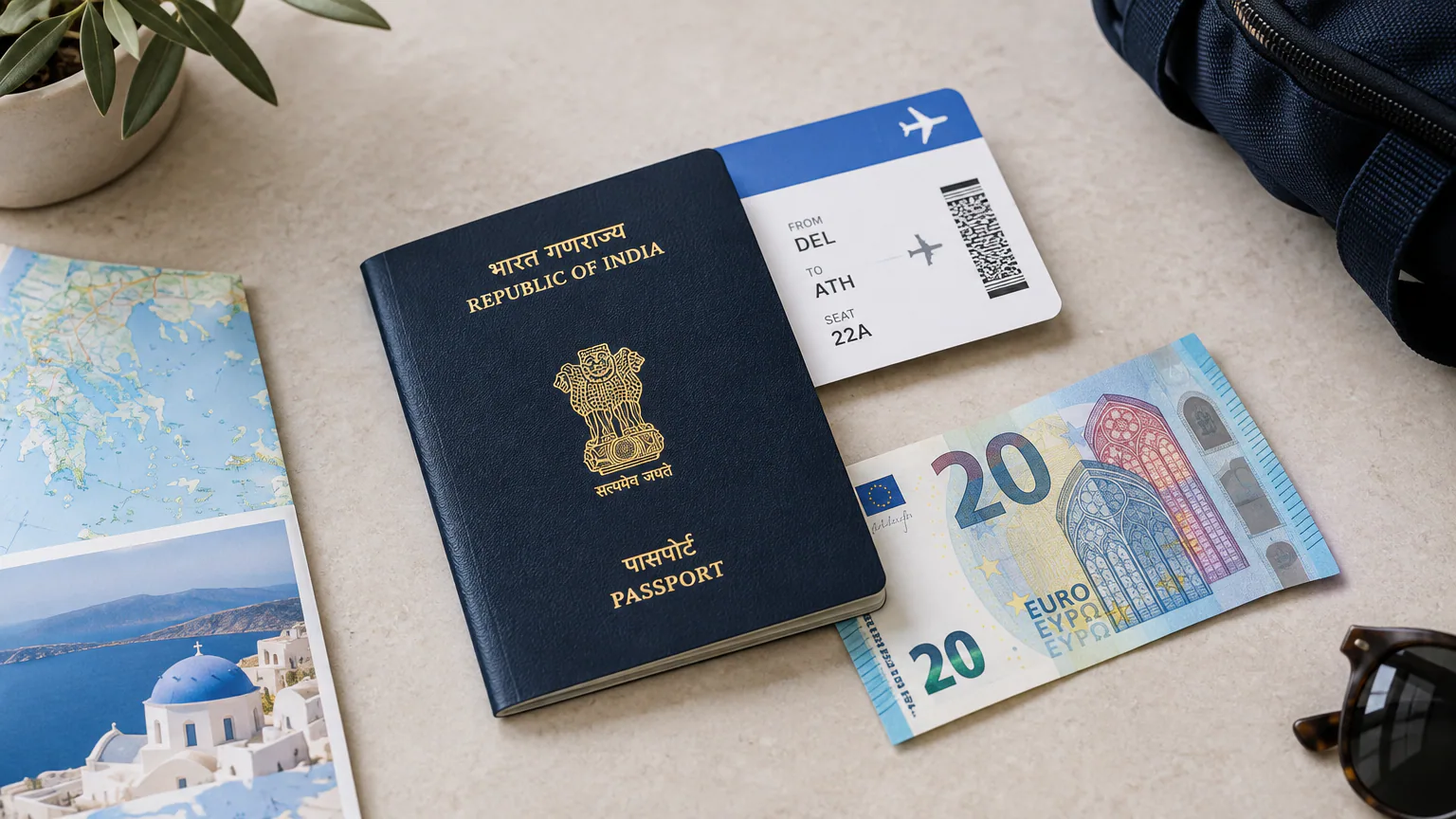
Indian citizens require a Schengen visa to travel to Greece. This is the most important planning step and should be completed before booking flights or accommodation.
The relevant visa for a tourist trip is a uniform Schengen visa, which permits stays of up to 90 days in any 180-day period, subject to the applicable rules. Visa issuance remains at the discretion of the Greek Embassy's Visa Section.
Visa applications for Greece from India are handled through the Greek visa-application process and the visa-application centres identified by the Greek Embassy in India. The Greek Embassy in India advises applicants to apply well in advance because applications peak from April through July.
The stated Schengen-visa processing time is up to 15 working days after an admissible application is received by the Greek Embassy. Delivery from India may add approximately 5 days from New Delhi or 6–8 days from elsewhere in India. Factor this total timeline into your planning.
The Greek Embassy's tourism-document checklist includes proof of accommodation for all cities visited and an employment letter stating position and salary. A Schengen visa application generally requires a completed and signed application form and a passport with at least two blank pages. Always check the current official checklist on the Greek Embassy India website before applying, as requirements can be updated.
- Visa type: Uniform Schengen visa (Type C, short-stay tourist)
- Permitted stay: Up to 90 days within any 180-day period
- Processing time: Up to 15 working days from receipt of admissible application, plus delivery time (approx. 5 days from New Delhi; 6–8 days from elsewhere in India)
- Peak application period: April to July — apply earlier than usual if travelling in summer
- Key documents: Completed signed application form; passport with at least two blank pages; proof of accommodation for all cities visited; employment letter stating position and salary; travel insurance; and other documents per the official checklist
- Apply through: Greek Embassy India visa-application centres
How to Reach Greece from India
There are currently no direct flights between India and Greece. All routes involve at least one connection. Athens International Airport Eleftherios Venizelos (ATH) is the primary international gateway.
Flights from India to Athens
Connecting flights operate from major Indian cities including Delhi (DEL), Mumbai (BOM), Bengaluru (BLR), and Chennai (MAA). Common one-stop routing hubs include Dubai (DXB), Doha (DOH), Istanbul (IST), Frankfurt (FRA), and Zurich (ZRH). Airlines frequently operating these routes include Emirates, Qatar Airways, Turkish Airlines, Lufthansa, and Swiss.
Total journey time including connection typically ranges from 10 to 15 hours depending on the hub and layover duration. Booking three to four months in advance generally yields better fares, particularly for peak-season travel between June and August.
Step-by-Step: Planning Your Trip from India to Greece
Follow these steps in order to avoid common planning mistakes:
- Apply for your Schengen visa first — before booking non-refundable flights. Gather all documents per the Greek Embassy checklist, including accommodation proof and employment letter. Allow for up to 15 working days processing plus delivery time.
- Book flights from your nearest Indian departure city to Athens (ATH). Compare one-stop options via Dubai, Doha, and Istanbul for the best combination of price and journey time.
- Book accommodation in advance, especially for Santorini and Mykonos in summer, where popular properties sell out months ahead.
- Plan island connections. Ferries from Piraeus port (Athens) connect to most major islands. High-speed ferries are faster; conventional ferries are slower but cheaper. Domestic flights are available for longer routes such as Athens to Crete or Rhodes.
- Purchase comprehensive travel insurance covering medical emergencies, trip cancellation, and lost luggage. Travel insurance is typically required as part of the Schengen visa application.
Greece Trip Cost from India: 2026 Budget Estimates (INR)
The table below shows indicative per-person costs for a 7-day trip to Greece from India in 2026, assuming double occupancy and round-trip flights from a major Indian city. These are approximate planning estimates only and do not represent actual Tripstor package prices. Actual costs vary significantly by booking time, season, and availability.
| Cost Category | Budget (INR) | Mid-Range (INR) | Luxury (INR) |
|---|---|---|---|
| Round-trip flights from India | 50,000 – 70,000 | 70,000 – 1,00,000 | 1,00,000 – 1,50,000+ |
| Accommodation (7 nights, per person sharing) | 20,000 – 35,000 | 35,000 – 70,000 | 70,000 – 1,50,000+ |
| Local transport and activities | 10,000 – 15,000 | 15,000 – 30,000 | 30,000 – 60,000+ |
| Food and drink | 10,000 – 15,000 | 15,000 – 25,000 | 25,000 – 50,000+ |
| Visa and travel insurance | 10,000 – 12,000 | 10,000 – 12,000 | 10,000 – 12,000 |
| Miscellaneous (shopping, tips, etc.) | 5,000 – 10,000 | 10,000 – 20,000 | 20,000 – 50,000+ |
| Total estimated cost per person (7 days) | 1,05,000 – 1,57,000 | 1,50,000 – 2,57,000 | 2,55,000 – 4,72,000+ |
Where to Stay in Greece: Neighbourhoods and Options
Greece offers accommodation across all price points, from budget hostels and family guesthouses to boutique hotels and luxury cliff-side villas. The right neighbourhood matters as much as the property itself. Indicative nightly rates below are for a standard double room in 2026 and are approximate only.
Athens: Where to Stay
Plaka is the historic neighbourhood at the foot of the Acropolis — ideal for first-time visitors who want to be close to the main archaeological sites, with charming streets and traditional tavernas.
Syntagma is the central business and transport hub, close to the Parliament building, upscale shopping on Ermou Street, and the metro network.
Koukaki is a more local, bohemian neighbourhood near the Acropolis Museum, popular with independent travellers for its cafes, restaurants, and generally better value than Plaka.
Budget option: Athens Backpackers (Plaka) — dorms and private rooms, lively communal atmosphere. Approx. INR 2,500–4,000 per night, room only.
Mid-range option: Electra Metropolis (Syntagma) — modern hotel with rooftop pool and Acropolis views. Approx. INR 10,000–18,000 per night, room only.
Luxury option: Hotel Grande Bretagne (Syntagma) — historic landmark hotel with opulent interiors and iconic city views. Approx. INR 30,000–60,000+ per night, room only.
Santorini: Where to Stay
Oia is the most photographed village on the island, famous for sunset views and luxury cave hotels carved into the caldera cliff. It is the most expensive area and books out earliest.
Fira is the island's capital, with a wider range of hotels, restaurants, and shops, plus good transport connections to the port and airport.
Perissa and Perivolos on the southeast coast offer black-sand beaches and a more relaxed, budget-friendlier atmosphere away from the caldera.
Budget option: Stelios Place (Perissa) — simple, clean rooms near the beach. Approx. INR 4,000–7,000 per night, room only.
Mid-range option: Aressana Spa Hotel and Suites (Fira) — stylish hotel with pool, close to Fira's centre. Approx. INR 18,000–35,000 per night, breakfast included.
Luxury option: Canaves Oia Epitome (Oia) — exclusive villas with private pools and caldera sunset views. Approx. INR 70,000–1,50,000+ per night, breakfast included.
Mykonos: Where to Stay
Mykonos Town (Chora) puts you in the heart of the island's nightlife, shopping, and dining, with the windmills and Little Venice a short walk away.
Platis Gialos and Ornos are popular beach areas with family-friendly resorts and good amenities, offering a balance of relaxation and easy access to the town.
Ano Mera is a quieter, more traditional inland village offering an authentic Mykonian experience at better value, though you will need transport to reach the beaches.
Budget option: Mykonos Beach Hotel (Mykonos Town) — simple rooms with sea views, short walk to town. Approx. INR 5,000–9,000 per night, room only.
Mid-range option: Petasos Beach Resort and Spa (Platis Gialos) — elegant hotel with sea views and good facilities. Approx. INR 15,000–30,000 per night, breakfast included.
Luxury option: Cavo Tagoo Mykonos (Mykonos Town) — iconic design hotel with infinity pools. Approx. INR 60,000–1,20,000+ per night, breakfast included.
Greek Food Guide for Indian Travellers
Greek cuisine is part of the Mediterranean diet, built around olive oil, fresh vegetables, legumes, seafood, and grilled meats. For Indian travellers, the key practical point is that vegetarian options are genuinely plentiful — not an afterthought. Many traditional Greek dishes are naturally meat-free.
Must-Try Greek Dishes
Moussaka: A baked dish with layers of sautéed aubergine (eggplant), minced meat (typically lamb or beef), and a creamy béchamel topping. Vegetarian versions using lentils or mixed vegetables are available in many restaurants.
Souvlaki: Grilled pieces of meat (pork, chicken, or lamb) on a skewer, served in pita bread with tomatoes, onions, and tzatziki. Vegetarian versions with halloumi cheese or grilled vegetables are widely available.
Tzatziki: A cooling dip of strained yogurt, cucumber, garlic, olive oil, and dill. Served as a starter or accompaniment — naturally vegetarian.
Greek Salad (Horiatiki): Fresh tomatoes, cucumber, red onion, Kalamata olives, green pepper, and a thick slice of feta cheese, dressed with olive oil and dried oregano. Naturally vegetarian and vegan if feta is omitted.
Spanakopita: Flaky phyllo pastry filled with spinach, feta cheese, onions, and herbs. A widely available and satisfying vegetarian option.
Gigantes Plaki: Large white beans baked in a tomato sauce with herbs — a hearty, naturally vegan dish found across Greece.
Fava: A smooth dip made from yellow split peas, drizzled with olive oil and lemon. A Santorini speciality and a naturally vegan starter.
Vegetarian and Vegan Options for Indian Travellers
Greece is genuinely vegetarian-friendly. Beyond the dishes listed above, look for dolmades (stuffed vine leaves — confirm whether made with meat or rice), ladera (vegetable dishes slow-cooked in olive oil), and horta (boiled wild greens with lemon and olive oil). Most tavernas can guide you through their vegetarian options.
One practical note: some dishes that appear vegetarian may use meat-based stock. It is worth asking, particularly for soups and stews. The phrase 'Eimai hortofagos' (I am vegetarian) is understood in most tourist areas. Dedicated vegan restaurants are found in Athens and on the larger islands.
Indian travellers will find that the emphasis on legumes, fresh produce, and olive oil in Greek cooking creates many naturally familiar flavour profiles, even if the spice levels are milder than Indian cuisine.
Restaurant Suggestions by Destination
Athens: Tzitzikas kai o Mermigas (near Syntagma) for traditional Greek dishes in a lively, colourful setting. Vegan Nation (Exarcheia) for dedicated plant-based options. Avli (Psirri) for an authentic taverna experience in a courtyard setting.
Santorini: Metaxi Mas (Exo Gonia) for authentic Cretan-Santorinian cuisine with panoramic views. PitoGyros Traditional Grill House (Oia) for excellent souvlaki and gyros. Floga (Oia) for fine dining with caldera views.
Mykonos: Kiki's Tavern (Agios Sostis) for grilled seafood in a rustic, no-reservations setting on a quiet beach. Avra Restaurant (Mykonos Town) for classic Greek dishes in a garden setting. Nice n Easy (Little Venice) for organic and health-conscious options with a sea view.
Practical Travel Tips for Indians Visiting Greece
The following tips address the most common practical questions from Indian travellers planning a first trip to Greece.
Currency, Cards, and Cash
Greece uses the Euro (€). Credit and debit cards (Visa and Mastercard) are widely accepted in cities, hotels, and tourist-area restaurants. However, carry some cash for smaller islands, village tavernas, ferry tickets purchased at the port, and small purchases at markets.
ATMs are available at airports, city centres, and most island towns. Inform your Indian bank of your travel dates before departure to prevent your card being blocked for overseas transactions. Multi-currency travel cards can offer better exchange rates than airport currency counters.
SIM Cards and eSIM Connectivity
Staying connected in Greece is straightforward. Local SIM cards from providers including Cosmote, Vodafone Greece, and Wind are available at the airport and in city-centre shops. Ensure your phone is unlocked before travelling.
eSIM options are increasingly practical for Indian travellers: you can activate a Greek or EU data plan digitally before departure, giving you connectivity from the moment you land. Check whether your handset supports eSIM before relying on this option.
Getting Around Greece: Cities and Islands
Athens: The metro system is efficient and connects the airport, central Athens, and the port of Piraeus. Taxis and ride-hailing apps are also available. Walking is the best way to explore Plaka and the area around the Acropolis.
Between islands: Ferries are the primary mode of inter-island travel. High-speed ferries connect major islands quickly; conventional ferries are slower but cheaper. Piraeus is the main ferry hub for the Cyclades and Crete. Domestic flights are available for longer routes, such as Athens to Rhodes or Heraklion (Crete). Book ferry tickets in advance during peak season.
On islands: Renting a car, scooter, or ATV is the most flexible way to explore. Local buses connect main towns and popular beaches on larger islands. Walking is often the best option in old towns and village centres.
Safety, Etiquette, and Local Customs
Greece is generally a safe destination for tourists, including solo female travellers. Major tourist areas are well-policed. Standard precautions apply: be aware of your belongings in crowded areas such as Athens city centre and busy ferry terminals, where pickpocketing can occur.
When visiting churches, monasteries (including Meteora), and other religious sites, dress modestly: covered shoulders and knees are required. Some sites provide wraps at the entrance.
Tipping is customary but not mandatory. Rounding up the bill or leaving 5–10% in restaurants is appreciated. The Greek people are known for their hospitality (philoxenia). A simple 'Kalimera' (good morning) or 'Efharisto' (thank you) is always well received.
Solo female travellers, including Indian women, generally report Greece as a comfortable destination. Stick to well-lit, populated areas at night and use standard travel awareness in any unfamiliar city.
What to Pack for a Greece Trip
Packing for Greece depends on your travel months and itinerary mix of cities, ruins, and beaches.
- Light, breathable clothing (linen and cotton) for summer; add a light jacket or cardigan for spring and autumn evenings
- Comfortable walking shoes with grip for cobblestone streets and archaeological sites
- Swimwear and a beach cover-up
- High-SPF sunscreen, a wide-brimmed hat, and UV-protection sunglasses
- Modest clothing (covered shoulders and knees) for visiting churches and monasteries
- Travel adapter: Greece uses Type C and Type F plugs (230V, 50Hz)
- Any prescription medications with a copy of the prescription
- Portable power bank for long sightseeing days
- Reusable water bottle — tap water is drinkable in most of mainland Greece and many islands
Greece vs. Italy: Which Should Indian Travellers Choose?
Both Greece and Italy are popular European choices for Indian travellers and both require a Schengen visa. The right choice depends on what you prioritise.
Choose Greece if: You want ancient Greek and Byzantine history, island hopping in the Cyclades or Ionian islands, a more relaxed Mediterranean pace, volcanic and coastal scenery (Santorini, Zakynthos), and a destination that works well as a honeymoon or beach-focused trip.
Choose Italy if: You want a broader historical sweep covering Roman, Renaissance, and Baroque periods; iconic cities such as Rome, Florence, and Venice; diverse regional landscapes from the Dolomites to the Amalfi Coast; and globally renowned regional cuisines across multiple distinct culinary traditions.
In terms of pace, Greece — particularly on the islands — tends to be more relaxed. Italy offers more variety in urban experiences and cultural depth across its regions. Both are excellent choices; many Indian travellers combine both on a longer Europe trip.
- Primary appeal
- Greece: ancient ruins, island scenery, beaches | Italy: art cities, diverse regions, cuisine
- Best for
- Greece: honeymoons, island hopping, history | Italy: art, food, city breaks
- Visa
- Both require a Schengen visa for Indian citizens
- Pace
- Greece: relaxed, especially on islands | Italy: busier, more urban variety
- Vegetarian food
- Both offer good vegetarian options; Greek cuisine has more naturally meat-free traditional dishes
How Many Days Do You Need for Greece?
A 7-to-10-day trip is sufficient to cover Athens and two islands at a comfortable pace. A 12-to-14-day itinerary allows for three or four islands, a mainland excursion to Delphi or Meteora, and a less rushed experience overall.
A practical 10-day structure for first-time Indian visitors: 2 days in Athens (Acropolis, Acropolis Museum, Plaka, National Archaeological Museum); 1 day for a day trip to Delphi or Cape Sounion; 3 days in Santorini; 3 days in Mykonos or Crete; 1 day buffer for ferry connections and departure.
If your priority is beaches and relaxation, concentrate on two islands. If history is the main draw, add Delphi, Meteora, or the Peloponnese (Nafplio, Mycenae, Epidaurus) to your mainland time.
Good questions. Clearer plans.
Do Indian citizens need a visa to visit Greece?
Yes. Indian citizens require a Schengen visa to travel to Greece. The relevant visa for a tourist trip is a uniform Schengen visa, which permits stays of up to 90 days in any 180-day period. Applications are submitted through the Greek Embassy in India and its designated visa-application centres. Processing takes up to 15 working days from receipt of an admissible application, plus delivery time (approximately 5 days from New Delhi; 6–8 days from elsewhere in India). Apply well in advance, especially if travelling between April and July when applications peak. Visa issuance is at the discretion of the Greek Embassy's Visa Section.
What is the best time to visit Greece from India?
April–May and September–October are the best months for most Indian travellers. These shoulder seasons offer pleasant temperatures, manageable crowds, and lower prices than peak summer. Greece has a warm Mediterranean climate with sea-and-sun conditions extending from early spring through late autumn. July and August are the hottest and most crowded months — ideal for beach holidays but expensive and busy. Winter (November–February) is quiet and suits Athens city breaks.
How much does a Greece trip from India cost in 2026?
Indicative per-person costs for a 7-day trip (double occupancy, round-trip flights from India) are approximately INR 1,05,000–1,57,000 for budget travel, INR 1,50,000–2,57,000 for mid-range, and INR 2,55,000–4,72,000+ for luxury. These are planning estimates only; actual costs vary by booking time, season, and availability. Travelling in shoulder season (April–May or September–October) and choosing less-visited islands can reduce costs significantly.
How many days should I plan for a Greece trip from India?
A 7-to-10-day trip covers Athens and two islands at a comfortable pace. For a more complete experience — including a mainland excursion to Delphi or Meteora and three or four islands — plan 12 to 14 days. A 10-day itinerary is the most popular choice for first-time Indian visitors: 2–3 days in Athens, 3 days in Santorini, and 3 days in Mykonos or Crete, with one day as a travel buffer.
How do I travel between Greek islands?
Ferries are the primary way to travel between Greek islands. High-speed ferries connect major islands quickly; conventional ferries are slower but cheaper. Piraeus port in Athens is the main hub for the Cyclades and Crete. Domestic flights are available for longer routes, such as Athens to Rhodes or Heraklion. Book ferry tickets in advance during peak season (June–August), as popular routes sell out.
Is Greece safe for Indian solo female travellers?
Greece is generally considered safe for solo female travellers, including Indian women. Major tourist areas are well-policed and locals are typically helpful. Standard precautions apply: stay in well-lit, populated areas at night, be aware of your belongings in crowded spots, and use reliable transport. Public transport is reliable and many women travel solo in Greece without issues.
What are the best Greek islands for Indian families?
Crete is the top choice for Indian families, offering a mix of beaches, historical sites (Knossos), and varied activities. Rhodes has a medieval Old Town and family-friendly beach resorts. Naxos and Paros in the Cyclades offer beautiful beaches and a more relaxed atmosphere than Mykonos or Santorini, making them well suited to families with children. Corfu in the Ionian Sea is another good option with lush scenery and calm beaches.
Is Greek food suitable for Indian vegetarians?
Yes. Greek cuisine includes many naturally vegetarian dishes: Greek salad, spanakopita (spinach and feta pastry), gigantes plaki (baked beans), fava (split pea dip), dolmades (stuffed vine leaves — confirm rice-only version), and various vegetable stews (ladera). Most tavernas can accommodate vegetarian requests. Some dishes may use meat-based stock, so it is worth asking. Dedicated vegan restaurants are available in Athens and on larger islands.
Can I find Indian food in Greece?
Indian restaurants are available in Athens and on popular islands such as Mykonos and Santorini, catering to the growing number of Indian tourists and expatriates. Options typically include North and South Indian dishes. Outside major tourist centres, Indian restaurants are rare, so it is worth identifying options in advance if this is important to you.
What should I pack for a trip to Greece?
Pack light, breathable clothing (linen or cotton) for summer; add a light jacket for spring and autumn evenings. Bring comfortable walking shoes for cobblestone streets and archaeological sites, swimwear, high-SPF sunscreen, a hat, and sunglasses. Include modest clothing (covered shoulders and knees) for visiting churches and monasteries. Greece uses Type C and Type F plugs (230V), so bring a travel adapter. Carry any prescription medications with a copy of the prescription.
Keep exploring
A little inspiration for your journey
Practical reads for this destination — timing, places, costs and tips before you plan.
 Travel journalGreece Visa for Indians 2026: Complete Requirements & Application Guide
Indian citizens need a Schengen visa to visit Greece in 2026. The visa permits stays of up to 90 days within any 180-day period and covers travel across the entire…
Read the guide- Travel journalGreece Travel Guide for Indians: Complete 2026 Planning Resource
Greece offers Indian travellers a rare combination: UNESCO-listed ancient ruins, volcanic island landscapes, a Mediterranean coastline, and one of the world's most celebrated cuisines — all reachable via connecting flights…
Read the guide
A little inspiration.
A holiday made yours.
Share your dates and departure city — a travel expert replies with ideas within 24 hours.
Plan my holidayLet’s make it personal.
Tell us about your dates, departure city and the moments you’d love to include.
What happens next?
Discuss your preferences, review a tailored proposal and refine the details before you decide.