
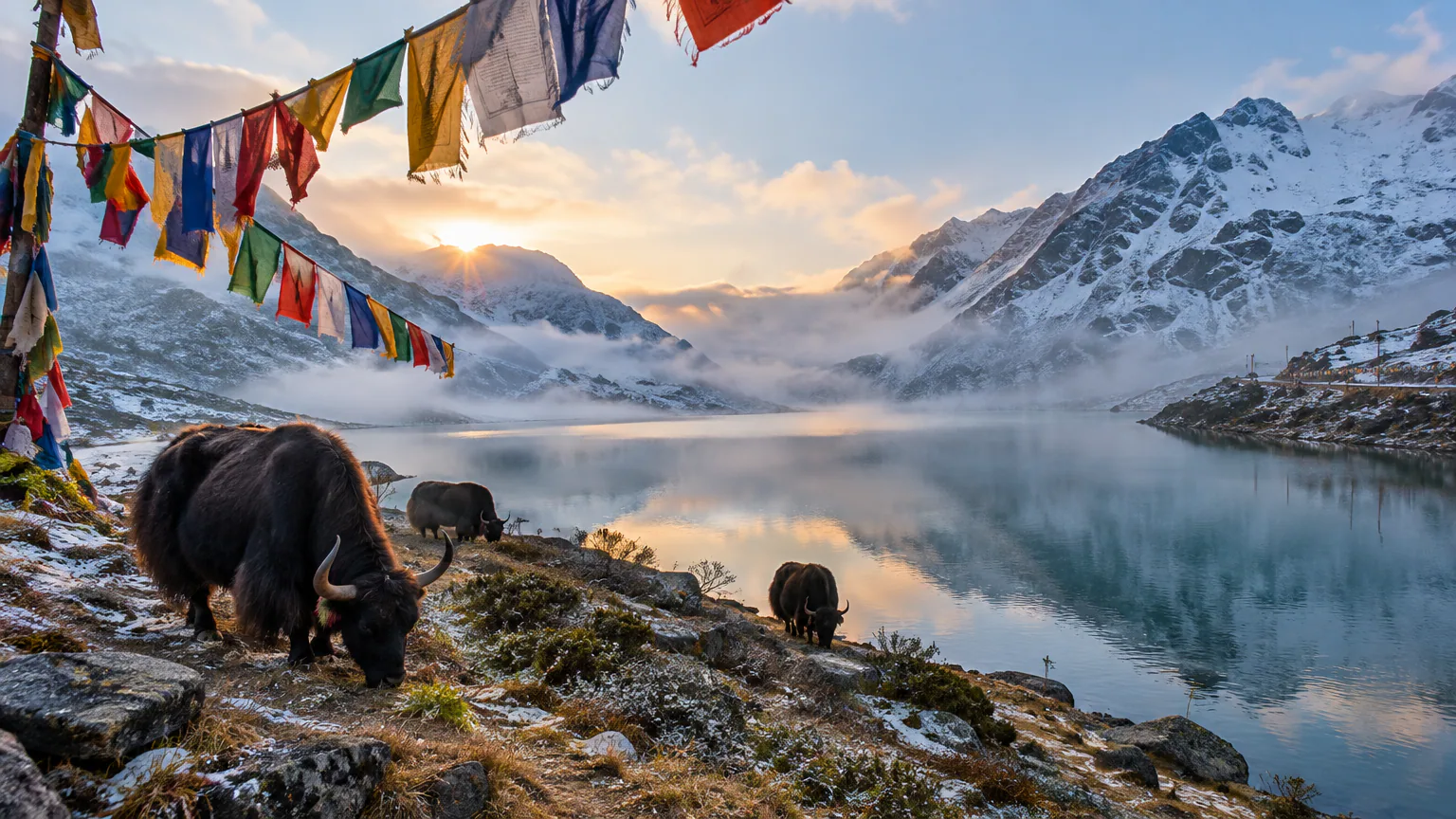
What Actually Changes a Sikkim Trip
Permits, road distances and altitude shape every Sikkim itinerary more than hotel choice does. Protected-area permits for Tsomgo Lake, Baba Mandir, Nathula and North Sikkim are not optional, and Gangtok sits roughly 4.5 to 6 hours by road from Bagdogra, so travel days must be planned around transfers.
At a glance
Sikkim, in brief
Sikkim uses the Indian rupee, Hindi, English and Nepali are widely understood, and Indian mobile numbers work across Gangtok and most tourist towns. Power plugs are Indian standard. The main practical essentials are a government photo ID, protected-area permits for border zones, and cash for smaller towns.
Sikkim.
Planned around you.
- Currency
- Indian Rupee (INR)Cards work in Gangtok hotels; carry cash for smaller towns and shared jeeps.
- Languages
- Nepali, Bhutia, Lepcha, Hindi, EnglishHindi and English are widely understood in tourist areas.
- Plug type
- Indian standard (Type C, D, M)230V, 50Hz. Carry a universal adapter if your devices use other plugs.
- SIM / eSIM
- Indian mobile numbers work in Gangtok and most tourist townsPrepaid Indian SIMs work across Sikkim; connectivity can drop in remote valleys.
- Time difference
- IST (UTC+5:30)No time change within India.
- Emergency number
- 112Single emergency number for police, fire and ambulance across India.
Before You Go to Sikkim
Book permits before you reach Gangtok, confirm your Bagdogra transfer in writing, and carry printed copies of every document. The most common mistake is arriving without the passport-size photographs and photocopies that permit offices require, which delays or blocks Tsomgo and North Sikkim excursions.
Government photo ID
Original plus at least four photocopies for permits, hotel check-in and police checks.
Where to get it: Any government office or your existing documentsCommon mistake: Carrying only a digital copy; permit offices need physical photocopies.
Passport-size photographs
Carry at least six printed copies for permit applications.
Where to get it: Any photo studio or print shop before departureCommon mistake: Assuming the permit office will take photos on the spot.
Protected-area permits
Arrange for Tsomgo Lake, Baba Mandir, Nathula, North Sikkim and selected Silk Route areas through a registered operator or designated police and tourism office.
Where to get it: Registered tour operator or designated police and tourism officesCommon mistake: Leaving permit arrangement to the morning of the excursion.
Bagdogra-Gangtok transfer booking
Confirm shared jeep or private SUV in advance. Shared vehicles are about INR 700-1,200 per person; private SUV about INR 4,500-7,500 per vehicle.
Where to get it: Registered operator or hotel conciergeCommon mistake: Arriving at Bagdogra without a confirmed transfer during peak season.
Travel insurance
Choose a policy that covers high-altitude road travel and trip interruption.
Where to get it: Any Indian travel insurance providerCommon mistake: Assuming standard policies cover high-altitude driving.
Forex and cards
Carry INR cash for shared jeeps, small cafes and remote homestays. Cards work in Gangtok hotels.
Where to get it: ATM or bank before departureCommon mistake: Relying only on cards in smaller towns.
Useful apps
Download offline maps, your airline app and a weather app before leaving.
Where to get it: App storeCommon mistake: Assuming reliable data in remote valleys.
Money and Payments in Sikkim
Cash is essential in Sikkim for shared jeeps, small cafes and remote homestays, while cards work in Gangtok hotels and larger restaurants. ATMs exist in Gangtok and district towns but can run dry or go offline in remote areas, so withdraw before heading to North or West Sikkim.
- Carry cash for shared jeeps
Shared vehicles and local taxis generally prefer cash. Keep small denominations for the Bagdogra-Gangtok route and local sightseeing.
Money - UPI works in Gangtok
UPI is widely accepted in Gangtok shops, restaurants and hotels. Smaller towns and villages may accept only cash.
Money - Withdraw before remote travel
ATMs exist in Gangtok and district towns but can be unreliable in remote areas. Withdraw enough cash before heading to Lachung, Yumthang or Yuksom.
Money - Download offline maps
Connectivity can drop in deep valleys and on high-altitude routes. Download offline maps and save your operator's number before leaving Gangtok.
Connectivity - Indian SIMs work across Sikkim
Prepaid Indian mobile numbers work in Gangtok and most tourist towns. Expect slower data in remote valleys.
Connectivity
Cultural Tips for Sikkim
Sikkim's monasteries and local communities expect modest dress and quiet behaviour. Remove shoes before entering monastery halls, walk clockwise around stupas and prayer wheels, and ask before photographing monks or locals. Tipping is not mandatory but is appreciated for drivers and guides.
- Dress modestly at monasteries
Cover shoulders and knees. Remove shoes before entering monastery halls. Some monasteries prohibit photography inside the main hall.
Etiquette - Walk clockwise around stupas
At stupas and prayer wheels, walk clockwise. Do not touch religious objects without permission.
Etiquette - Ask before photographing people
Ask before photographing monks, locals or religious ceremonies. Respect a refusal.
Etiquette - Tipping is appreciated
Tipping is not mandatory but is customary for drivers, guides and hotel staff. A small tip for good service is appropriate.
Etiquette - Agree on taxi fares first
Bargaining is not common in shops or for taxi fares. Agree on the fare before starting the journey.
Etiquette
Food Tips for Sikkim
Sikkim's food is Nepali and Tibetan at its core: momos, thukpa, gundruk and phagshapa appear on most menus. Vegetarian food is widely available, and Gangtok has Indian restaurants serving rotis, dal and rice. Eat cooked food at busy places and drink boiled or bottled water in remote areas.
- Across Sikkim
Momos
Steamed dumplings with vegetable or meat fillings, served with a spicy chutney. A staple snack and meal across Gangtok and district towns.
Best forQuick meals, snacks
Try them at busy local eateries where they are steamed fresh.
- Across Sikkim
Thukpa
A noodle soup with vegetables or meat, common in Gangtok and colder regions. Warming and filling for high-altitude days.
Best forLunch, cold-weather meals
Ask for less chilli if you prefer mild food.
- Across Sikkim
Gundruk
Fermented leafy greens, often served as a soup or side dish. A traditional Nepali preparation with a distinct tangy flavour.
Best forVegetarian travellers, local cuisine
Pair with rice for a simple local meal.
- Across Sikkim
Phagshapa
Strips of pork cooked with radish and dried chillies, a Nepali speciality. Found in local restaurants in Gangtok and district towns.
Best forNon-vegetarian travellers
Ask for it at Nepali restaurants rather than multi-cuisine places.
- Across Sikkim
Sel roti
A ring-shaped rice-flour bread, often sweet and served during festivals or as a snack. Available at local bakeries and street stalls.
Best forSnacks, breakfast
Best eaten fresh and warm.
- Gangtok
Indian vegetarian restaurants in Gangtok
Gangtok has Indian restaurants serving rotis, dal, rice and thalis. Vegetarian food is widely available in the capital.
Best forVegetarian travellers, Indian food
Ask your hotel for recommendations if you need Jain or pure vegetarian food.
Safety in Sikkim
Sikkim is generally safe for Indian tourists on standard circuits, but high-altitude routes, monsoon landslides and permit checks require preparation. Acclimatise before Nathula and North Sikkim, check weather forecasts before road travel, and carry your permit documents at all checkpoints.
- Altitude sickness on high-altitude routes
How to avoid itAscend gradually, stay hydrated, avoid alcohol on the first day at altitude. If symptoms worsen, descend and seek medical help.
- Monsoon landslides blocking roads
How to avoid itCheck local weather and road status before travelling between June and September. Keep buffer days in your itinerary.
- Permit checks on border routes
How to avoid itCarry original ID, permit copies and passport-size photographs at all times. Do not enter restricted areas without a valid permit.
- Unreliable ATMs in remote areas
How to avoid itWithdraw enough cash in Gangtok before travelling to Lachung, Yumthang, Yuksom or remote West Sikkim.
- Patchy mobile connectivity in valleys
How to avoid itDownload offline maps and save your operator's number before leaving Gangtok. Inform someone of your route.
Packing by Season for Sikkim
Sikkim packing changes sharply by season: layers and a windproof jacket for spring and autumn, rain gear and quick-dry clothing for monsoon, and heavy insulation for winter. Comfortable walking shoes, a reusable water bottle and printed documents are useful year-round.
Spring (March to May)
Light layers, a fleece, a windproof jacket, comfortable walking shoes, sunscreen and a hat. April and May bring flowers and spring landscapes.
Where to get it: Pack at homeCommon mistake: Packing only summer clothing; mornings and evenings can be cold.
Autumn (October to mid-December)
Warm layers, a fleece or light down jacket, a windproof outer layer, gloves and a hat for high-altitude excursions. October and November are especially reliable for clear skies.
Where to get it: Pack at homeCommon mistake: Underestimating cold mornings at Nathula and North Sikkim.
Monsoon (June to September)
Rain jacket, quick-dry clothing, waterproof footwear, a dry bag for electronics and insect repellent. Landslide risk is higher.
Where to get it: Pack at homeCommon mistake: Bringing only cotton clothing that stays wet.
Winter (December to February)
Heavy insulation, thermal innerwear, a down jacket, gloves, a woollen cap, warm socks and waterproof boots. North Sikkim is especially cold.
Where to get it: Pack at homeCommon mistake: Assuming Gangtok temperatures apply to Lachung and Yumthang.
Documents and photocopies
Government photo ID, permit copies, passport-size photographs and hotel confirmations in a waterproof pouch.
Where to get it: Print before departureCommon mistake: Carrying only digital copies; permit offices need physical photocopies.
Reusable water bottle
Some protected areas discourage plastic bottles. Carry a reusable bottle and refill where safe drinking water is available.
Where to get it: Pack at homeCommon mistake: Relying on buying bottled water in remote areas.
Holiday ideas to start from
Reviewed itineraries for this destination — personalise with a specialist, never an instant booking.
Pelling Romantic Stay Premium 4 Nights: Sikkim Honeymoon Package 2026
From₹36,700per adult, twin sharing, land only
From idea to itinerary, with a real person.
- Share your plan
Dates, departure city, travellers and the moments you’d love. It only takes a minute.
- Shape it with a specialist
A real person refines the route, stays and pace with you. Change anything.
- Review your quote
A clear, personalised quote with confirmed inclusions. No payment to enquire.
From our travel specialists
What our team sees when planning these trips, beyond what the guidebooks say.
Confirmed 11 Oct 2026
- Practical
Local transport and road delays catch travellers out most often: journeys such as Gangtok–Pelling and Gangtok–Lachung can take much longer than map estimates because of mountain roads and checkpoints. Shared vehicles, permits and operator-arranged transfers also make independent point-to-point travel less straightforward than expected.[6][8]
Travellers commonly wish they had understood how long mountain-road journeys take, especially Gangtok–Lachung and Gangtok–Pelling, and that weather can change plans. They also advise checking permits for Nathu La and North Sikkim in advance and carrying ID copies and passport photos for every traveller, including children.[6][8]
Before you go
Straight answers to help you plan — then personalise the trip with a specialist.
8 answered belowAsk a specialist anything about this trip — there’s no obligation.
Ask a specialistWhat is the best time to visit Sikkim?
October to mid-December and March to May are generally best for clear views, comfortable temperatures and sightseeing. October and November are especially reliable for clear skies, while April and May are strong choices for flowers and spring landscapes. Monsoon runs roughly June to September with higher landslide risk.
How many days are enough for a Sikkim trip?
Five to seven days covers Gangtok plus one western or northern circuit. Ten days allows a slower multi-region itinerary including Pelling, Yuksom, Lachung and Yumthang. Add a buffer day if your plan includes Nathula or North Sikkim, because road and weather conditions can change.
What is the average cost of a Sikkim tour package?
Indicative land-only twin-sharing packages range from about INR 18,000 per person for budget trips to INR 50,000 or more for premium programs. A typical 5- to 7-night land package costs approximately INR 18,000-50,000 per person on twin sharing, excluding flights. These are planning ranges, not confirmed Tripstor offers.
Is a permit required to visit Sikkim?
Indian citizens need no visa, but permits are required for protected and border areas such as Tsomgo Lake, Baba Mandir, Nathula, North Sikkim and selected Silk Route areas. Domestic-tourist permits are generally arranged through registered operators or issued through designated police and tourism offices. Carry photocopies and passport-size photographs.
How do I reach Sikkim by flight?
Fly to Pakyong when suitable services operate; Bagdogra is the main practical gateway, followed by a road transfer to Gangtok that generally takes 4.5 to 6 hours. Direct Delhi-Bagdogra services are commonly available. Kolkata-Bagdogra is about 1.25 hours by air. Mumbai, Chennai, Bengaluru, Hyderabad, Pune and Ahmedabad usually connect through Delhi or Kolkata.
Which places are best to visit in Sikkim?
Gangtok, Tsomgo Lake, Nathula, Pelling, Yuksom, Lachung-Yumthang and Ravangla are the main package destinations. Gangtok is the usual base for East Sikkim excursions. Pelling, Yuksom and Ravangla anchor the west and south. Lachung and Yumthang sit in North Sikkim and need a separate permit and an overnight stay.
Is Sikkim safe for family travel?
Yes for standard circuits with sensible acclimatisation and road planning, though high-altitude routes and monsoon travel require flexibility. Sikkim is generally safe for Indian tourists on standard circuits. Check current conditions before you travel, carry permit documents at checkpoints, and keep buffer days for weather delays.
Is Sikkim better than Darjeeling?
Sikkim is better for high-altitude scenery, monasteries and protected-area excursions; Darjeeling is easier for shorter, simpler hill holidays. Sikkim requires permits for border areas and involves longer road transfers. Choose Sikkim if you want Nathula, Tsomgo Lake and North Sikkim; choose Darjeeling for a quicker hill break.