
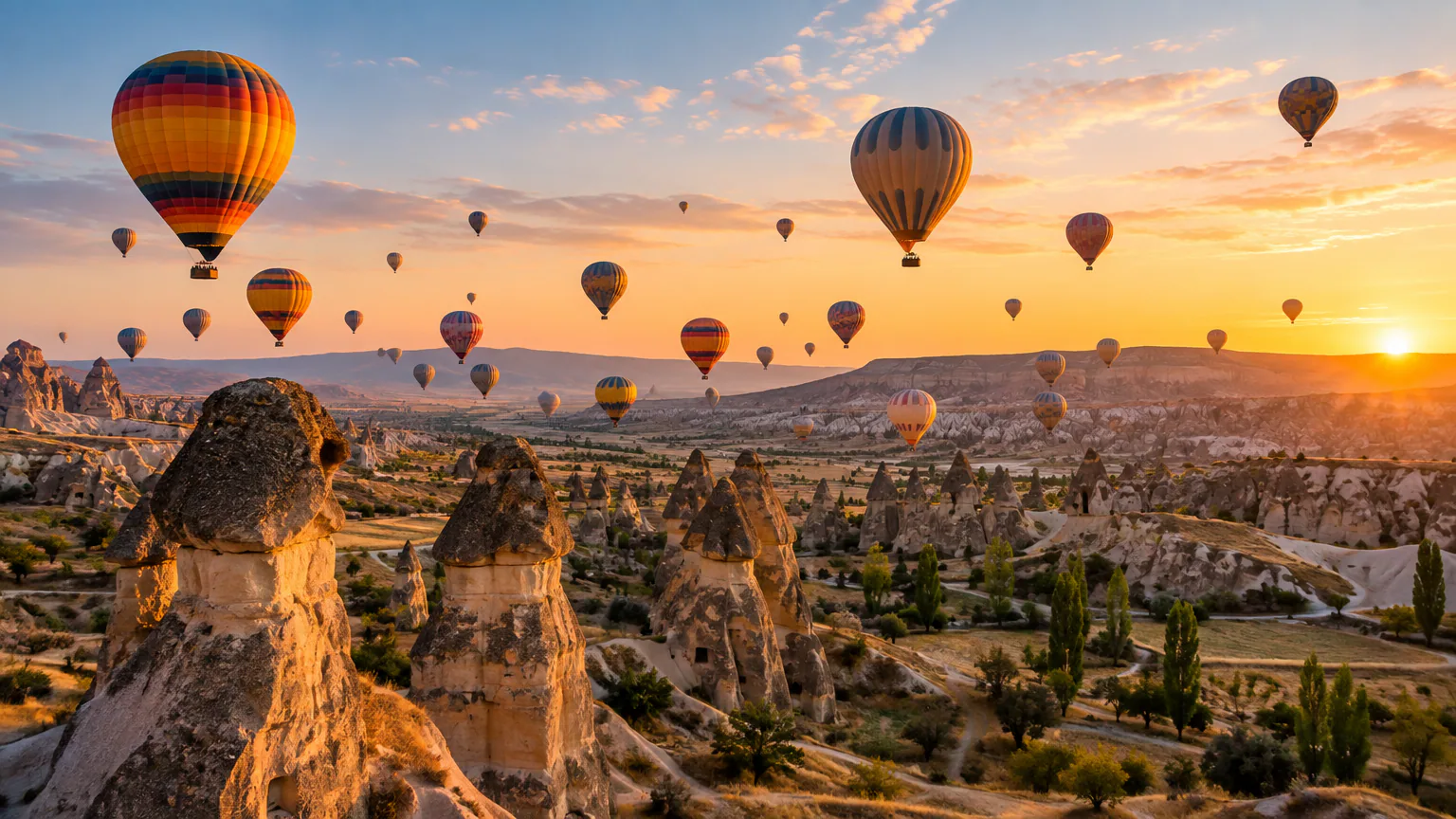
How Many Places Can You Cover?
A first trip to Turkey usually covers three to five must-see places, with Istanbul, Cappadocia and Pamukkale as the top three. The main areas are the Marmara region around Istanbul, the Central Anatolia region for Cappadocia, the Aegean coast for Ephesus and Pamukkale, and the Mediterranean coast for Antalya.
For a seven-day trip, most itineraries focus on Istanbul, Cappadocia and one additional region. A 10–14 day trip allows a more balanced route covering Istanbul, Cappadocia, Pamukkale, Ephesus and the Antalya or Aegean coast. The distances between these regions are significant, so domestic flights are commonly used to save travel time.
At a glance
Turkey, in brief
Turkey's must-see places are Istanbul, Cappadocia, Pamukkale, Ephesus and Antalya. An ideal first trip runs 7–14 days, with Istanbul as the best base for arrival and departure. The best season is April–May or September–October, and typical entry fees for major sites range from free to around 1,500 Turkish lira.
Turkey.
7–14 days
- Must-see places
- Istanbul, Cappadocia, Pamukkale, Ephesus, Antalya
- Ideal days
- 7–14 days7 days covers Istanbul, Cappadocia and one more region; 10–14 days allows a balanced route
- Best base
- IstanbulMain international gateway with the widest range of hotels and domestic flight connections
- Best season
- April–May and September–OctoberComfortable sightseeing weather; July–August suit beach holidays but are hotter and busier
- Typical entry fee range
- Free to about 1,500 Turkish liraIndicative 2026 planning range per person for major sites; some mosques are free, while sites like Ephesus and Pamukkale charge entry
- Visa snapshot
- Visa required for Indian passport holdersSome Indian ordinary, special and service passport holders may qualify for a single-entry e-Visa if they meet supporting-visa or residence-permit conditions
Top Places in Turkey
The top places in Turkey combine Ottoman and Roman heritage with distinctive landscapes. Istanbul, Cappadocia, Pamukkale, Ephesus and Antalya form the core first-trip route, while Bodrum and Ankara add coastal leisure or museum depth. Each place needs at least one full day, and Cappadocia ideally two.
- Sultanahmet, Istanbul
Hagia Sophia
A 6th-century basilica that later became a mosque and now functions as a mosque with visitor access. Its large dome and mosaics reflect Byzantine and Ottoman layers.
Best forHistory and architecture
Visit early morning to avoid queues; dress modestly and cover your head if you are a woman. Entry is free for worshippers and visitors outside prayer times.
- Sultanahmet, Istanbul
Topkapı Palace
The primary residence of Ottoman sultans for nearly 400 years, with courtyards, the Harem and views over the Bosphorus.
Best forOttoman history and palace collections
Buy the Harem ticket as an add-on; allow at least three hours. Closed on Tuesdays.
- Sultanahmet, Istanbul
Blue Mosque (Sultan Ahmed Mosque)
An early 17th-century mosque known for its hand-painted blue Iznik tiles and six minarets. It remains an active place of worship.
Best forIslamic architecture and photography
Enter through the visitor entrance outside prayer times; women must cover their heads and everyone should wear modest clothing. Free entry.
- Göreme, Cappadocia
Göreme Open Air Museum
A UNESCO World Heritage site with rock-cut churches and monasteries dating from the 10th–12th centuries, featuring well-preserved frescoes.
Best forByzantine art and cave architecture
Go early to avoid tour groups; the Dark Church requires an extra ticket. Wear comfortable shoes for uneven paths.
- Derinkuyu, Cappadocia
Derinkuyu Underground City
An ancient multi-level underground city that could shelter thousands of people, with tunnels, storage rooms and chapels.
Best forUnique underground history
Not suitable for claustrophobic travellers; some passages are low and narrow. Visit with a guide to understand the layout.
- Pamukkale, Denizli
Pamukkale Travertine Terraces
White calcium terraces formed by mineral-rich springs, a UNESCO World Heritage site alongside the ancient city of Hierapolis.
Best forNatural landscapes and photography
Visit early or late in the day; use the upper entrance to walk down. Shoes are not allowed on the terraces to protect the surface.
- Pamukkale, Denizli
Hierapolis Ancient City
A Greco-Roman city with a theatre, necropolis and the Cleopatra Antique Pool, located above the travertine terraces.
Best forRoman ruins and hot springs
Combine with Pamukkale on the same ticket; allow two to three hours. The antique pool has a separate entry fee.
- Selçuk, İzmir
Ephesus Ancient City
One of the best-preserved Roman cities in the eastern Mediterranean, with the Library of Celsus, Curetes Street and the Terrace Houses.
Best forRoman archaeology
Stay in Selçuk rather than doing a rushed day trip from Istanbul. Enter early; the Terrace Houses need an additional ticket.
- Ephesus, Selçuk
Library of Celsus
A reconstructed facade of a Roman library built in 114 AD, one of the most photographed structures in Ephesus.
Best forIconic ancient architecture
Visit before 10 am for fewer crowds and better light. The facade is at the end of Curetes Street.
- Antalya
Kaleiçi Old Town
A historic quarter with narrow streets, Ottoman houses, a Roman harbour and Hadrian's Gate.
Best forOld-town atmosphere and dining
Wander on foot in the late afternoon; many boutique hotels are inside Kaleiçi. The harbour is good for a sunset walk.
- Antalya
Düden Waterfalls
A series of waterfalls on the Düden River, with the lower falls dropping directly into the Mediterranean.
Best forNature and family outings
The lower falls are best seen from a boat; the upper falls have a park and picnic area. Visit in spring for stronger flow.
- Bodrum
Bodrum Castle
A 15th-century castle built by the Knights of St John, now housing the Museum of Underwater Archaeology.
Best forCastle views and maritime history
Allow two hours; the castle offers views over the marina. Entry fee applies.
- Ankara
Museum of Anatolian Civilizations
Houses a rich collection of artefacts from Anatolian civilisations, including Hittite and Urartian pieces.
Best forMuseum lovers and history buffs
Closed on Mondays; allow two to three hours. It is a good indoor option in winter.
- Ankara
Anıtkabir
The mausoleum of Mustafa Kemal Atatürk, a large complex with a ceremonial plaza and museum.
Best forModern Turkish history
Free entry; expect security checks. Visit in the morning to avoid crowds.
- Istanbul
Bosphorus Strait
The waterway separating Europe and Asia, lined with palaces, fortresses and waterfront mansions.
Best forScenic cruises and city views
Take a public ferry rather than a private tour for a cheaper experience; the sunset timing is popular.
Underrated Places in Turkey Most Tourists Miss
Beyond the main circuit, Turkey has lesser-known places that reward travellers with extra time. Aphrodisias, Mount Nemrut, the Lycian Way, Şanlıurfa and Amasya offer archaeology, hiking and history without the peak-season crowds of Istanbul or Cappadocia.
- Aydın Province
Aphrodisias
A well-preserved ancient city dedicated to Aphrodite, with a stadium, theatre and temple. It is a UNESCO World Heritage site.
Best forArchaeology without crowds
It is quieter than Ephesus; combine with Pamukkale if you have a car. Allow two hours.
- Adıyaman Province
Mount Nemrut
A UNESCO World Heritage site at over 2,000 metres, known for the colossal stone heads of gods commissioned by King Antiochus I.
Best forSunrise views and ancient statues
Best at sunrise or sunset; the access road may be closed in winter. Check local conditions before going.
- Antalya to Fethiye
Lycian Way
A long-distance walking trail along the Turquoise Coast, passing ancient ruins and remote villages.
Best forHiking and coastal scenery
Do a day section rather than the full route; carry water and start early. Spring and autumn are best.
- Southeastern Anatolia
Şanlıurfa
A city with biblical associations, including the Pool of Abraham and nearby Göbekli Tepe, a Neolithic site.
Best forOff-the-beaten-path history
Göbekli Tepe requires a short drive; book a guided tour. Summers are very hot.
- Black Sea Region
Amasya
An Ottoman town with rock-cut tombs of Pontic kings, traditional houses along the Yeşilırmak river.
Best forOttoman architecture and quiet streets
Walk along the river and visit the tombs for views. It is a good stop between Ankara and the Black Sea.
Places by Type of Experience
Families benefit from Istanbul's short transfers and Antalya's beaches, while couples often combine Cappadocia's cave stays with a coastal resort. Adventure travellers head to Cappadocia for balloon flights and the Lycian Way for hiking, and culture travellers prioritise Istanbul, Ephesus and Pamukkale.
Families
Best forIstanbul, Antalya, Bodrum
StrengthsIstanbul has compact sightseeing and ferries; Antalya and Bodrum offer beaches and resorts with activities for children.
Trade-offsLong travel days between regions can be tiring; Cappadocia's underground cities may not suit very young children.
Couples
Best forCappadocia, Antalya, Bodrum
StrengthsCave hotels in Cappadocia and Aegean resorts in Bodrum create romantic settings; hot-air balloon rides are a highlight.
Trade-offsBalloon flights are weather-dependent and not always included; peak-season prices in resort areas are higher.
Adventure travellers
Best forCappadocia, Lycian Way, Pamukkale
StrengthsCappadocia offers ballooning and hiking; the Lycian Way provides coastal trekking; Pamukkale has paragliding nearby.
Trade-offsSome activities require advance booking and good weather; hiking sections need proper gear and fitness.
Culture travellers
Best forIstanbul, Ephesus, Pamukkale, Ankara
StrengthsIstanbul's Hagia Sophia and Topkapı Palace, Ephesus's Roman ruins and Ankara's Museum of Anatolian Civilizations cover diverse periods.
Trade-offsMajor sites can be crowded; some require additional tickets for specific sections like the Harem or Terrace Houses.
Suggested Order for a Turkey Itinerary
A realistic four-day route covers Istanbul, Cappadocia and Pamukkale, using domestic flights to save time. Start with two nights in Istanbul, fly to Cappadocia for one night, then fly to Denizli for Pamukkale before returning to Istanbul. This order groups nearby places and minimises backtracking.
Day01 Stop 1 of 4Arrive in Istanbul and explore Sultanahmet
Visit Hagia Sophia, the Blue Mosque and Topkapı Palace, all within walking distance in the historic peninsula.
MorningArrive at Istanbul Airport and transfer to your hotel in Sultanahmet or Taksim.
AfternoonVisit Hagia Sophia and the Blue Mosque; allow two hours for both.
EveningWalk through the Hippodrome and enjoy dinner near Sultanahmet.
Day02 Stop 2 of 4Bosphorus and fly to Cappadocia
Take a morning Bosphorus ferry, then fly to Kayseri or Nevşehir for Cappadocia.
MorningBosphorus ferry from Eminönü; a public ferry is a cost-effective option.
AfternoonFly to Cappadocia; transfer to Göreme or Ürgüp.
EveningCheck into a cave hotel and dine in Göreme.
Day03 Stop 3 of 4Cappadocia balloon and underground city
Optional sunrise balloon flight, then visit Göreme Open Air Museum and Derinkuyu Underground City.
MorningBalloon flight if weather permits; otherwise hike in Rose Valley.
AfternoonGöreme Open Air Museum and Derinkuyu Underground City.
EveningSunset at Uçhisar Castle or Red Valley.
Day04 Stop 4 of 4Fly to Pamukkale and return to Istanbul
Fly to Denizli, visit Pamukkale and Hierapolis, then fly back to Istanbul.
MorningFly to Denizli; transfer to Pamukkale.
AfternoonExplore Pamukkale travertines and Hierapolis; use the upper entrance.
EveningFly back to Istanbul from Denizli or continue to Ephesus.
Visiting Tips for Turkey
Buy tickets online for major sites like Ephesus and Pamukkale to skip queues, and carry cash for small purchases. Public ferries in Istanbul are cheaper than private tours, and domestic flights are the fastest way between regions. Dress modestly at mosques and avoid visiting during prayer times.
- Buy tickets in advance
For Ephesus, Pamukkale and Göreme Open Air Museum, online tickets can save time. Some sites have separate tickets for the Terrace Houses or Dark Church.
Tickets - Use public ferries in Istanbul
The Bosphorus ferry from Eminönü is a cheap way to see the strait; private tours cost more. Use an Istanbulkart for multiple rides.
Transport - Fly between regions
Domestic flights connect Istanbul to Kayseri, Nevşehir, Denizli and İzmir. They save long bus journeys and are often affordable if booked early.
Transport - Dress modestly at mosques
Women should cover their heads and everyone should wear clothing that covers shoulders and knees. Shoes are removed at mosque entrances.
Etiquette - Carry cash for small purchases
Cards are accepted in hotels and restaurants, but small shops, taxis and local buses may prefer cash in Turkish lira.
Money - Check opening days
Topkapı Palace is closed on Tuesdays; the Museum of Anatolian Civilizations is closed on Mondays. Plan your days accordingly.
Planning
From idea to itinerary, with a real person.
- Share your plan
Dates, departure city, travellers and the moments you’d love. It only takes a minute.
- Shape it with a specialist
A real person refines the route, stays and pace with you. Change anything.
- Review your quote
A clear, personalised quote with confirmed inclusions. No payment to enquire.
From our travel specialists
What our team sees when planning these trips, beyond what the guidebooks say.
Confirmed 11 Oct 2026
Local transport is easier with Istanbul’s rechargeable travel card, which can be used on buses, trams and ferries. Indian vegetarians need to ask specifically for etsiz and check ingredients because dishes may contain chicken stock; summer heat also makes carrying water important.
Sultanahmet in Istanbul is the most practical first base because Hagia Sophia, the Blue Mosque, Topkapi Palace, the Hippodrome and the Basilica Cistern are close together. For Cappadocia, Göreme is the usual base because it is convenient for valleys, cave hotels, tours and balloon departures.
Travellers often rebook or move their Cappadocia balloon flight after fog or wind cancels the first attempt. They also add a guided Green Tour or free walking tour in Istanbul after finding that organised transport and historical context make sightseeing easier.
Summer is commonly underestimated: Turkey can be very hot, making sightseeing and outdoor activities tiring, especially in Istanbul, Pamukkale and Cappadocia. Winter can also disappoint visitors to Cappadocia because fog and poor weather may cancel balloon flights; April–May and September–October are repeatedly described as more comfortable periods.
Before you go
Straight answers to help you plan — then personalise the trip with a specialist.
8 answered belowAsk a specialist anything about this trip — there’s no obligation.
Ask a specialistDo Indian citizens need a visa for Turkey?
Yes. Indian ordinary, special and service passport holders require a visa. Some may qualify for a single-entry e-Visa if they meet Türkiye's supporting-visa or residence-permit conditions. Eligible travellers should apply online before travel; those who do not meet e-Visa criteria need the appropriate sticker-visa process.
What is the best time to visit Turkey?
April–May and September–October are generally best for comfortable sightseeing. July–August suit beach holidays but are hotter, busier and more expensive. For Cappadocia balloon flights, spring and autumn offer more reliable weather conditions.
How much does a Turkey tour package cost from India?
A typical land-only twin-sharing package is approximately ₹75,000 to ₹3,00,000 per person depending on duration, hotels, domestic flights, private touring and optional activities. This is an indicative planning range for 2026, not a confirmed Tripstor offer.
How many days are enough for Turkey?
Seven days covers Istanbul, Cappadocia and one additional region. 10–14 days allows a more balanced Istanbul-Cappadocia-Pamukkale-Ephesus-coast itinerary. Adding Ankara or the Black Sea region requires extra days.
Is Turkey safe for Indian tourists?
Main tourist areas are widely visited, but travellers should monitor official advisories, use registered transport, protect belongings in crowded areas and avoid demonstrations or restricted border zones. No destination is universally safe; take normal precautions.
What are the must-visit places in Turkey?
Istanbul, Cappadocia, Pamukkale, Ephesus and either Antalya or the Aegean coast are the core choices for a first trip. These cover Ottoman and Roman heritage, unique landscapes and Mediterranean beaches.
Is the Cappadocia hot-air-balloon ride included in Turkey packages?
Not always. It is commonly an optional extra because prices fluctuate and flights depend on weather and aviation capacity. Check your package inclusions carefully and book early if you want to fly.
What currency is used in Turkey?
The Turkish lira is the official currency. Cards are common in cities and hotels, but cash is useful for small purchases, local transport and smaller businesses. ATMs are widely available in tourist areas.