
What Odisha Travel Tips India Really Means
The handful of things that most change an Odisha trip are season, transport mode and temple access rules. October to March is the reliable window. A hired car with driver makes the Bhubaneswar–Puri–Konark–Chilika circuit practical. Non-Hindus cannot enter Jagannath Temple's inner complex, so plan Puri accordingly.
At a glance
Odisha, in brief
Odisha uses the Indian rupee, and Hindi and English work alongside Odia in tourist areas. Plug type is the standard Indian three-pin. Airtel, Jio and Vi SIMs work across Bhubaneswar, Puri and Konark, with patchier coverage near Chilika and forest parks. Emergency number is 112. Indian citizens need no permit; carry photo ID.
Odisha.
Planned around you.
- Currency
- Indian Rupee (INR)Cards and UPI widely accepted in Bhubaneswar and Puri; carry cash for Chilika and rural stops.
- Languages
- Odia, Hindi, EnglishEnglish is common in hotels, airports and major restaurants.
- Plug type
- Indian three-pin (Type D)Same as the rest of India; no adapter needed for domestic travellers.
- SIM / eSIM
- Airtel, Jio, ViCoverage is strong in Bhubaneswar, Puri and Konark; weaker near Chilika and forest parks.
- Time difference
- IST (UTC+5:30)No change from the rest of India.
- Emergency number
- 112Single emergency helpline across India.
Before You Go to Odisha
Book trains and hotels early for the October–March window, especially around Puri's festival calendar. Carry a government photo ID for hotel check-in and monument tickets. Download IRCTC, a cab app and a weather app. The common mistake is treating Bhubaneswar, Puri, Konark and Chilika as a single day trip; they need separate travel days.
Government photo ID
Carry Aadhaar, driving licence or passport for hotel check-in and monument ticketing.
Where to get it: Personal documentsCommon mistake: Assuming a digital copy alone is accepted everywhere; carry the original.
Train tickets
Book Bhubaneswar–Puri and onward sectors on IRCTC early, especially October to March.
Where to get it: IRCTCCommon mistake: Leaving booking to the last week during peak season.
Hotel bookings
Confirm check-in ID requirements and cancellation terms, particularly around Puri festival dates.
Where to get it: Hotel directly or a travel plannerCommon mistake: Assuming all Puri stays are walk-in friendly during Rath Yatra season.
Cab or car with driver
Arrange a vehicle for the Bhubaneswar–Puri–Konark–Chilika circuit rather than relying on point-to-point autos.
Where to get it: App cab, hotel concierge or local operatorCommon mistake: Underestimating the 60 km Bhubaneswar–Puri road time of 1.5–2 hours.
Travel insurance
Domestic policies covering medical emergencies and trip delays are useful for wildlife and coastal segments.
Where to get it: Insurer or travel plannerCommon mistake: Assuming standard health cover handles all activity-related incidents.
Weather and park status
Check cyclone-season advisories and wildlife park opening dates before locking non-refundable bookings.
Where to get it: IMD and state forest departmentCommon mistake: Planning Chilika dolphin trips or forest visits without confirming seasonal operations.
Useful apps
Install IRCTC, a cab app, a weather app and a UPI app before departure.
Where to get it: App storesCommon mistake: Relying on a single payment app in areas with weak signal.
Money and Payments in Odisha
UPI and cards work well in Bhubaneswar, Puri and Konark, but carry cash for Chilika, rural eateries and small handicraft stalls. ATMs are easy to find in cities and thinner near parks. Airtel, Jio and Vi give reliable data in the main circuit; expect weaker signal around Chilika and forest areas. Download offline maps before coastal drives.
- Carry ₹2,000–₹3,000 in cash
Useful for Chilika boat operators, small eateries and handicraft purchases where UPI signal may fail.
Money - Use UPI in cities
Bhubaneswar and Puri hotels, restaurants and larger shops commonly accept UPI and cards.
Money - Withdraw before Chilika
ATMs are reliable in Bhubaneswar and Puri; options thin out around Satapada and Mangalajodi.
Money - Keep a backup payment app
Two UPI apps reduce the risk of a single app failing at a critical moment.
Money - Download offline maps
Signal weakens around Chilika Lake and forest parks; offline maps help with coastal and park drives.
Connectivity - Buy a local SIM only if needed
Domestic travellers can rely on existing Airtel, Jio or Vi connections across the main circuit.
Connectivity
Cultural Tips for Odisha
Dress modestly at temples, remove footwear before entering, and follow the Jagannath Temple rule that non-Hindus cannot enter the inner complex. Photography is restricted inside many religious sites. Tipping is optional but appreciated for drivers and guides. Ask before photographing people, especially in rural and fishing communities.
- Temple dress code
Cover shoulders and knees; remove footwear before entering temple premises.
Etiquette - Jagannath Temple access
Non-Hindus cannot enter the inner complex; exterior viewing is possible from designated nearby locations.
Etiquette - Photography rules
Many religious sites restrict photography inside; check signage or ask before shooting.
Etiquette - Tipping
Optional; ₹100–₹200 per day for a car driver or guide is a reasonable range where service is good.
Etiquette - Ask before portraits
In Chilika fishing villages and rural markets, request permission before photographing people.
Culture - Festival crowds
Puri's festival calendar draws large crowds; plan transport and stays well ahead.
Culture
Odisha Food Tips: What to Eat and Where
Odisha's food is rice-based, lightly spiced and easy to navigate for vegetarians. Try dalma, chhena poda, rasabali and Puri's temple-style mahaprasad where available. Bhubaneswar and Puri have the widest choice of vegetarian and Indian restaurants. Carry basic stomach medication and stick to freshly cooked food at busy stalls.
- Across Odisha
Dalma
A lentil-and-vegetable dish cooked with panch phoron, commonly served with rice.
Best forVegetarians
Ask for it in a traditional Odia thali for the full combination.
- Bhubaneswar and Puri
Chhena poda
A baked cottage-cheese dessert with a caramelised top, widely available in sweet shops.
Best forDessert
Buy from a busy sweet shop for freshness.
- Puri
Rasabali
A milk-based sweet associated with Puri's temple food tradition.
Best forDessert
Try it alongside other Odia sweets rather than as a standalone purchase.
- Puri
Mahaprasad
Temple-style cooked food available in the Jagannath Temple vicinity, subject to access rules.
Best forCultural food experience
Non-Hindus cannot enter the inner complex; ask locally about permitted purchase points.
- Satapada and Chilika Lake
Chilika seafood
Fresh fish and prawn preparations at lakeside eateries, typically cooked to order.
Best forNon-vegetarians
Confirm prices before ordering and choose busy places.
Safety in Odisha
Odisha's main tourist circuit is generally manageable with normal precautions. Use registered transport, avoid isolated beaches after dark, and follow park and coastal warnings. Cyclone season can disrupt travel, so check IMD advisories before coastal segments. Heat and dehydration are real risks in summer. No destination is risk-free; plan around weather and local advice.
- Cyclone and heavy-rain disruption on the coast
How to avoid itCheck IMD advisories before coastal travel and keep buffer days around Chilika and Puri in the pre-monsoon and post-monsoon windows.
- Heat and dehydration in summer
How to avoid itCarry water, use sun protection and schedule outdoor sightseeing for early morning or late afternoon.
- Unregistered boats at Chilika
How to avoid itBook boat trips through recognised operators and confirm life-jacket availability before boarding.
- Isolated beaches after dark
How to avoid itAvoid walking alone on remote stretches after sunset and stick to populated areas.
- Wildlife park rules
How to avoid itFollow forest department instructions, keep distance from animals and avoid feeding them.
- Road safety on long transfers
How to avoid itUse a hired car with driver for the Bhubaneswar–Puri–Konark–Chilika circuit and avoid night driving on unfamiliar routes.
Packing by Season for Odisha
Pack light cotton for the October–March window, with a light layer for early mornings. Summer needs breathable clothing, a hat and high-SPF sunscreen. Monsoon calls for quick-dry fabrics, a compact umbrella and waterproof footwear. Temple visits require covered shoulders and knees, so carry a scarf or shawl. A basic medical kit is useful year-round.
Light cotton clothing
Best for the October–March sightseeing window across Bhubaneswar, Puri, Konark and Chilika.
Where to get it: Personal packingCommon mistake: Overpacking heavy fabrics for a mostly warm, humid state.
Light layer or shawl
Useful for early mornings, air-conditioned transport and temple dress codes.
Where to get it: Personal packingCommon mistake: Forgetting that shoulders and knees need covering at religious sites.
Sun protection
Hat, sunglasses and high-SPF sunscreen for summer and coastal days.
Where to get it: Personal packingCommon mistake: Underestimating coastal sun even in winter.
Quick-dry clothing and umbrella
Monsoon showers can be sudden; quick-dry fabrics and a compact umbrella help.
Where to get it: Personal packingCommon mistake: Carrying only cotton that stays damp in humid conditions.
Waterproof footwear
Useful for monsoon travel and for uneven temple and park terrain.
Where to get it: Personal packingCommon mistake: Wearing new, unbroken-in footwear for long temple walks.
Basic medical kit
ORS, stomach medication, mosquito repellent and personal prescriptions.
Where to get it: PharmacyCommon mistake: Assuming pharmacies are easily accessible around Chilika and forest parks.
Reusable water bottle
Helps with hydration during summer sightseeing and long road transfers.
Where to get it: Personal packingCommon mistake: Buying single-use bottles at every stop instead of carrying a refillable one.
Holiday ideas to start from
Reviewed itineraries for this destination — personalise with a specialist, never an instant booking.
Bhubaneswar Konark Puri 4 Nights: Heritage Tour Package 2026
From₹22,000per adult, twin sharing, land only
From idea to itinerary, with a real person.
- Share your plan
Dates, departure city, travellers and the moments you’d love. It only takes a minute.
- Shape it with a specialist
A real person refines the route, stays and pace with you. Change anything.
- Review your quote
A clear, personalised quote with confirmed inclusions. No payment to enquire.
From our travel specialists
What our team sees when planning these trips, beyond what the guidebooks say.
Confirmed 11 Oct 2026
A common planning mistake is squeezing Bhubaneswar, Puri, Konark and Chilika into only three or four days. Travellers report that Chilika deserves at least half a day, so adding it to the coastal temple circuit is more practical with roughly five to six days; public transport to smaller boating points can also consume much of a day.
Travellers should not underestimate the monsoon, especially July and August: heavy rain, humidity, rougher coastal seas, waterlogging around Puri and Konark, and reduced access to hill routes or waterfall trails can disrupt sightseeing. April to June is also very hot, making temple and outdoor visits uncomfortable.
Bhubaneswar is the most practical initial base because it provides access to the major temple circuit and convenient day trips to Puri, Konark and Chilika; travellers can then move to Puri for the beach portion. For a first visit, a Bhubaneswar-to-Puri coastal loop is considered manageable without excessive rushing.
Families benefit from allowing more time than a tightly packed temple itinerary, especially when adding Chilika or craft villages; public transport and long road transfers can be tiring. Couples often value quieter experiences such as a Chilika boat ride, a sunset at Konark or a slower Puri beach day rather than treating every stop as a rushed excursion.
Before you go
Straight answers to help you plan — then personalise the trip with a specialist.
8 answered belowAsk a specialist anything about this trip — there’s no obligation.
Ask a specialistWhat is the best time to visit Odisha?
October to March is generally best for comfortable sightseeing, pilgrimage, beaches and wildlife, with November to February the most reliable core season. Summer heat and monsoon rain make those months less comfortable for the Bhubaneswar–Puri–Konark–Chilika circuit, though Chilika birding peaks from November to February.
How many days are enough for an Odisha tour?
Five to seven days covers Bhubaneswar, Puri, Konark and Chilika. Ten days allows wildlife or southern Odisha to be added. The Bhubaneswar–Puri road transfer alone is roughly 60 km and commonly takes 1.5–2 hours, so build in separate travel days rather than compressing the circuit.
What is Odisha famous for?
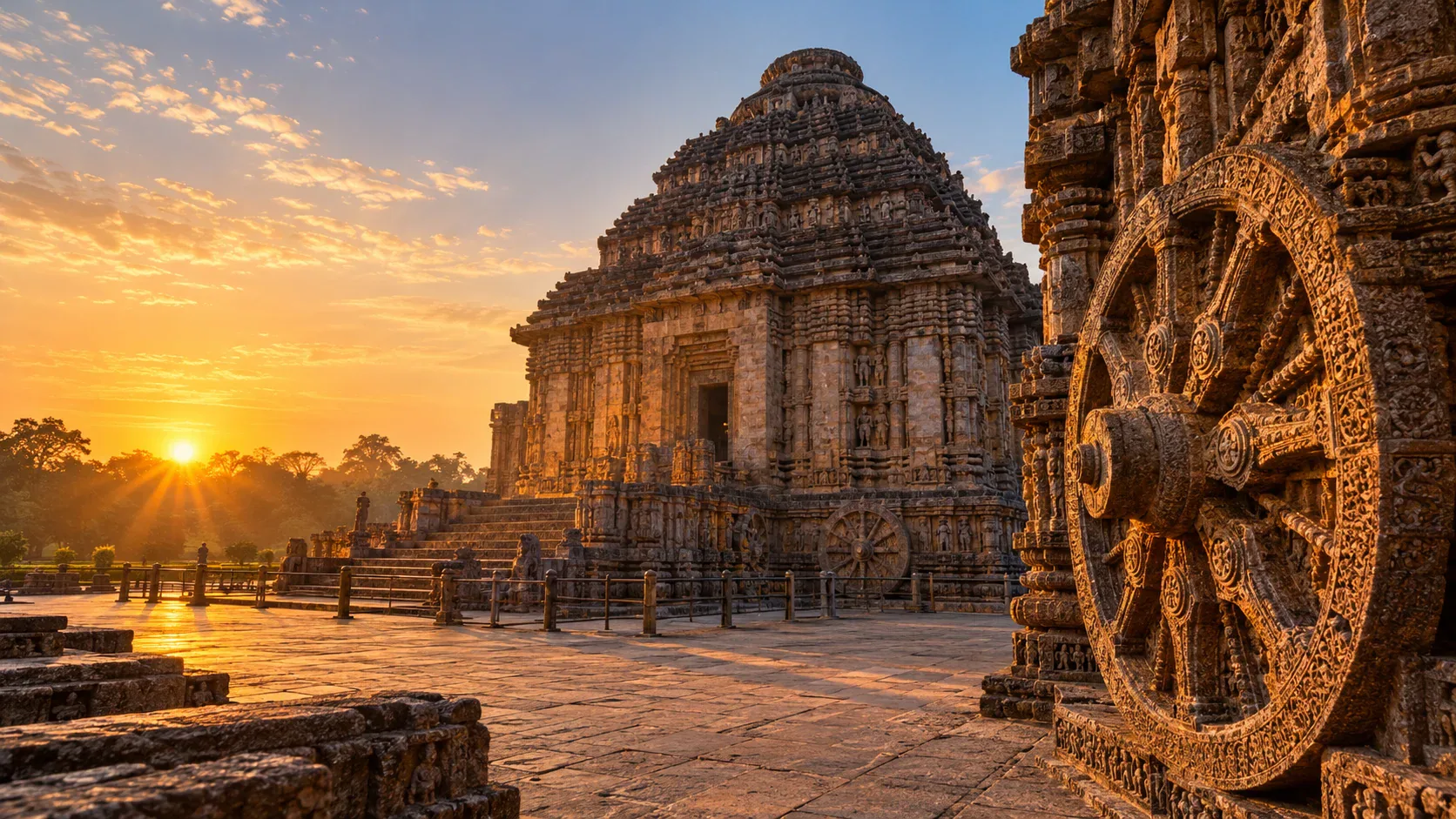
Odisha is known for Jagannath Temple in Puri, the Konark Sun Temple, Kalinga architecture, classical dance, handicrafts, Chilika Lake and wildlife. The state's temple-and-coast circuit is the most popular introduction, and Chilika's migratory bird season from November to February adds a strong nature focus.
Is Odisha safe for tourists?
The main tourist circuit is generally manageable with normal precautions. Use registered transport, avoid isolated beaches after dark and follow park and coastal warnings. Coastal Odisha can be affected by cyclones, so check IMD advisories before Chilika boat trips or beach time. No destination is risk-free.
How do I travel from Bhubaneswar to Puri and Konark?
Use rail or road to Puri, then a hired car or taxi for Konark. A private vehicle is the most efficient option for the combined circuit. Bhubaneswar to Puri is roughly 60 km and commonly takes 1.5–2 hours by road, while rail is economical for the city-to-city leg.
Can non-Hindus enter Jagannath Temple in Puri?
No. Non-Hindus are not permitted inside the temple complex, but exterior viewing is available from designated nearby locations. Dress modestly and follow signage at the permitted viewing points. Other temples and monasteries in Odisha may have different access rules, so check locally before visiting.
Is Chilika Lake worth visiting?
Yes, particularly from November to February for migratory birds. Satapada is commonly used for dolphin trips and Mangalajodi for birding. Book boats through recognised operators, confirm life-jacket availability and check weather advisories before travelling to the lake from Puri or Bhubaneswar.
What is the cost of an Odisha tour package?
Indicative land-only twin-sharing prices are about INR 18,000 budget, INR 32,000 standard, INR 52,000 premium and INR 90,000 luxury per person, excluding flights. These are planning ranges, not confirmed Tripstor offers. Final pricing depends on season, hotel category, duration and inclusions.