
What Meghalaya Travel Tips India Really Covers
Meghalaya travel tips india come down to five practical things: reaching Guwahati first, booking a cab because attractions are dispersed, carrying government photo ID, packing for rain, and keeping cash for smaller towns. These choices shape cost, comfort and how much of Shillong, Sohra, Mawlynnong and Dawki you actually cover.
Meghalaya is a domestic destination, so the planning focus is permits, ID, connectivity and local logistics rather than passports or foreign visas. The state's tourist circuit is spread across East Khasi Hills and West Jaintia Hills, and public transport between viewpoints is limited. A reserved cab or a Tripstor-arranged vehicle usually saves more time than trying to stitch together shared sumos.
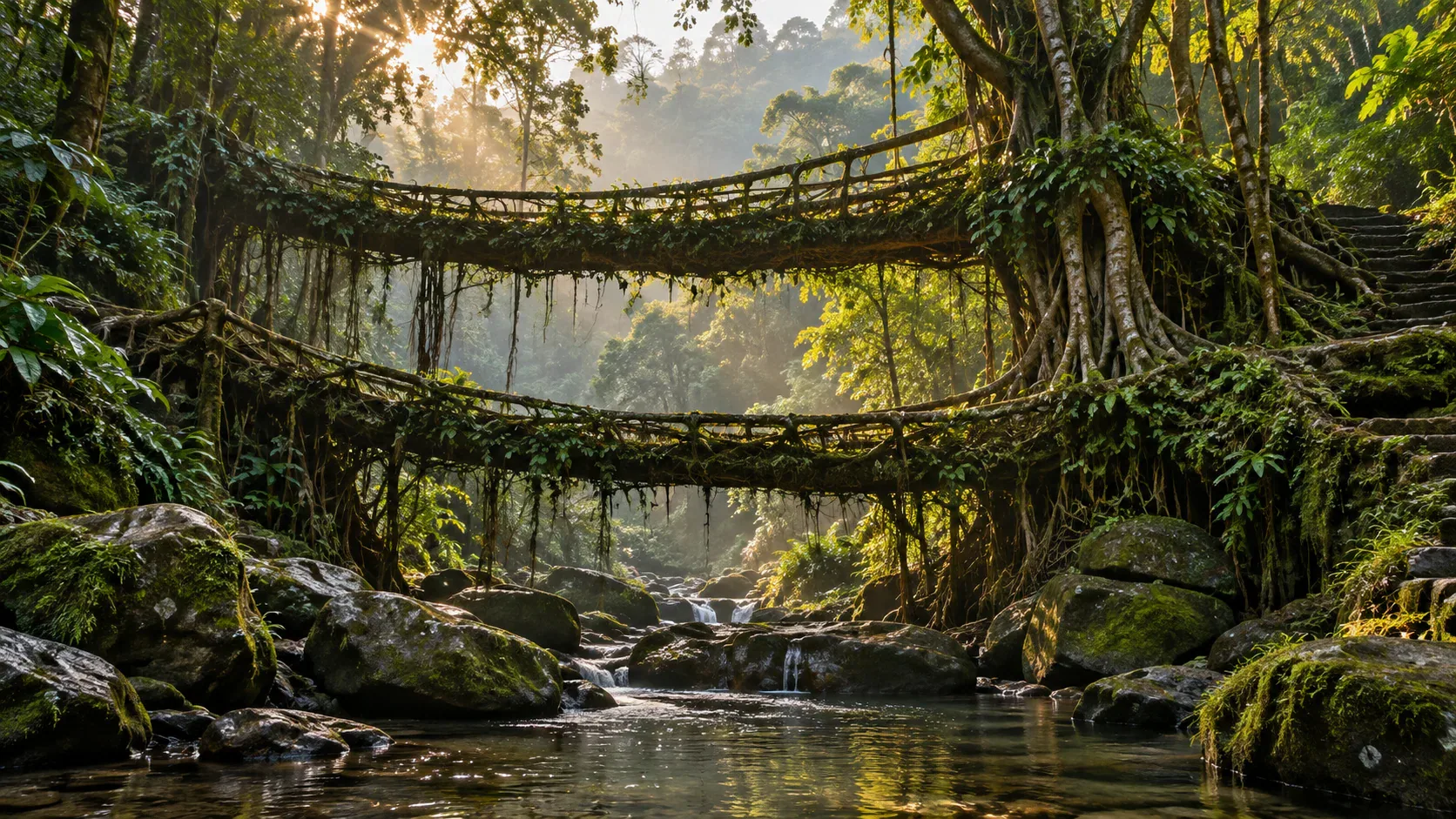
Weather is the second big variable. October to April generally gives clearer skies for sightseeing, while May to September fills waterfalls but can affect roads, trails and visibility. Build at least one buffer day if your itinerary includes Nongriat's living root bridge area or remote border routes.
At a glance
Meghalaya, in brief
Meghalaya uses the Indian rupee, English and Khasi are widely understood in tourist areas, and the standard plug is Type C, D or M at 230V. Indian nationals generally need no visa, RAP or ILP, but should carry government photo identification. Mobile coverage is patchy outside Shillong.
Meghalaya.
Planned around you.
- Currency
- Indian rupee (INR)Cards accepted in Shillong; carry cash for smaller towns
- Languages
- English, Khasi, GaroEnglish is widely understood in tourist areas
- Plug type
- Type C, D and M230V supply; bring a universal adapter
- SIM / eSIM
- Indian SIM recommendedCoverage is patchy outside Shillong and along remote routes
- Time difference
- IST (UTC+5:30)No change from mainland India
- Emergency number
- 112National emergency helpline
Before You Go to Meghalaya
Before you go to Meghalaya, book your Guwahati flight and Shillong transfer early, carry government photo ID, arrange travel insurance that covers trekking, and download offline maps. The common mistake is assuming local transport is easy to arrange on arrival, especially in peak season from October to April.
Government photo ID
Carry Aadhaar, passport or driving licence for hotel check-in and any border-area checks.
Where to get it: Already held; carry originals and a photocopyCommon mistake: Relying on a digital copy alone at checkpoints
Guwahati flight booking
Book early for October to April travel; direct flights operate from Delhi and Kolkata.
Where to get it: Airline websites or TripstorCommon mistake: Leaving booking until peak season when fares rise
Shillong road transfer
Pre-book a reserved cab or shared sumo from Guwahati; the drive is about 100 km and 3.5–4.5 hours.
Where to get it: Tripstor or local operatorsCommon mistake: Assuming you can easily find transport on arrival
Travel insurance
Choose a policy that covers trekking, medical evacuation and trip cancellation.
Where to get it: Insurance providersCommon mistake: Buying basic cover that excludes adventure activities
Forex and cards
Carry INR cash for smaller towns; cards work in Shillong but not everywhere.
Where to get it: Banks or ATMs in Guwahati or ShillongCommon mistake: Depending entirely on cards in remote areas
Offline maps and apps
Download Google Maps offline for Meghalaya; network is patchy outside Shillong.
Where to get it: App storesCommon mistake: Assuming continuous mobile data on remote routes
Meghalaya's main gateway is Guwahati, Assam. From there, Shillong is about 100 km and commonly takes 3.5–4.5 hours by road. Shillong Airport has more limited service, so most itineraries start with a Guwahati arrival and a pre-booked cab or shared sumo.
Use the checklist below to prepare documents, bookings, forex and apps. Each item notes where to get it and the mistake to avoid.
Money and Payments in Meghalaya
Money and payments in Meghalaya are straightforward in Shillong, where cards and UPI work at hotels and restaurants, but cash remains essential for smaller towns, local taxis and entry fees. ATMs are available in Shillong and larger towns; carry enough INR for remote stretches. Mobile data is patchy outside Shillong.
- Carry cash for smaller towns
ATMs are available in Shillong and larger towns, but smaller establishments and local taxis may not accept cards or UPI. Keep INR 3,000–5,000 for a week-long trip.
Money - Use UPI where accepted
UPI works at many Shillong hotels, restaurants and shops. Ask before assuming, especially outside the capital.
Money - Budget for local taxis
Shillong taxis commonly cost approximately INR 2500–4000 per vehicle per day; longer Cherrapunji, Dawki and Jowai circuits cost more depending on vehicle and season.
Money - Prepaid SIM for data
An Indian prepaid SIM from a major operator works in Shillong. Coverage is patchy outside the capital and along remote routes.
Connectivity - Download offline maps
Google Maps offline areas for Meghalaya help when signal drops on the Shillong–Sohra–Dawki circuit.
Connectivity
Shillong taxis commonly cost approximately INR 2500–4000 per vehicle per day, while longer Cherrapunji, Dawki and Jowai circuits cost more depending on vehicle and season. These are indicative local rates, not Tripstor package prices. For a land-only twin-sharing package, indicative ranges start from about INR 18,000 budget to INR 50,000 or more premium, excluding flights.
Use UPI where accepted, but keep a few thousand rupees in cash for smaller establishments. Prepaid SIMs from major Indian operators work in Shillong; expect weak signal on remote routes.
Cultural Tips for Meghalaya
Cultural tips for Meghalaya start with dressing modestly at religious sites, removing shoes before entering churches and monasteries, and asking before photographing people. Tipping is not mandatory but appreciated for guides and drivers. Khasi and Garo communities value politeness and patience, especially in smaller villages.
- Dress modestly at religious sites
Cover shoulders and knees for church visits. Remove shoes before entering churches and monasteries.
Etiquette - Ask before photographing people
In villages and markets, ask permission before taking portraits. A polite request in English usually works.
Etiquette - Tipping is discretionary
For a day cab, INR 200–500 is a reasonable gesture; for guides, INR 300–500 per day is common. Not mandatory.
Tipping - Respect sacred groves
Follow local guidance at living root bridges and sacred groves. Do not damage plants or structures.
Culture - Keep noise low in villages
Khasi and Garo communities value calm. Avoid loud music or shouting in residential areas.
Culture
Meghalaya is predominantly Christian, with churches in Shillong and villages across the Khasi and Jaintia Hills. Dress modestly for church visits, and avoid loud behaviour in religious spaces. At living root bridges and sacred groves, follow local guidance and do not damage plants or structures.
Tipping is discretionary. For a day cab, INR 200–500 is a reasonable gesture; for guides, INR 300–500 per day is common. Always ask before taking photos of individuals, especially in rural areas.
Meghalaya Food Tips
Meghalaya food tips for Indian travellers centre on trying local Khasi and Garo dishes while knowing that vegetarian and Indian food options exist mainly in Shillong. Jadoh, tungrymbai and pukhlein are worth trying. In smaller towns, pure-veg choices are limited, so plan meals around Shillong or Sohra.
- Shillong and Khasi Hills
Jadoh
A Khasi rice-and-meat dish, often cooked with pork or chicken and served with pickles.
Best forTrying local Khasi cuisine
Ask for a vegetarian version if needed; it may be plain rice with dal.
- Shillong and Khasi Hills
Tungrymbai
Fermented soybean curry, usually cooked with pork. It has a strong, earthy flavour.
Best forAdventurous eaters
Try it at a local eatery in Shillong rather than a hotel buffet.
- Shillong and Khasi Hills
Pukhlein
A sweet rice-flour snack, often sold in local markets and tea stalls.
Best forSnacking
Best fresh and warm; pair with tea.
- Shillong
Shillong restaurants
The capital has the widest choice of North Indian, Chinese and Assamese food, plus local Khasi eateries.
Best forVegetarian and Indian food options
Eat your main meals in Shillong if you are vegetarian or prefer Indian food.
- Sohra
Sohra eateries
Small local restaurants serving rice, dal and seasonal vegetables; options are limited compared with Shillong.
Best forSimple local meals
Carry snacks for long sightseeing days around Sohra and Mawlynnong.
Shillong has the widest range of restaurants, including North Indian, Chinese and Assamese options. Sohra and Mawlynnong have fewer choices, mostly local eateries serving rice, dal and seasonal vegetables. If you are vegetarian, confirm whether meat stock is used in curries.
Below are dishes and food-related places to look for. Only names supported by the research are included.
Safety in Meghalaya
Safety in Meghalaya for Indian tourists is generally manageable on the main circuit, but wet trails, remote roads and after-dark travel need standard precautions. The main risks are slips on root-bridge paths, poor visibility in monsoon, and limited medical facilities outside Shillong. Never guarantee safety; plan around weather and daylight.
- Slippery trails to living root bridges
How to avoid itWear shoes with good grip, use handrails where provided, and avoid the descent in heavy rain. Consider a local guide for Nongriat.
- Landslides and road blocks in monsoon
How to avoid itCheck local road conditions before long drives, keep buffer days, and avoid remote routes during heavy rain.
- Limited medical facilities outside Shillong
How to avoid itCarry a basic first-aid kit and prescription medicines. For serious issues, return to Shillong or Guwahati.
- Poor visibility on hill roads after dark
How to avoid itPlan drives to finish before dusk. Avoid night driving on the Shillong–Sohra–Dawki circuit.
- Weak mobile signal on remote routes
How to avoid itDownload offline maps, share your itinerary with someone, and carry a power bank.
The principal tourist circuit is generally suitable for visitors, but standard precautions are needed on wet trails, remote roads and after dark. Heavy rain from May to September can make trails slippery and roads prone to landslides. Carry a basic first-aid kit and any prescription medicines.
Below are common issues and prevention steps.
Packing by Season for Meghalaya
Packing by season for Meghalaya depends on whether you travel in the clearer months from October to April or the wet months from May to September. Layers, rain protection and grippy footwear matter year-round. In winter, Shillong nights can be cold, so pack a warm jacket.
Layered clothing
Pack a warm jacket for winter nights and light layers for daytime. Shillong can be cool even in October.
Common mistake: Packing only summer clothes for a winter trip
Rain jacket and umbrella
Essential from May to September; useful year-round for sudden showers.
Common mistake: Assuming monsoon rain is brief; it can last for days
Grippy footwear
Shoes with good tread for wet trails, root bridges and uneven paths.
Common mistake: Wearing smooth-soled sneakers on slippery descents
Quick-dry clothes
Useful in monsoon when humidity is high and clothes take longer to dry.
Common mistake: Bringing only heavy cotton that stays damp
Power bank and offline maps
Network is patchy outside Shillong; keep your phone charged and maps downloaded.
Common mistake: Relying on continuous mobile data
Basic first-aid kit
Include bandages, antiseptic and any prescription medicines.
Common mistake: Assuming pharmacies are easily available in remote areas
October to April generally gives clearer skies for sightseeing, but mornings and evenings can be cool, especially in Shillong and Sohra. May to September brings heavy rain and fuller waterfalls, so waterproofs and quick-dry clothing are essential. Use the checklist below to pack for your season.
Holiday ideas to start from
Reviewed itineraries for this destination — personalise with a specialist, never an instant booking.
Meghalaya Waterfall Journey 5 Nights: Meghalaya Nature Package 2026
From₹27,000per adult, twin sharing, land only
From idea to itinerary, with a real person.
- Share your plan
Dates, departure city, travellers and the moments you’d love. It only takes a minute.
- Shape it with a specialist
A real person refines the route, stays and pace with you. Change anything.
- Review your quote
A clear, personalised quote with confirmed inclusions. No payment to enquire.
From our travel specialists
What our team sees when planning these trips, beyond what the guidebooks say.
Confirmed 11 Oct 2026
Families and couples learn that convenience depends heavily on transport: a private car with a reliable local driver is more comfortable than trying to combine shared transport with long sightseeing days. They also benefit from choosing October to April, starting early, carrying rain protection, and leaving slack for weather rather than planning a tightly packed route.
The monsoon, especially June to September, is often underestimated: rain can change suddenly, make trails slippery, delay roads, and disrupt tightly planned itineraries. Some travellers deliberately choose the monsoon for waterfalls and lush scenery, but October to April is more commonly recommended for clearer weather and easier travel.
Travellers often add extra days or rearrange plans when rain or road conditions affect the schedule. They also tend to switch to taxis or a private local driver for longer routes, add rain gear and spare clothing, and include less rushed village or trail stops rather than only the standard sightseeing circuit.
Shillong is the most practical first base because it has the broadest accommodation and transport access, including connections from Guwahati, and works for day trips toward Cherrapunji and Dawki. Travellers should usually limit the Shillong stay and move closer to major sights when the itinerary includes long excursions.
Before you go
Straight answers to help you plan — then personalise the trip with a specialist.
8 answered belowAsk a specialist anything about this trip — there’s no obligation.
Ask a specialistWhat is the best time to visit Meghalaya?
October to April is generally best for clearer skies and sightseeing; July to September is greener but much wetter. May to September offers the fullest waterfalls, but heavy rain can affect roads, trails and visibility. Plan buffer days if you travel in monsoon.
How many days are enough for Meghalaya?
Five to seven days covers Shillong, Sohra, Mawlynnong and Dawki at a practical pace. Add a day if you want Nongriat's living root bridge or Mawsynram. Shorter trips of three to four days can cover Shillong and Sohra only.
How much does a Meghalaya tour package cost?
Indicative land-only twin-sharing packages range from about INR 18,000 budget to INR 50,000 or more premium, excluding flights. Public listings show comparable packages from approximately INR 18,750 upward. These are planning ranges, not Tripstor offers.
Is Meghalaya safe for tourists?
The principal tourist circuit is generally suitable for visitors, but standard precautions are needed on wet trails, remote roads and after dark. Heavy rain can make trails slippery and roads prone to landslides. Carry a first-aid kit and avoid night driving on hill roads.
How do I reach Meghalaya by air?
Fly to Guwahati, Assam, then continue by road to Shillong; Shillong Airport has more limited service. Guwahati–Shillong is approximately 100 km and commonly takes 3.5–4.5 hours. Direct flights to Guwahati operate from Delhi and Kolkata.
Do Indians need a permit to visit Meghalaya?
Indian nationals generally do not need a visa, RAP or ILP for Meghalaya. Carry government photo identification. Confirm current border-area rules before visiting Dawki or remote routes, as permissions can change.
Which places are covered in a Meghalaya tour?
Common circuits include Shillong, Sohra, Mawlynnong, Dawki, Nongriat and sometimes Mawsynram or Jowai. A five- to seven-day trip can cover most of these at a practical pace. Shorter trips usually focus on Shillong and Sohra.
Is Cherrapunji and Sohra the same place?
Yes. Sohra is the official and local name commonly used for the destination historically known as Cherrapunji. You will see both names in signage and bookings. Sohra is in East Khasi Hills and is a base for waterfalls and living root bridges.