
Guides for this destination
Practical reads before you plan — timing, places, costs, visas and tips.
Showing 5 of 5 guides
 Nepal Trip Cost from India: Complete 2026 Budget GuideRead the guide
What Is Nepal and Why Visit
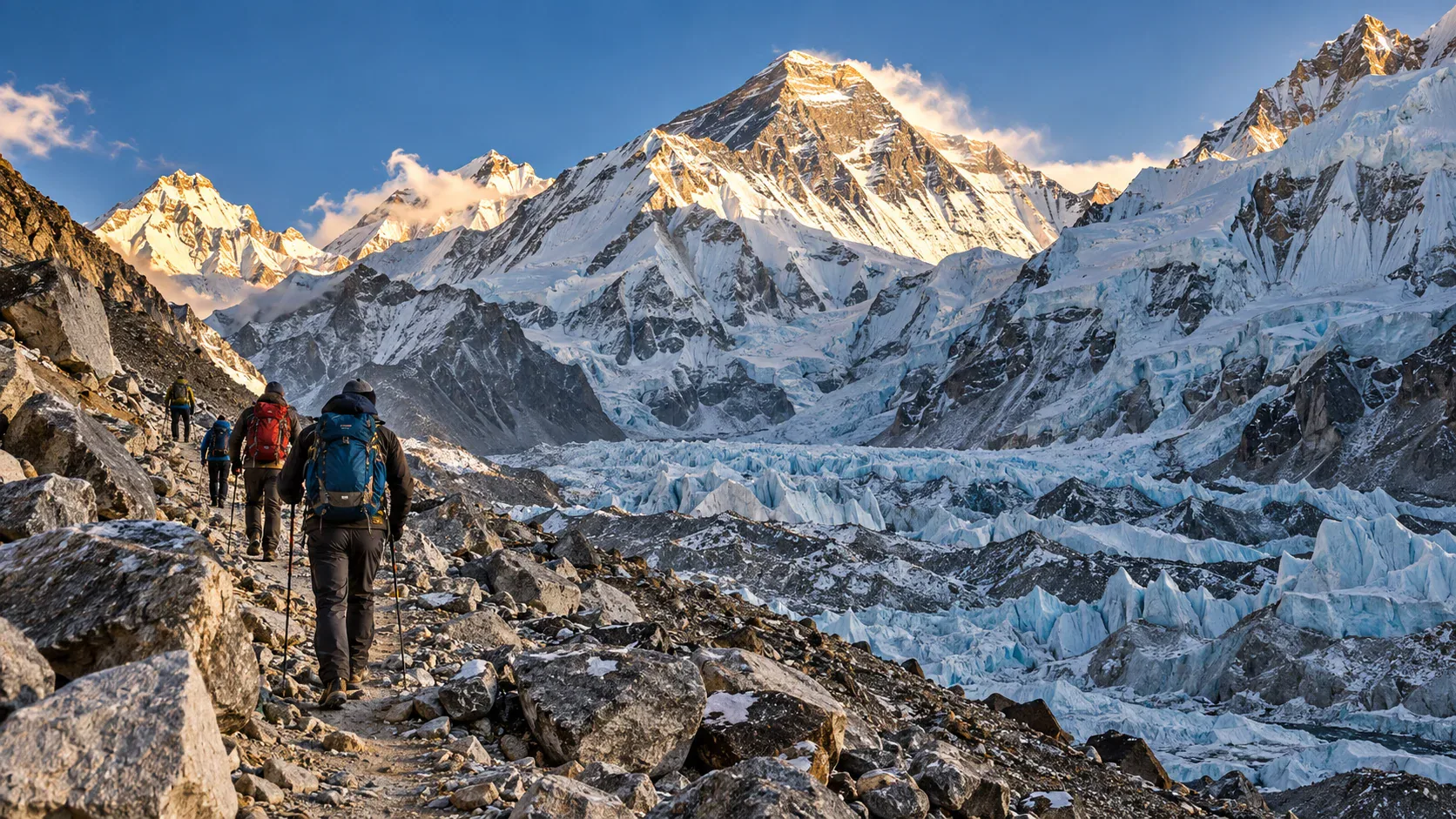
Nepal is a landlocked Himalayan country between India and China, home to Mount Everest at 8,849 m and eight of the world's highest peaks. October-November and March-April bring the clearest mountain views, and Indian citizens enter without a visa.
Nepal sits along the southern slope of the Himalayas, sharing open borders with India across Uttar Pradesh, Bihar, West Bengal, Sikkim and Uttarakhand. The country rises from the Terai plains near sea level to Mount Everest at 8,849 m, packing subtropical forests, mid-hill towns and high alpine valleys into a short north-south span.
The signature attraction is the Everest region, but most Indian travellers combine Kathmandu's UNESCO-listed Durbar Squares with Pokhara's Annapurna views and Phewa Lake. Three distinctive experiences define a first Nepal trip: a mountain flight or Everest Base Camp trek, a sunrise run to Sarangkot above Pokhara, and a wildlife safari in Chitwan National Park.
Traveller types range widely. Families favour Kathmandu, Pokhara and Chitwan circuits. Trekkers target the Everest, Annapurna and Langtang regions. Pilgrims visit Pashupatinath in Kathmandu and Muktinath in Mustang. Budget backpackers use the Thamel area as a base, while luxury travellers stay at properties in Kathmandu's Durbar Marg and Pokhara's lakeside.
At a glance
Nepal, in brief
Nepal is a South Asian Himalayan country with visa-free entry for Indian citizens, a best season of October-November and March-April, and Kathmandu's Tribhuvan International Airport as the main gateway. A 7-10 day trip covers Kathmandu, Pokhara and Chitwan comfortably.
Nepal.
7-10 days
- Region
- South Asia, landlocked between India and ChinaOpen border with India across five states
- Best season
- October-November and March-AprilClearest mountain views and favourable trekking conditions
- Ideal trip length
- 7-10 daysCovers Kathmandu, Pokhara and Chitwan at a comfortable pace
- Gateway airport
- Tribhuvan International Airport (KTM), KathmanduDirect flights from Delhi, Mumbai, Kolkata and Bengaluru
- Currency
- Nepalese rupee (NPR)INR 100 is approximately NPR 160; ₹2,000 notes not accepted
- Language
- Nepali; English widely used in tourismHindi understood in most tourist areas
Why Indians Love Nepal
Indians love Nepal for visa-free entry, short direct flights from Delhi and Kolkata, and the rare combination of Himalayan scenery with familiar food and Hindi-friendly tourism. The country delivers an international mountain holiday without the paperwork of a long-haul trip.
- Visa-free entry for Indian citizens
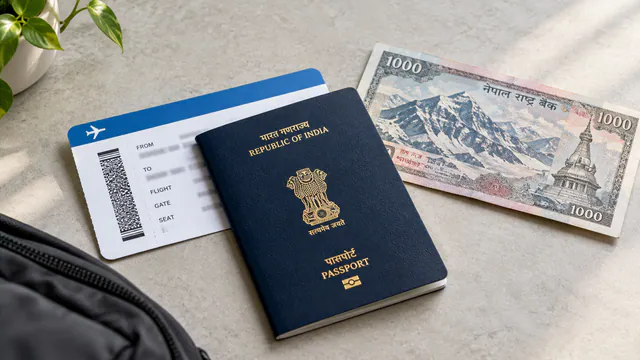
Indian nationals do not need a visa for Nepal. Carry a valid Indian passport or voter ID. The open border allows road entry via Sunauli, Raxaul, Kakarbhitta and other crossings.
Entry - Short direct flights from Indian cities
Air India, IndiGo and Nepal Airlines operate direct flights from Delhi to Kathmandu in about 1 hour 35 minutes. Kolkata, Mumbai and Bengaluru also have connections.
Transport - Familiar food and Hindi-friendly tourism
Thamel, Pokhara Lakeside and Sauraha have vegetarian thalis, Hindi-speaking guides and INR acceptance in many shops, making Nepal easy for first-time international travellers from India.
Comfort
Three concrete reasons keep Nepal at the top of Indian travel lists. First, entry is simple: no visa, no fee, and the border can be crossed by road at Sunauli, Raxaul, Kakarbhitta and other points. Second, direct flights from Delhi take about 1 hour 35 minutes, and Air India, IndiGo and Nepal Airlines serve the route. Third, the tourism ecosystem in Thamel, Pokhara Lakeside and Sauraha is built around Indian tastes, with vegetarian thalis, Hindi-speaking guides and INR acceptance in many shops.
Beyond logistics, Nepal offers experiences that are hard to match elsewhere in the region. A mountain flight from Kathmandu gives Everest views in under an hour. Pokhara's Phewa Lake and Sarangkot sunrise are accessible without trekking. Chitwan National Park offers rhino and tiger safaris in the Terai. For pilgrims, Pashupatinath in Kathmandu and Muktinath in Mustang carry deep religious significance.
Top 10 Places to Visit in Nepal
Nepal's top places span Kathmandu's UNESCO Durbar Squares, Pokhara's Annapurna views, Chitwan's wildlife, Lumbini's Buddhist heritage and Everest region trekking hubs. Each offers a distinct experience, and most first-time visitors combine three or four in a 7-10 day trip.
- Kathmandu
Kathmandu Durbar Square
UNESCO World Heritage Site in the old city, with the Hanuman Dhoka palace complex and Kumari Ghar. The 2015 earthquake damaged several structures, and restoration continues.
Best forHeritage and culture
Visit early morning to avoid crowds and see the Kumari's window before 10 am.
- Kathmandu
Pashupatinath Temple
One of the holiest Shiva temples in South Asia, on the Bagmati River. The main temple is open only to Hindus; the surrounding complex is open to all.
Best forPilgrimage
Non-Hindus can view the temple from the eastern bank. Evening aarti is at approximately 6 pm.
- Kathmandu
Boudhanath Stupa
One of the largest spherical stupas in Nepal, a UNESCO site and centre of Tibetan Buddhism in Kathmandu. The surrounding area has monasteries and rooftop cafes.
Best forCulture and photography
Walk clockwise around the stupa. Sunset from a rooftop cafe gives good light for photos.
- Kathmandu
Swayambhunath (Monkey Temple)
Hilltop stupa west of Kathmandu with panoramic valley views. The site is reached by 365 steps or a road on the east side.
Best forViews and heritage
The east-side road is easier for elderly travellers. Hold belongings tight; monkeys snatch food.
- Lalitpur
Patan Durbar Square
UNESCO World Heritage Site across the Bagmati from Kathmandu, known for the Krishna Mandir and the Patan Museum. The museum is housed in a restored palace.
Best forHeritage and museums
Combine with a walk to the Golden Temple nearby. The museum is closed on some public holidays.
- Bhaktapur
Bhaktapur Durbar Square
UNESCO World Heritage Site about 13 km east of Kathmandu, with the 55-Window Palace and Nyatapola Temple. The old town is largely pedestrian.
Best forHeritage and food
Try juju dhau (king curd) in Bhaktapur. Allow at least half a day.
- Pokhara
Phewa Lake and Pokhara Lakeside
Freshwater lake in Pokhara with Annapurna reflections on clear days. Boats can be hired from the Lakeside area, and the Tal Barahi Temple sits on an island.
Best forRelaxation and views
Row boats are available; life jackets are provided. Early morning gives the calmest water.
- Pokhara
Sarangkot
Hilltop viewpoint about 30 minutes from Pokhara Lakeside, known for sunrise over the Annapurna and Dhaulagiri ranges. Paragliding launches operate from the ridge.
Best forSunrise and adventure
Leave Pokhara by 4:30 am for sunrise. Carry a jacket; mornings are cold even in summer.
- Chitwan, Terai
Chitwan National Park
Nepal's first national park and a UNESCO World Heritage Site, known for one-horned rhinos, Bengal tigers and gharial crocodiles. Safaris run from Sauraha and other buffer-zone villages.
Best forWildlife
Book jeep safaris through your hotel. Elephant-back safaris are discouraged for animal welfare reasons.
- Rupandehi, Terai
Lumbini
UNESCO World Heritage Site and birthplace of Gautama Buddha. The Maya Devi Temple marks the exact spot, and the surrounding monastic zone has temples built by several countries.
Best forPilgrimage and heritage
The site is spread out; hire a cycle rickshaw or e-rickshaw. Allow a full day.
The list below covers the places most Indian travellers include in a Nepal itinerary. Distances and altitudes are indicative; check current conditions before travel.
Best Time to Visit Nepal from India
The best time to visit Nepal from India is October-November for post-monsoon clarity and March-April for spring blooms and stable trekking weather. December-February is cold but clear in the hills, while June-September brings monsoon rain and landslide risk.
January
Good time to goCold and clear in hills; fog in Terai; snow at high altitude
Good for lower-altitude sightseeing; pack warm layers
February
Good time to goCold mornings, warming days; clear mountain views
Good for Kathmandu, Pokhara and Chitwan
March
Best time to goWarm days, rhododendrons bloom, stable trekking weather
Best for trekking and mountain views
April
Best time to goWarm to hot; haze builds in Terai; pre-monsoon showers late month
Best for trekking; book early
May
Shoulder seasonHot in Terai; pre-monsoon clouds; trekking conditions deteriorate
Fair; better for high-altitude treks than Terai
June
Not recommendedMonsoon begins; heavy rain, landslides, leeches on trails
Avoid trekking; Kathmandu sightseeing possible
July
Not recommendedPeak monsoon; rain across most regions; flight delays possible
Avoid unless visiting for specific monsoon research
August
Not recommendedMonsoon continues; rain and humidity; some rain-shadow areas drier
Avoid; Upper Mustang and Dolpo are exceptions
September
Good time to goMonsoon retreats; rain tapers late month; trails still wet
Good from late September; check trail conditions
October
Best time to goClear skies, stable weather, excellent mountain views
Best overall month for Nepal
November
Best time to goClear and cool; good visibility; cold nights at altitude
Best for views and trekking; book early
December
Good time to goCold and clear; snow at high passes; Terai pleasant
Good for lower-altitude trips; high treks need cold gear
- BestMar, Apr, Oct, Nov
- GoodJan, Feb, Sep, Dec
- FairMay
- AvoidJun, Jul, Aug
Nepal's weather varies sharply by altitude. The Terai is hot and humid for much of the year, the mid-hills around Kathmandu and Pokhara are temperate, and the high mountains are cold year-round. The table below gives a month-by-month view for planning a 2026 trip.
Nepal Trip Cost from India (2026)
A Nepal trip from India in 2026 costs roughly ₹25,000-₹40,000 per person for a 7-day budget trip, ₹50,000-₹80,000 for mid-range, and ₹1,20,000 and above for luxury. These are indicative travel-budget estimates, not Tripstor package offers.
Budget
Backpackers and students
- Flights: ₹12,000-₹18,000 return
- Land: ₹13,000-₹22,000 for guesthouses, buses and local meals
- Kathmandu, Pokhara and Chitwan by tourist bus
Mid-range
Families and couples
- Flights: ₹15,000-₹22,000 return
- Land: ₹35,000-₹58,000 for 3-star hotels, private transfers and some meals
- Includes a mountain flight or Sarangkot sunrise trip
Luxury
Honeymooners and comfort-focused travellers
- Flights: ₹20,000-₹30,000 return in flexible fare classes
- Land: ₹1,00,000+ for 5-star hotels, private guides and helicopter transfers
- Includes Everest-view helicopter tour or luxury lodge stay
The figures below assume a 7-day trip for one person sharing a twin room, with return flights from Delhi to Kathmandu. Flight and land costs are split in the tier highlights. Actual prices vary by season, booking window and itinerary. For a confirmed quote, request a custom Nepal package from Tripstor.
How to Reach Nepal from India
Nepal is reached from India by direct flights to Kathmandu, by train to border towns such as Gorakhpur and Raxaul, or by road across open border crossings. Direct flights from Delhi take about 1 hour 35 minutes.
Delhi
Direct
Typical fareIndicative ₹12,000-₹18,000 return
Air India, IndiGo and Nepal Airlines operate this route
Mumbai
Direct or via Delhi
Typical fareIndicative ₹15,000-₹22,000 return
Check current schedules; some services are seasonal
Kolkata
Direct
Typical fareIndicative ₹10,000-₹16,000 return
Shortest route from eastern India
Bengaluru
Direct or via Delhi
Typical fareIndicative ₹18,000-₹25,000 return
Limited direct frequencies; check schedules
Gorakhpur
Sunauli border
Typical fareIndicative ₹500-₹1,500 by bus or shared jeep
Cross at Sunauli; immigration formalities for Indians are minimal
Raxaul
Birgunj border
Typical fareIndicative ₹300-₹800 by bus or shared jeep
Common route from Bihar; trains connect Raxaul to Indian cities
New Jalpaiguri
Kakarbhitta border
Typical fareIndicative ₹500-₹1,200 by bus or shared jeep
Convenient for Sikkim and Darjeeling itineraries
Travelling from your city?
Tell us where you start. A specialist can plan connections around your stay.
Plan my journeyThe table below lists common routes from Indian cities. Flight durations are indicative and depend on aircraft, weather and air traffic. Fares vary by season and booking window. For road entry, carry a valid Indian passport or voter ID; the border is open to Indian citizens.
Where to Stay in Nepal
Nepal's main stay areas are Thamel and Durbar Marg in Kathmandu, Lakeside in Pokhara, and Sauraha in Chitwan. Budget guesthouses, mid-range 3-star hotels and luxury 5-star properties are available in all three, with indicative nightly rates varying by season.
Budget
Backpackers and solo travellers
- Thamel, Kathmandu: guesthouses and hostels near the main tourist strip
- Pokhara Lakeside: budget rooms a short walk from Phewa Lake
- Sauraha, Chitwan: simple lodges near the park buffer zone
Mid-range
Families and couples
- Durbar Marg, Kathmandu: 3-star hotels with restaurants and easy transport
- Pokhara Lakeside: hotels with lake or mountain views
- Sauraha, Chitwan: jungle lodges with safari packages
Luxury
Honeymooners and comfort-focused travellers
- Durbar Marg and Lazimpat, Kathmandu: 5-star hotels with multiple dining options
- Pokhara Lakeside: upscale resorts with spa and lake views
- Chitwan: luxury jungle lodges with guided safaris
The tiers below give neighbourhood guidance and indicative nightly rates per room. These are travel-budget estimates, not Tripstor contracted inventory. For confirmed hotel options, request a custom Nepal package.
Local Food and Cuisine in Nepal
Nepali cuisine centres on dal bhat, momos, thukpa, sel roti and Newari dishes such as bara and chatamari. Vegetarian food is widely available, and Indian travellers will find familiar flavours alongside regional specialities.
- Across Nepal
Dal bhat
Steamed rice with lentil soup, seasonal vegetables and pickles. Often served with chicken, mutton or fish curry. A staple meal in Kathmandu, Pokhara and Chitwan.
Best forEveryday meal
Ask for vegetarian dal bhat without meat stock if needed. Refills are often free.
- Thamel, Kathmandu; Pokhara Lakeside
Momos
Steamed or fried dumplings with vegetable, chicken or buffalo filling, served with tomato achar. Widely available as street food and in restaurants.
Best forSnack
Vegetable momos are common. Confirm the achar is not too spicy if you prefer mild food.
- Kathmandu and mountain regions
Thukpa
Himalayan noodle soup with vegetables or meat, popular in colder areas and trekking routes. Tibetan in origin and widely available in Boudhanath and Thamel.
Best forComfort food
A good option for cold evenings in Kathmandu or Pokhara. Ask for less chilli if preferred.
- Kathmandu and across Nepal
Sel roti
Ring-shaped fermented rice bread, traditionally prepared during Tihar and other festivals. Sweet, slightly crisp and often sold at street stalls.
Best forBreakfast or snack
Best eaten fresh and warm. Available at local sweet shops in the morning.
- Patan and Kathmandu Durbar Square areas
Newari dishes (bara, chatamari)
Bara is a lentil pancake, and chatamari is a rice-flour crepe with toppings. Newari cuisine is native to the Kathmandu Valley and served in local restaurants.
Best forLocal speciality
Try these in Patan or near Kathmandu Durbar Square. Some versions contain egg or meat; ask before ordering.
The dishes below are commonly found across Kathmandu, Pokhara and Chitwan. Where specific restaurants are not named in the research data, the area is given instead. Vegetarian travellers should confirm whether dal bhat is cooked with meat stock, and Jain travellers can request no onion or garlic in many Kathmandu restaurants.
Nepal Travel Tips for Indians
Nepal travel tips for Indians cover visa-free entry, currency rules, SIM cards, altitude precautions and local etiquette. Indian citizens do not need a visa, but should carry valid ID and be aware that ₹2,000 notes are not accepted in Nepal.
- Carry valid Indian ID
Indian citizens do not need a visa for Nepal. Carry a valid Indian passport or voter ID. Aadhaar is not officially accepted as a travel document for international entry.
Entry - Currency and payments
Nepalese rupee is the local currency. INR 100 and ₹500 notes are widely accepted, but ₹2,000 notes are not. Cards work in hotels and larger restaurants; carry cash for smaller towns.
Money - SIM and connectivity
Indian SIM cards work on roaming in Nepal, but data packs can be expensive. Buy a local Ncell or Nepal Telecom SIM with your passport for cheaper data. Wi-Fi is common in hotels and cafes.
Connectivity - Altitude awareness
Kathmandu sits at about 1,400 m and Pokhara at about 800 m. High-altitude treks above 3,000 m need acclimatisation days. Watch for headache, nausea and breathlessness, and descend if symptoms worsen.
Health - Safety and local etiquette
Nepal is generally safe for Indian travellers. Avoid political gatherings, dress modestly at temples, and walk clockwise around Buddhist stupas. Remove shoes before entering temple grounds.
Safety - Road travel and traffic
Nepal drives on the left. Mountain roads are narrow and can be slow; allow extra time for Kathmandu-Pokhara and Pokhara-Chitwan transfers. Tourist buses are more comfortable than local buses.
Transport - Travel insurance
Travel insurance is not mandatory for Indian citizens, but is recommended for trekking and adventure activities. Check that the policy covers helicopter evacuation if you plan high-altitude treks.
Health - Packing for Nepal
Layers work best: warm jacket for mornings and evenings, light clothes for daytime, comfortable walking shoes, sunscreen and a reusable water bottle. Rain gear is essential from June to September.
Packing
The tips below are practical for a 2026 trip. Entry rules can change; check the Nepal Department of Immigration website before travel. For a full document checklist, see the Nepal visa planning guide.
Nepal vs Other Himalayan Destinations
Nepal competes with Bhutan, Sikkim and Uttarakhand for Indian Himalayan travellers. Nepal offers visa-free entry, Everest views and lower costs, while Bhutan has restricted numbers and a daily fee, and Sikkim and Uttarakhand are domestic options with no passport requirement.
Nepal
Best forEverest views, trekking, heritage and wildlife in one trip
StrengthsVisa-free for Indians; direct flights from Delhi and Kolkata; wide range of budgets; familiar food and Hindi-friendly tourism
Trade-offsPeak-season crowds on Everest and Annapurna trails; road travel between cities can be slow; monsoon disrupts June-September
Bhutan
Best forQuiet Himalayan culture and controlled tourism
StrengthsWell-preserved monasteries and landscapes; low visitor numbers; good road conditions on main routes
Trade-offsSustainable Development Fee applies to Indian travellers; fewer direct flights; higher daily costs
Sikkim and Uttarakhand
Best forDomestic Himalayan trips without passport or currency change
StrengthsNo international entry formalities; INR accepted everywhere; easy rail and road access from Indian cities
Trade-offsNo Everest-scale peaks; some areas need inner-line permits; peak-season crowds at popular viewpoints
The comparison below is honest about trade-offs. Nepal's advantage is accessibility and variety; its disadvantages are crowded trails in peak season and slower road travel. Bhutan suits travellers who want a quieter, more controlled experience and are willing to pay the Sustainable Development Fee. Sikkim and Uttarakhand suit those who prefer domestic travel without border formalities, though they lack Everest-scale peaks.
From idea to itinerary, with a real person.
- Share your plan
Dates, departure city, travellers and the moments you’d love. It only takes a minute.
- Shape it with a specialist
A real person refines the route, stays and pace with you. Change anything.
- Review your quote
A clear, personalised quote with confirmed inclusions. No payment to enquire.
From our travel specialists
What our team sees when planning these trips, beyond what the guidebooks say.
Confirmed 11 Oct 2026
Pokhara is the strongest base for a first visit if travellers want a calmer setting, lake activities and easy access to short mountain hikes such as Australian Camp; Kathmandu remains useful for heritage sights and international arrival connections. Reports commonly combine Kathmandu and Pokhara rather than treating either city as the sole base.
Travellers commonly add a short hike after seeing the scenery, with Australian Camp near Pokhara mentioned as an easy addition. They also often use local transport and apps such as InDrive or Pathao instead of relying entirely on prearranged transfers.
Money and payments catch Indian visitors out: reports say UPI works in many but not all places, while Indian cash is accepted inconsistently, so travellers should carry suitable Nepalese cash as a backup. Local transport can be chaotic, and strict vegetarians may have difficulty finding suitable food outside tourist areas.
Carry acceptable Indian identification such as an Aadhaar card or voter ID, and avoid relying on ₹500 and ₹2,000 notes because travellers report that these may not be accepted. Travellers also wish they had arranged a local guide for sightseeing or trekking where navigation and local context matter.
Before you go
Straight answers to help you plan — then personalise the trip with a specialist.
8 answered belowAsk a specialist anything about this trip — there’s no obligation.
Ask a specialistDo Indian citizens need a visa for Nepal?
No, Indian citizens do not need a visa for Nepal. Carry a valid Indian passport or voter ID for entry. The border is open, and road crossings at Sunauli, Raxaul and Kakarbhitta are commonly used. Aadhaar is not officially accepted as a travel document for international entry.
What is the best time to visit Nepal from India?
October-November and March-April are the best months for Nepal, with clear mountain views and stable trekking weather. December-February is cold but clear in the hills. Avoid June-September, when monsoon rain causes landslides and trail closures.
How much does a Nepal trip cost from India?
A 7-day Nepal trip from India costs roughly ₹25,000-₹40,000 per person for budget travel, ₹50,000-₹80,000 for mid-range, and ₹1,20,000 and above for luxury. These are indicative estimates for one person sharing a twin room, including return flights from Delhi.
How do I reach Nepal from India?
Direct flights from Delhi to Kathmandu take about 1 hour 35 minutes, with Air India, IndiGo and Nepal Airlines operating the route. Kolkata has a shorter flight of about 1 hour 30 minutes. Road entry is possible via Sunauli, Raxaul and Kakarbhitta.
Is Nepal safe for Indian travellers?
Nepal is generally safe for Indian travellers, including families and solo visitors. Avoid political gatherings, dress modestly at temples and watch for altitude sickness on high treks. Travel insurance is recommended for trekking and adventure activities.
Can I use Indian rupees in Nepal?
INR 100 and ₹500 notes are widely accepted in Nepal, but ₹2,000 notes are not. Nepalese rupee is the official currency, with INR 100 approximately NPR 160. Cards work in hotels and larger restaurants; carry cash for smaller towns and villages.
What should I pack for a Nepal trip?
Pack layers for Nepal: a warm jacket for mornings and evenings, light clothes for daytime, comfortable walking shoes, sunscreen and a reusable water bottle. Rain gear is essential from June to September. For high-altitude treks, add thermal layers and a down jacket.
How many days do I need for a Nepal trip?
A 7-10 day Nepal trip covers Kathmandu, Pokhara and Chitwan comfortably. Add 12-14 days for Everest Base Camp or Annapurna Base Camp treks. A short 4-5 day trip can cover Kathmandu and Pokhara only.