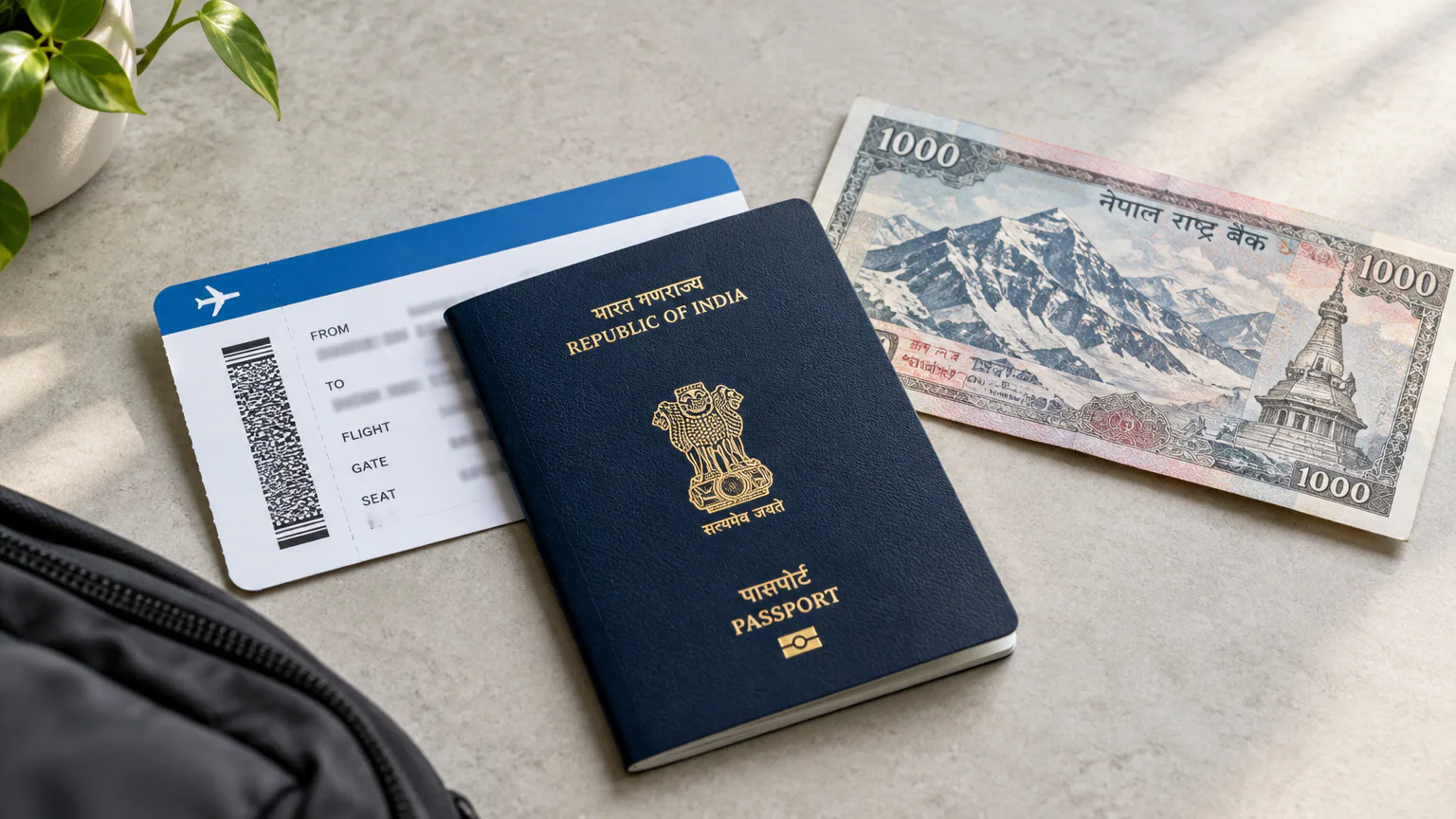
At a glance
Nepal at a Glance
Nepal packs seven UNESCO World Heritage Sites, two of the world's great trekking regions, and a wildlife national park into a country smaller than most Indian states. Indian nationals travel visa-free, making it one of the most accessible international destinations from any major Indian city.
Nepal Places to Visit.
5–7 days for highlights; 10–14 days with trekking
- Must-see places
- Kathmandu, Pokhara, Chitwan, Lumbini, NagarkotThese five areas cover culture, wildlife, and mountain views.
- Ideal trip length
- 5–7 days for highlights; 10–14 days with trekkingAdd 2–3 days for Chitwan or a short Annapurna trek.
- Best bases
- Kathmandu for culture; Pokhara for mountains and treksBoth have airports and established tourist infrastructure.
- Best seasons
- October–November and March–AprilClear skies and comfortable temperatures for sightseeing and trekking.
- Visa for Indians
- No visa required; carry passport or Election Commission voter IDAadhaar is not accepted as a travel document for Nepal.
- Currency
- Nepalese Rupee (NPR)Indian Rupees accepted in some tourist areas; carry NPR for smaller payments.
How Many Places Can You Cover?
A well-planned Nepal trip covers 10–15 named sites across five geographic zones: the Kathmandu Valley, Pokhara, Chitwan, Lumbini, and the hill stations near Kathmandu. The Kathmandu Valley alone holds seven UNESCO World Heritage Sites, so even a 5-day trip can feel dense with history.
The Kathmandu Valley clusters its seven UNESCO sites within a compact radius, making it possible to visit Kathmandu Durbar Square, Swayambhunath, Boudhanath, and Pashupatinath in two full days. Patan Durbar Square in Lalitpur and Bhaktapur Durbar Square each deserve a half-day minimum. Adding Changu Narayan, the oldest of the seven, suits travellers with a third day in the valley.
Pokhara is a 25-minute flight or roughly 6-hour drive from Kathmandu. The city pairs Phewa Lake with the Sarangkot sunrise viewpoint and serves as the gateway to Annapurna treks ranging from 3 days (Ghorepani Poon Hill) to 14 days (Annapurna Circuit). Chitwan National Park, Nepal's first national park and a UNESCO site, requires a minimum of two nights for a jeep safari and canoe ride. Lumbini, the birthplace of Siddhartha Gautama, is a short drive from Chitwan and suits a dedicated half-day. Nagarkot, a hill station in Bhaktapur district, is a 90-minute drive from Kathmandu and works as an overnight add-on for Himalayan sunrise views.
Top Places to Visit in Nepal
The best places to visit in Nepal span ancient temple complexes, a lakeside city with Annapurna views, a jungle national park, a Buddhist pilgrimage site, and hill-station sunrise points. Each destination is distinct in character and can be combined into a single itinerary without backtracking.
- Kathmandu
Kathmandu Durbar Square
A UNESCO World Heritage Site with ancient palaces, courtyards, and temples from the Malla period, including Kumari Chowk, the home of the living goddess.
Best forCulture and history
Visit early morning to avoid crowds; Indian nationals pay the SAARC entry rate, which is lower than the standard foreign rate. Dress modestly.
- Kathmandu
Swayambhunath (Monkey Temple)
An ancient religious complex atop a hill offering panoramic views of the Kathmandu Valley. One of the seven UNESCO sites in the valley.
Best forPhotography and spirituality
Climb the 365 steps for sunrise or sunset views; be cautious of resident monkeys near food. Entry fee applies.
- Kathmandu
Boudhanath Stupa
One of the largest spherical stupas in Nepal and a UNESCO site, serving as a centre of Tibetan Buddhism with monasteries lining the surrounding lanes.
Best forPeaceful walks and cultural immersion
Walk clockwise around the stupa; visit in the evening when butter lamps are lit and monks chant. Entry fee applies.
- Kathmandu
Pashupatinath Temple
Nepal's most sacred Hindu temple, a UNESCO site on the Bagmati River, with cremation ghats that are open to respectful observation.
Best forReligious and cultural observation
Non-Hindus may view from the east bank of the Bagmati; dress respectfully and do not photograph cremations. Entry fee applies.
- Lalitpur (Patan)
Patan Durbar Square
A UNESCO site in Lalitpur known for Newari architecture, the 17th-century Krishna Mandir, and the Patan Museum, considered one of the finest museums in South Asia.
Best forArchitecture and museum lovers
Combine with a visit to the nearby Golden Temple (Hiranya Varna Mahavihar). Entry fee applies; allow 2–3 hours.
- Bhaktapur
Bhaktapur Durbar Square
A UNESCO site with well-preserved medieval architecture, the 55-Window Palace, and the five-storey Nyatapola Temple. The town is also known for juju dhau (king curd).
Best forHistory and local crafts
Try juju dhau from a local shop near the square. Entry fee applies; allow 2–3 hours.
- Pokhara
Phewa Lake
A freshwater lake offering reflections of Annapurna and Machhapuchhre on clear days, with boating, lakeside walks, and the island Tal Barahi Temple.
Best forRelaxation and mountain views
Rent a boat or take a short ferry to Tal Barahi Temple. Sunrise on the lake gives the clearest mountain reflections.
- Pokhara
Sarangkot
A hilltop viewpoint above Pokhara for sunrise over the Annapurna range, and the main launch site for tandem paragliding over the valley.
Best forAdventure and sunrise views
Arrive by 5 AM for sunrise; paragliding bookings are available through operators in Pokhara's Lakeside area.
- Chitwan
Chitwan National Park
Nepal's first national park and a UNESCO World Heritage Site, known for one-horned rhinos, Bengal tigers, gharial crocodiles, and over 500 bird species.
Best forWildlife and nature
Book a jeep safari and a canoe ride on the Rapti River; tiger sightings are not guaranteed. The dry season (February–April) offers better wildlife visibility.
- Rupandehi
Lumbini
The birthplace of Siddhartha Gautama (Buddha), a UNESCO World Heritage Site with the Maya Devi Temple, the Ashoka Pillar, and monasteries built by Buddhist nations worldwide.
Best forPilgrimage and spiritual seekers
Use an e-rickshaw to cover the spread-out monastic zone; start early to avoid midday heat. The site is a short drive from Chitwan by road.
- Bhaktapur district
Nagarkot
A hill station east of Kathmandu, known for Himalayan sunrise views on clear days, including sightlines toward Everest on the best mornings.
Best forShort escape and sunrise views
Check the weather forecast before booking; cloud cover is common outside October–November and March–April. Stay overnight for the best chance of a clear sunrise.
Trekking and Adventure: Nepal Tourist Attractions Beyond the Cities
Nepal's two main trekking regions — the Annapurna area near Pokhara and the Khumbu region near Everest — are among the most visited nepal tourist attractions for active travellers. Routes range from 3-day teahouse walks to 14-day high-altitude expeditions, with permits required for both.
The Annapurna region offers the most flexible options for Indian travellers on limited time. The Ghorepani Poon Hill circuit takes 4–5 days from Pokhara and reaches 3,210 metres, giving close views of Dhaulagiri and the Annapurna range without requiring technical skills. The Mardi Himal trek (4–6 days) and Annapurna Base Camp trek (7–10 days, reaching 4,130 metres) are progressively more demanding. All Annapurna treks require an Annapurna Conservation Area Permit and a TIMS card, both obtainable in Pokhara or Kathmandu.
The Everest Base Camp trek in the Khumbu region is a 14-day return route from Lukla, passing through Namche Bazaar, Tengboche Monastery, and Dingboche before reaching Base Camp. Acclimatisation days at Namche Bazaar and Dingboche are not optional; skipping them significantly increases the risk of acute mountain sickness. A Sagarmatha National Park entry permit is required. Lukla is reached by a short flight from Kathmandu; the airstrip is weather-dependent and delays are common in monsoon and winter months.
For travellers who want adventure without multi-day trekking, Pokhara offers tandem paragliding from Sarangkot, white-water rafting on the Seti and Trishuli rivers, and mountain biking on trails around the Annapurna foothills. Chitwan adds canoe rides on the Rapti River and guided jungle walks as part of its national park activities.
Best Time to Visit Nepal's Top Places
October and November are the peak months for visiting Nepal's top places, combining post-monsoon clear skies with comfortable temperatures across Kathmandu, Pokhara, and the trekking routes. March and April offer a second window with rhododendron blooms on the Annapurna trails and reliable visibility before the pre-monsoon haze builds.
January
Shoulder seasonCold and dry; Kathmandu nights near freezing; high passes may be snowbound
Good for Chitwan wildlife; avoid high-altitude treks
February
Good time to goWarming gradually; rhododendrons begin at lower elevations; clear days
Solid for Chitwan and Pokhara; early trekkers find quiet trails
March
Best time to goWarm and clear; rhododendrons peak on Annapurna trails; pre-monsoon haze builds late month
Excellent for Annapurna treks and Kathmandu sightseeing
April
Best time to goWarm to hot in valleys; clear mornings; haze increases toward month end
Peak trekking season; book accommodation in advance
May
Shoulder seasonHot and humid in lowlands; pre-monsoon storms possible; some trail closures
Manageable for Kathmandu and Pokhara; avoid high passes
June
Not recommendedMonsoon begins; heavy rain; landslides possible on mountain roads
Not recommended for trekking; Chitwan is very hot and wet
July
Not recommendedPeak monsoon; persistent rain; leeches on lower trails
Avoid trekking; Kathmandu valley sites remain open but muddy
August
Not recommendedMonsoon continues; occasional clear spells; Terai very hot
Similar to July; not suitable for most itineraries
September
Shoulder seasonMonsoon easing; trails wet but clearing; lush green landscapes
Late-season trekkers find fewer crowds; views improving by month end
October
Best time to goPost-monsoon clarity; warm days, cool nights; excellent visibility
Best overall month; Everest and Annapurna views at their clearest
November
Best time to goClear and cool; ideal temperatures for trekking and sightseeing
Second-best month; slightly cooler than October, equally clear
December
Good time to goCold; Kathmandu evenings chilly; high passes may close; clear skies
Good for Chitwan and Kathmandu; avoid high-altitude routes
- BestMar, Apr, Oct, Nov
- GoodFeb, Dec
- FairJan, May, Sep
- AvoidJun, Jul, Aug
Underrated Places in Nepal Most Tourists Miss
Travellers who extend beyond the standard Kathmandu–Pokhara–Chitwan circuit find quieter destinations with genuine character. Bandipur, Gorkha, Tansen, Ilam, and Rara Lake each offer distinct experiences and see a fraction of the visitor numbers at the main sites.
- Gandaki Province
Bandipur
A preserved Newari hilltop town with car-free streets and views of the Annapurna range, positioned between Kathmandu and Pokhara on the Prithvi Highway.
Best forCulture and relaxed stopovers
Stay overnight to experience the quiet evening atmosphere; reachable by bus from Kathmandu or Pokhara.
- Gandaki Province
Gorkha
Historic hilltop palace complex and ancestral home of the Shah dynasty, with panoramic Himalayan views from the Gorkha Durbar.
Best forHistory and moderate hiking
Start the climb to Gorkha Durbar early to avoid heat; combine with a visit to the Gorkha Museum below.
- Palpa
Tansen
A historic hill town with Newari architecture, traditional dhaka weaving, and views of the Himalayas, reachable by road from Pokhara or Butwal.
Best forOffbeat culture and crafts
Explore the winding streets around Shitalpati and try local sweets; accessible by road from Pokhara or Butwal.
- Province No. 1
Ilam
Nepal's tea-growing region with rolling estates and views of Kanchenjunga on clear days; the town of Ilam is the main base.
Best forTea lovers and nature walks
Visit tea estates and sample local varieties; autumn gives the clearest Kanchenjunga views.
- Karnali Province
Rara Lake
Nepal's largest lake, set within Rara National Park in a remote western region, with clear water and surrounding pine and oak forests.
Best forRemote trekking and solitude
Requires a flight to Nepalgunj and onward travel; plan for at least 4–5 days including travel time.
Bandipur is a preserved Newari hilltop town in Gandaki Province, accessible by bus from either Kathmandu or Pokhara. Its car-free main street and views of the Annapurna range make it a practical overnight stop between the two cities rather than a detour. Gorkha, also in Gandaki Province, holds the ancestral hilltop palace of the Shah dynasty; the climb to Gorkha Durbar rewards with panoramic Himalayan views and is best started early to avoid midday heat.
Tansen in Palpa district is a historic hill town with Newari architecture and a quieter atmosphere than Pokhara, reachable by road from Pokhara or Butwal. Ilam in Province No. 1 is Nepal's tea-growing region, with rolling estates and views of Kanchenjunga on clear days; autumn is the best season for a visit. Rara Lake in Karnali Province is Nepal's largest lake and sits within a remote national park; reaching it requires a flight to Nepalgunj followed by onward travel, making it suitable for travellers with extra time and a preference for solitude.
Places by Type of Experience
Nepal's best places suit different travel priorities. Families find the most practical infrastructure in Kathmandu and Pokhara; couples favour Pokhara's lakeside and Nagarkot's sunrise points; adventure travellers head to the Annapurna or Khumbu regions; culture-focused visitors can spend a full week in the Kathmandu Valley alone.
Families
Best forKathmandu, Pokhara, Chitwan
StrengthsShort travel times between sites, child-friendly wildlife activities at Chitwan, boating on Phewa Lake, and well-established tourist infrastructure in both cities.
Trade-offsKathmandu's air quality and traffic can be challenging; Chitwan requires early morning starts for safari activities.
Couples
Best forPokhara, Nagarkot, Dhulikhel
StrengthsScenic lakeside setting in Pokhara, romantic sunrise viewpoints at Nagarkot and Sarangkot, and quieter hill-station stays near Kathmandu.
Trade-offsNagarkot and Dhulikhel views are weather-dependent; Pokhara's Lakeside area can be crowded during October–November peak season.
Adventure travellers
Best forAnnapurna region, Khumbu (Everest Base Camp), Chitwan, Pokhara
StrengthsTrekking on Annapurna and Everest routes, tandem paragliding from Sarangkot, white-water rafting on the Trishuli River, and jungle safaris in Chitwan.
Trade-offsHigh-altitude treks require fitness, acclimatisation days, and trekking permits; Lukla flights to the Khumbu are weather-dependent.
Culture and heritage travellers
Best forKathmandu Valley, Lumbini, Patan, Bhaktapur
StrengthsSeven UNESCO World Heritage Sites within the Kathmandu Valley, the Maya Devi Temple and Ashoka Pillar at Lumbini, and living Newari traditions in Patan and Bhaktapur.
Trade-offsEntry fees at multiple heritage sites add up; some temple interiors are restricted to Hindus; crowds at Boudhanath and Pashupatinath peak in the morning.
Suggested Order for a 5–7 Day Trip
A practical 5–7 day Nepal itinerary starts in Kathmandu for two days of heritage sites, moves to Pokhara by morning flight for mountain views and lake activities, then adds Chitwan for wildlife. Reversing the order (Chitwan first, Kathmandu last) also works and avoids ending on a long road journey.
Day01 Stop 1 of 7Arrive in Kathmandu
Arrive at Tribhuvan International Airport, transfer to Thamel, and visit Swayambhunath for a late-afternoon overview of the Kathmandu Valley.
MorningArrive at Tribhuvan International Airport; transfer to hotel in Thamel.
AfternoonRest and walk around Thamel to orient yourself.
EveningVisit Swayambhunath (Monkey Temple) for sunset views over the valley.
Day02 Stop 2 of 7Kathmandu Valley Heritage
Full-day tour covering Kathmandu Durbar Square, Pashupatinath Temple, and Boudhanath Stupa — three of the valley's seven UNESCO sites.
MorningKathmandu Durbar Square and Kumari Chowk; allow 2 hours.
AfternoonPashupatinath Temple on the Bagmati River; view from the east bank.
EveningBoudhanath Stupa at dusk when butter lamps are lit; dinner at a nearby Tibetan restaurant.
Day03 Stop 3 of 7Patan and Bhaktapur
Explore Patan Durbar Square and the Patan Museum in the morning, then drive to Bhaktapur for the 55-Window Palace and Nyatapola Temple.
MorningPatan Durbar Square and Patan Museum in Lalitpur; allow 2–3 hours.
AfternoonDrive to Bhaktapur; explore Bhaktapur Durbar Square and Nyatapola Temple; try juju dhau.
EveningReturn to Kathmandu or stay overnight in Bhaktapur.
Day04 Stop 4 of 7Fly to Pokhara
Morning flight from Kathmandu to Pokhara (approximately 25 minutes); afternoon boating on Phewa Lake with views of Machhapuchhre.
MorningFly from Kathmandu to Pokhara; check in to Lakeside accommodation.
AfternoonRent a boat on Phewa Lake; visit Tal Barahi Temple on the island.
EveningLakeside walk and dinner.
Day05 Stop 5 of 7Sarangkot Sunrise and Pokhara Sights
Pre-dawn drive to Sarangkot for Annapurna sunrise, then explore Pokhara's Davis Falls, Gupteshwor Cave, and the International Mountain Museum.
MorningDrive to Sarangkot by 5 AM for sunrise over the Annapurna range; optional tandem paragliding.
AfternoonVisit Davis Falls, Gupteshwor Cave, and the International Mountain Museum.
EveningRelax at Lakeside; optional evening boat ride.
Day06 Stop 6 of 7Drive to Chitwan
Morning drive from Pokhara to Chitwan National Park (approximately 4–5 hours); afternoon jungle walk or canoe ride on the Rapti River.
MorningDrive from Pokhara to Chitwan; check in to resort near the park boundary.
AfternoonGuided jungle walk or canoe ride on the Rapti River.
EveningTharu cultural show at the resort.
Day07 Stop 7 of 7Chitwan Safari and Return to Kathmandu
Morning jeep safari in Chitwan National Park for one-horned rhinos and birdlife; afternoon drive or flight back to Kathmandu.
MorningJeep safari in Chitwan National Park; one-horned rhinos are the most reliably sighted large mammal.
AfternoonDrive or fly back to Kathmandu for onward departure.
Getting to Nepal's Top Places from India
Indian travellers reach Nepal most quickly by flying into Tribhuvan International Airport in Kathmandu. Overland entry through border crossings at Sunauli (for Varanasi travellers) or Raxaul–Birgunj (for Patna) is practical for those in eastern or central India. Domestic flights connect Kathmandu to Pokhara and the Chitwan airstrip at Bharatpur.
Delhi (Indira Gandhi International)
Direct
Multiple carriers operate Delhi–Kathmandu; check current schedules on airline and aggregator sites for 2026 fares.
Mumbai
Direct or via Delhi
Direct flights available from Mumbai to Kathmandu; via-Delhi options add connection time.
Kolkata
Direct
Kolkata is one of the closest major Indian cities to Kathmandu by air; short flight time.
Varanasi (overland)
Sunauli–Bhairahawa border crossing
Varanasi to Sunauli is approximately 4–5 hours by road; cross into Nepal at Sunauli and continue to Pokhara or Lumbini.
Patna (overland)
Raxaul–Birgunj border crossing
Patna to Raxaul is approximately 3–4 hours; cross at Birgunj and continue to Kathmandu by road.
Kathmandu to Pokhara
Multiple daily flights; tourist buses take approximately 6–7 hours and are significantly cheaper.
Kathmandu to Bharatpur (Chitwan)
Bharatpur Airport serves Chitwan; road journey from Kathmandu takes approximately 4–5 hours.
Travelling from your city?
Tell us where you start. A specialist can plan connections around your stay.
Plan my journeyVisiting Tips for Nepal
Practical preparation for Nepal covers documentation, money, transport, altitude, and cultural etiquette. Indian nationals must carry a passport or Election Commission voter ID — Aadhaar is not accepted at Nepal immigration. Entry fees at heritage sites are payable on arrival; keep small notes for fees and temple donations.
- Carry accepted identity documents
Indian nationals must present a passport or Election Commission voter ID at Nepal immigration. Aadhaar cards are not accepted as a travel document for Nepal. Carry the original document, not a photocopy.
Documentation - Budget for heritage site entry fees
Kathmandu Valley UNESCO sites charge entry fees; Indian nationals pay the SAARC rate, which is lower than the standard foreign rate. Keep small NPR notes for fees and temple donation boxes.
Money - Book domestic flights in advance during peak season
Flights between Kathmandu and Pokhara fill quickly in October–November and March–April. Book at least 2–3 weeks ahead during these months. Tourist buses are cheaper but take 6–7 hours.
Transport - Respect temple and stupa etiquette
Remove shoes before entering temples. Walk clockwise around stupas including Boudhanath and Swayambhunath. Ask permission before photographing religious ceremonies or individuals.
Etiquette - Allow acclimatisation time for high-altitude treks
For Everest Base Camp and Annapurna Base Camp (4,130 m), build in rest days at intermediate altitudes. Symptoms of acute mountain sickness — headache, nausea, dizziness — require descent, not rest at altitude.
Health - Check weather before Nagarkot and Sarangkot visits
Himalayan views from Nagarkot and Sarangkot are not guaranteed. October–November and March–April give the highest probability of clear mornings. Cloud cover is common in monsoon months (June–September).
Planning - Use NPR for small payments
Indian Rupees are accepted in some tourist areas of Kathmandu and Pokhara, but higher denominations may be refused. Carry Nepalese Rupees for transport, smaller restaurants, and entry fees.
Money - Verify trekking permit requirements before departure
Annapurna treks require an Annapurna Conservation Area Permit and a TIMS card. Everest Base Camp requires a Sagarmatha National Park entry permit. Requirements and fees should be confirmed for 2026 before travel.
Documentation
Common Mistakes and Risks for Nepal Visitors
Most problems Indian travellers encounter in Nepal are avoidable with straightforward preparation. The most common issues are carrying the wrong identity document, underestimating altitude effects, and booking transport without accounting for road conditions or weather delays on mountain routes.
- Travelling with only an Aadhaar card
How to avoid itNepal immigration does not accept Aadhaar as a travel document. Carry a valid passport or Election Commission voter ID. Check the Nepal immigration website for the current accepted document list before travel.
- Underestimating altitude sickness on treks
How to avoid itAscend gradually and include acclimatisation days at Namche Bazaar on the Everest route and at Chhomrong or Deurali on the Annapurna Base Camp route. Descend immediately if symptoms worsen.
- Assuming Indian Rupees are universally accepted
How to avoid itCarry Nepalese Rupees for entry fees, local transport, and smaller purchases. Exchange money at Tribhuvan Airport or authorised money changers in Thamel; keep the exchange receipt.
- Booking Chitwan without enough nights
How to avoid itA single night in Chitwan is insufficient for a jeep safari and canoe ride. Allow a minimum of two nights to cover the main wildlife activities.
- Ignoring road conditions on mountain routes
How to avoid itThe Kathmandu–Pokhara and Pokhara–Chitwan roads are subject to landslides during and after monsoon (June–October). Check road conditions before travelling by bus; domestic flights eliminate this risk.
- Missing trekking permits
How to avoid itAnnapurna and Everest treks require specific permits obtainable in Kathmandu or Pokhara. Entering a restricted trekking zone without the correct permit results in fines. Confirm current permit requirements for 2026 before departure.
From idea to itinerary, with a real person.
- 01Share your plan
Dates, departure city, travellers and the moments you’d love. It only takes a minute.
- 02Shape it with a specialist
A real person refines the route, stays and pace with you. Change anything.
- 03Review your quote
A clear, personalised quote with confirmed inclusions. No payment to enquire.
From our travel specialists
What our team sees when planning these trips, beyond what the guidebooks say.
Confirmed 11 Oct 2026
Families learn that overland transfers, especially between border towns, Kathmandu and Pokhara, can consume much of a day, so itineraries need realistic travel time and comfortable accommodation. Couples and honeymooners often prefer adding slower experiences such as boating on Phewa Lake, Sarangkot sunset and a peaceful valley or village stay instead of rushing between attractions.
Travellers commonly add a short hike after seeing the scenery, with Australian Camp near Pokhara mentioned as an easy addition. They also often use local transport and apps such as InDrive or Pathao instead of relying entirely on prearranged transfers.
Kathmandu’s narrow, dusty and polluted streets can disappoint travellers, particularly compared with Nepal’s mountain scenery. Reports favour spending more time in quieter places such as Pokhara, Australian Camp or Manang, depending on the available time and fitness.
A common mistake is packing Kathmandu, Pokhara and longer treks into too little time, while underestimating road journeys between destinations. Travellers report that major-road travel can be slow, so longer treks such as Annapurna Base Camp require advance planning rather than a last-minute booking.
Before you go
Straight answers to help you plan — then personalise the trip with a specialist.
10 answered belowAsk a specialist anything about this trip — there’s no obligation.
Ask a specialist01Do Indians need a visa for Nepal?
No. Indian nationals do not need a visa to enter Nepal. Carry a valid passport or Election Commission voter ID — these are the accepted identity documents. Aadhaar is not accepted as a travel document for Nepal, regardless of whether it is used for domestic travel in India.
02Can Indians travel to Nepal with an Aadhaar card?
No. Nepal immigration does not accept Aadhaar as a travel document. Indian travellers must carry a valid passport or Election Commission voter ID. This applies at all entry points including Tribhuvan International Airport and land border crossings such as Sunauli and Raxaul–Birgunj.
03What are the best places to visit in Nepal for first-time visitors?
First-time visitors to Nepal get the most from Kathmandu's seven UNESCO World Heritage Sites, Pokhara's Phewa Lake and Sarangkot sunrise, and Chitwan National Park for wildlife. Lumbini suits those with a pilgrimage or cultural interest. A 5–7 day trip covers all of these comfortably.
04What is the best time to visit Nepal?
October and November are the best months for clear mountain views, trekking, and comfortable sightseeing across Kathmandu, Pokhara, and the Annapurna region. March and April offer a second peak window with rhododendron blooms on the Annapurna trails. Avoid June to August for trekking due to monsoon rain and landslide risk.
05How much does a Nepal tour package cost from India?
A typical land-only twin-sharing package costs approximately INR 35,000–110,000 per person for a 4–7 night trip, excluding international flights. This is an indicative planning range based on budget to premium accommodation tiers and is not a confirmed offer or guarantee.
06How many days are enough for a Nepal trip?
Five to seven days suits Kathmandu, Pokhara, and one short excursion such as Chitwan or Nagarkot. Adding a multi-day Annapurna trek or a full Chitwan and Lumbini circuit typically requires 10–14 days. The Everest Base Camp trek alone takes 14 days from Lukla.
07Which places are best to visit in Nepal for families?
Kathmandu, Pokhara, and Chitwan are the most practical for families. Pokhara's Phewa Lake offers boating suitable for children; Chitwan provides jeep safaris and canoe rides with reliable one-horned rhino sightings. Both cities have established hotels and short travel times between them.
08Is Nepal safe for Indian tourists?
Nepal is broadly suitable for tourism. Travellers should plan for road safety on mountain routes, altitude illness on treks above the treeline, weather-related flight and road disruptions, and standard urban precautions in Kathmandu's Thamel area. Use reputable operators and check local conditions before travel.
09Which currency is used in Nepal, and can Indians use Indian rupees?
Nepal uses the Nepalese Rupee (NPR). Indian Rupees are accepted in some tourist areas of Kathmandu and Pokhara, but higher denominations may be refused. Carry NPR for entry fees, local transport, and smaller purchases. Exchange at authorised money changers and keep your receipt.
10What are the top things to do in Nepal beyond sightseeing?
Beyond heritage sites, the top things to do in Nepal include trekking in the Annapurna or Khumbu regions, tandem paragliding from Sarangkot above Pokhara, white-water rafting on the Trishuli River, jeep safaris in Chitwan National Park, and attending a Tharu cultural show in the Chitwan area.