
Guides for this destination
Practical reads before you plan — timing, places, costs, visas and tips.
What Is Maharashtra?
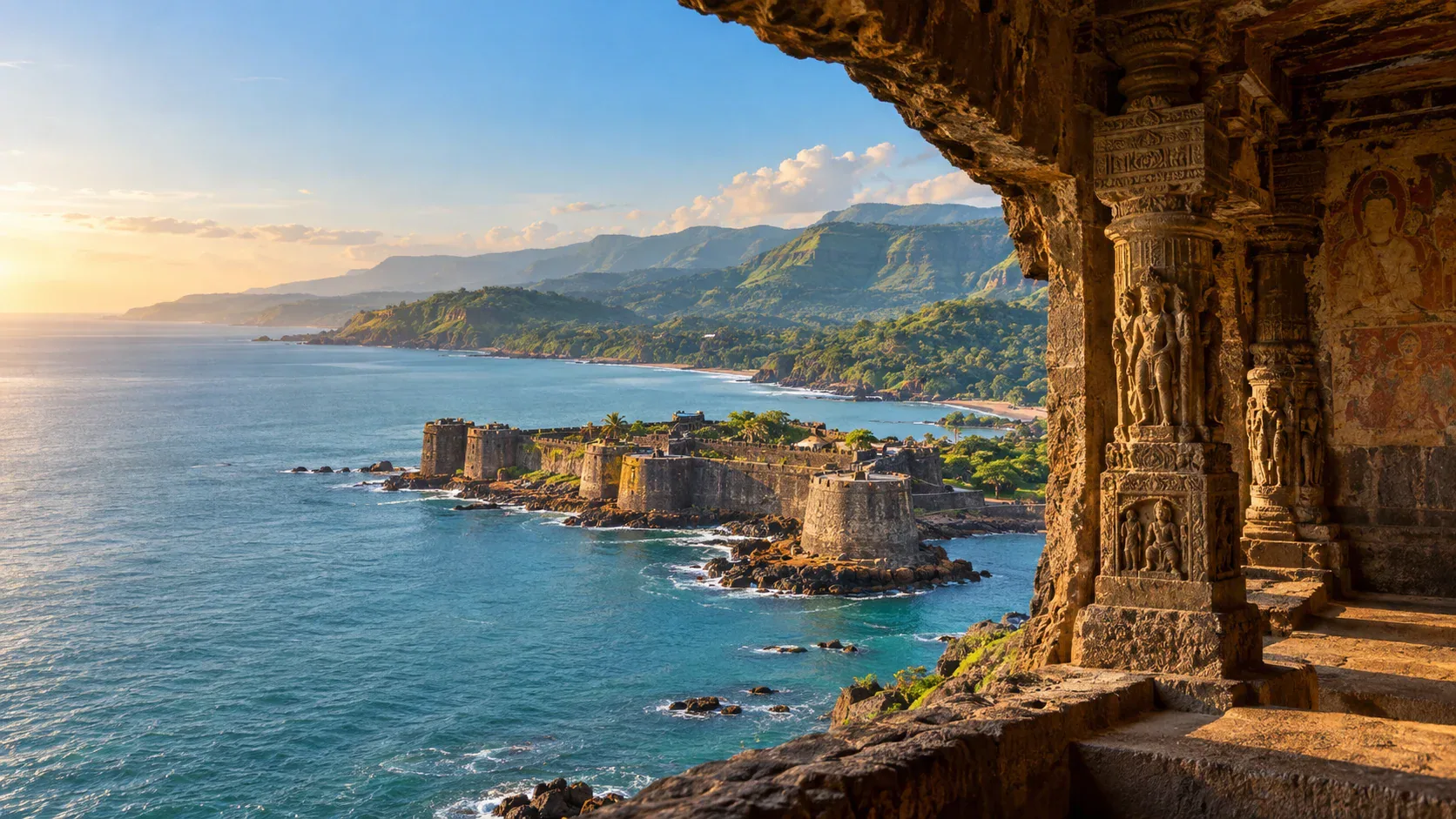
Maharashtra is a state in western and central India with an Arabian Sea coastline, the Western Ghats, the Deccan Plateau and the Vidarbha plains. Its signature attractions include the Ajanta and Ellora caves, the Gateway of India and hill stations such as Mahabaleshwar. Best season: October to February.
At a glance
Maharashtra, in brief
Maharashtra sits in western and central India, with October to February as the best season and seven to ten days as an ideal trip length. Mumbai's Chhatrapati Shivaji Maharaj International Airport is the main gateway. Indian travellers need no visa; carry a government photo ID for monument and hotel check-ins.
Maharashtra.
7 to 10 days
- Region
- Western and central IndiaArabian Sea coastline, Western Ghats, Deccan Plateau and Vidarbha plains
- Best season
- October to FebruaryGenerally best for sightseeing; monsoon suits landscapes but can disrupt hill, fort and cave access
- Ideal trip length
- 7 to 10 daysEnough for Mumbai plus one heritage or hill circuit
- Gateway
- Chhatrapati Shivaji Maharaj International Airport, Mumbai (BOM)Pune and Nagpur also have airports for regional entry
- Currency
- Indian rupee (INR)₹1 = ₹1; cards accepted widely in cities
- Language
- Marathi; Hindi and English widely used in tourismEnglish signage common at major sites
Why Travellers Love Maharashtra
Travellers choose Maharashtra for its mix of rock-cut heritage, coastline and hill stations within one state. Ajanta and Ellora offer UNESCO-listed cave art, the Konkan coast pairs sea forts with beaches, and Mumbai adds urban food and colonial-era architecture. Airlines such as IndiGo, Air India and Vistara connect major cities.
- Heritage that spans centuries
The Ajanta and Ellora caves near Chhatrapati Sambhajinagar hold Buddhist, Hindu and Jain rock-cut art. Ajanta is known for painted murals; Ellora for the monolithic Kailasa temple. Conservation work can affect access, so check current opening arrangements before travelling.
Heritage - A coastline with sea forts
The Konkan coast runs south from Mumbai through Alibaug, Murud-Janjira, Ganpatipule and Malvan. Murud-Janjira's sea fort and Malvan's Sindhudurg fort are common stops. Beaches such as Ganpatipule and Tarkarli suit relaxed stays, and Malvani seafood is a regional highlight.
Coast - Hill stations and monsoon landscapes
Mahabaleshwar, Lonavala, Khandala and Matheran sit in or near the Western Ghats. Mahabaleshwar is a popular summer and monsoon base, while Matheran restricts motor vehicles. IndiGo, Air India and Vistara connect Mumbai and Pune with other Indian cities for these circuits.
Hills
Top 10 Places to Visit in Maharashtra
The top places in Maharashtra cover Mumbai's urban landmarks, the Ajanta and Ellora caves, hill stations such as Mahabaleshwar and Lonavala, and Konkan coast stops including Ganpatipule and Malvan. Plan at least seven days to combine two regions comfortably, and carry photo ID for monument entries.
- Colaba, Mumbai
Gateway of India
An arch-monument on Mumbai's waterfront, completed in the early 20th century and facing the Arabian Sea. It is the city's most recognised landmark and a starting point for Colaba walks.
Best forFirst-time Mumbai visitors
Visit early morning to avoid crowds and combine with a walk to the nearby Colaba Causeway area.
- Near Chhatrapati Sambhajinagar (Aurangabad)
Ajanta Caves
A UNESCO-listed complex of Buddhist rock-cut caves known for ancient painted murals. The caves are cut into a horseshoe-shaped gorge and date to different phases of Buddhist art.
Best forHeritage and art travellers
Check current access and conservation-related closures before booking; photography rules can vary by cave.
- Near Chhatrapati Sambhajinagar (Aurangabad)
Ellora Caves
A UNESCO-listed rock-cut complex with Buddhist, Hindu and Jain caves, including the monolithic Kailasa temple carved from a single rock.
Best forArchitecture and history enthusiasts
Allow a full half-day; the site is large and walking distances between caves add up.
- Elephanta Island, Mumbai Harbour
Elephanta Caves
A UNESCO-listed island cave complex reached by boat from Mumbai, known for rock-cut temples and sculptures dedicated to Shiva.
Best forDay trips from Mumbai
Boats leave from the Gateway of India area; check the last return boat time before you set out.
- Satara district, Western Ghats
Mahabaleshwar
A hill station in the Western Ghats known for viewpoints, strawberry farms and a cooler climate than Mumbai or Pune. It is a common summer and monsoon base.
Best forFamilies and couples
Book stays ahead for summer and long weekends; roads can be misty and slow in heavy monsoon.
- Pune district, Western Ghats
Lonavala and Khandala
Twin hill stations between Mumbai and Pune, popular for monsoon greenery, viewpoints and easy weekend access from both cities.
Best forWeekend breaks from Mumbai and Pune
Weekday visits are calmer; expect heavy traffic on Mumbai-Pune expressway weekends.
- Raigad district, Western Ghats
Matheran
A hill station where motor vehicles are restricted, reached by toy train or on foot from the parking area. Its red laterite paths and forest cover make it a walking-focused destination.
Best forWalkers and quiet getaways
Confirm toy train operations before relying on it; otherwise plan the walk from the vehicle park.
- Ratnagiri district, Konkan coast
Ganpatipule
A coastal town with a beach and a well-known Ganpati temple, forming part of the Konkan beach circuit south of Mumbai.
Best forBeach and temple visits
Combine with Ratnagiri for Alphonso mango season and coastal food stops.
- Sindhudurg district, Konkan coast
Malvan and Tarkarli
A coastal belt known for Sindhudurg fort, clear-water stretches and Malvani seafood. Tarkarli is a common base for water activities in season.
Best forSeafood and coastal activities
Check sea conditions before water sports; monsoon can restrict activity.
- Ahmednagar district
Shirdi
A major pilgrimage town associated with Sai Baba, drawing visitors throughout the year. It is well connected by road and rail from Mumbai, Pune and Nashik.
Best forPilgrimage travellers
Expect long queues on weekends and festival days; plan darshan timings in advance.
Best Time to Visit Maharashtra
October to February is the best time to visit Maharashtra for most travellers, with cooler, drier conditions across Mumbai, Pune, the Ghats and heritage sites. March to May turns hot inland, while June to September brings monsoon rain that can disrupt hill, fort and cave access. Use the month table to match weather with crowds and prices.
January
Best time to goCool and dry across most regions; pleasant for Mumbai, Pune and heritage sites
Strong month for sightseeing and city travel
February
Best time to goDry and comfortable; warming slightly inland
Good for combining coast and heritage
March
Good time to goGetting hotter inland; coastal humidity rises
Workable if you avoid peak afternoon heat
April
Shoulder seasonHot in the Deccan and Vidarbha; hill stations remain relatively cooler
Better for Mahabaleshwar and Lonavala than plains
May
Shoulder seasonPeak summer heat inland; pre-monsoon humidity on the coast
Limit outdoor sightseeing; hill stations are the practical choice
June
Shoulder seasonSouthwest monsoon arrives; rain increases across the Ghats and coast
Suits monsoon landscapes but check cave and fort access
July
Shoulder seasonHeavy monsoon in the Ghats and Konkan; intermittent rain inland
Expect wet roads and possible activity closures
August
Good time to goContinued monsoon; green landscapes and waterfalls in the Ghats
Good for hill scenery if you accept rain delays
September
Good time to goMonsoon retreating; rain reduces through the month
A quieter shoulder month with improving conditions
October
Best time to goPost-monsoon; humidity eases and conditions become comfortable
One of the best months for a full state circuit
November
Best time to goDry and pleasant across most regions
Peak travel window; book stays early
December
Best time to goCool and dry; comfortable for coast, hills and heritage sites
Festive season with high demand and higher rates
- BestJan, Feb, Oct, Nov, Dec
- GoodMar, Aug, Sep
- FairApr, May, Jun, Jul
Maharashtra Trip Cost (2026)
A Maharashtra trip in 2026 typically costs from about ₹2,500 per person per day for budget travel to ₹12,000 or more for luxury, depending on route, season and hotel choice. These are indicative travel-budget estimates, not Tripstor package offers. Flights and land costs are usually split separately.
Budget
Students, solo travellers and backpackers
- Budget hotels and guesthouses
- State transport and shared cabs
- Street food and local eateries
- Second-class or sleeper rail where available
Mid-range
Families and couples
- 3-star and 4-star hotels
- Private cab for intercity legs
- Mix of restaurant and local dining
- Guided visits to Ajanta and Ellora
Luxury
Honeymooners and premium travellers
- 5-star and heritage-style stays
- Private transfers and dedicated guides
- Fine dining and curated experiences
- Flexible itineraries with buffer days
How to Reach Maharashtra
Mumbai's Chhatrapati Shivaji Maharaj International Airport (BOM) is the main gateway to Maharashtra, with Pune and Nagpur also receiving flights. IndiGo, Air India and Vistara connect major Indian cities. Rail and road links are strong, and the Konkan coast can be reached by train or a long drive from Mumbai.
Delhi
Direct to Mumbai (BOM)
Typical fareIndicative, varies by season
IndiGo, Air India and Vistara operate on this sector
Bengaluru
Direct to Mumbai (BOM) or Pune (PNQ)
Typical fareIndicative, varies by season
Multiple daily departures
Chennai
Direct to Mumbai (BOM)
Typical fareIndicative, varies by season
Useful for Konkan coast connections
Kolkata
Direct to Mumbai (BOM)
Typical fareIndicative, varies by season
Check baggage allowances on low-cost fares
Mumbai
Konkan Railway to Ratnagiri, Kudal or Sawantwadi
Typical fareIndicative, varies by class
Useful for Ganpatipule, Malvan and Tarkarli
Mumbai
Mumbai-Pune Expressway or NH-66 for the coast
Typical fareTolls and fuel extra
Private cab or self-drive; monsoon slows coastal roads
Pune
To Lonavala, Khandala and Mahabaleshwar
Typical fareTolls and fuel extra
Weekend traffic on the expressway is heavy
Mumbai
Boat to Elephanta Island from the Gateway of India area
Typical fareIndicative, varies by operator
Check last return boat time before departure
Travelling from your city?
Tell us where you start. A specialist can plan connections around your stay.
Plan my journeyWhere to Stay in Maharashtra
Where you stay in Maharashtra depends on your circuit: Mumbai for city access, Pune for the Ghats, Chhatrapati Sambhajinagar for Ajanta and Ellora, and Konkan coastal towns for beaches. Indicative nightly rates range from about ₹1,500 for budget stays to ₹15,000 or more for luxury, per room, before taxes.
Budget
Solo travellers and short stopovers
- Guesthouses near Mumbai suburban rail
- Budget stays around Chhatrapati Sambhajinagar for cave visits
- Basic rooms in Lonavala and Mahabaleshwar
- Coastal homestays in Konkan towns
Mid-range
Families and couples
- 3-star and 4-star hotels in Mumbai and Pune
- Resorts in Mahabaleshwar and Lonavala
- Beach-facing stays in Ganpatipule and Tarkarli
- Properties with parking for road trips
Luxury
Honeymoons and premium trips
- 5-star city hotels in Mumbai and Pune
- Premium hill resorts in the Western Ghats
- Heritage-style stays near Aurangabad
- Private villas on the Konkan coast
Local Food and Cuisine in Maharashtra
Maharashtra's cuisine ranges from Malvani coastal seafood to Kolhapuri and Varhadi inland dishes. Five dishes to try are vada pav, misal pav, thalipeeth, Kolhapuri mutton or veg rassa, and Malvani fish curry. Vegetarian options are widely available, and Jain food can be requested in many cities.
- Mumbai
Vada pav
A street snack of spiced potato fritter in a bread roll with chutneys. It is Mumbai's most common quick bite and available across the city.
Best forQuick vegetarian meals
Try it fresh from a busy stall; chutney spice levels vary.
- Pune and Kolhapur
Misal pav
A sprouted lentil curry topped with farsan, onions and lemon, served with bread rolls. Kolhapuri versions are typically hotter than Pune versions.
Best forVegetarian breakfast or brunch
Ask for the spice level before ordering if you are not used to high heat.
- Across Maharashtra
Thalipeeth
A multi-grain flatbread cooked on a griddle, often served with curd or butter. It appears on many Maharashtrian breakfast and snack menus.
Best forVegetarian travellers
Good option for travellers who want a less spicy vegetarian dish.
- Kolhapur
Kolhapuri rassa
A spicy curry, commonly made with mutton or vegetables, using Kolhapuri masala. The dish is known for its heat and complex spice mix.
Best forTravellers who enjoy spicy food
Order with plain rice or bhakri to balance the spice.
- Malvan and the Konkan coast
Malvani fish curry
A coastal curry made with coconut, kokum and local spices, usually served with rice. Fish and seafood are central to Malvani cooking.
Best forSeafood lovers
Ask about the day's catch; coastal restaurants often vary the fish by season.
Maharashtra Travel Tips
Maharashtra travel tips for 2026: carry a government photo ID for hotels and monument entries, use UPI or cards in cities and keep some cash for rural areas, and buy a local SIM or eSIM if you need data. Check cave and fort access during monsoon, and plan long intercity drives with buffer time.
- Carry photo ID
Hotels, monuments and some permits require a government photo ID. Keep a digital copy and a physical copy for cave and fort entries.
Documents - Use UPI and cards in cities
UPI and cards work widely in Mumbai, Pune and larger towns. Carry some cash for small eateries, rural transport and coastal villages.
Money - Plan connectivity for remote areas
Mobile coverage is generally good in cities but can be patchy in parts of the Western Ghats, Vidarbha and remote coastal stretches. Download offline maps before long drives.
Connectivity - Check monsoon access
June to September can disrupt hill, fort and cave access. Confirm current opening arrangements for Ajanta, Ellora and hill routes before booking.
Weather - Book peak season early
November and December see high demand in Mumbai, Mahabaleshwar, Lonavala and Konkan beach towns. Book stays and transport ahead for long weekends.
Planning - Respect local customs
Remove footwear at temples, dress modestly at religious sites such as Shirdi, and ask before photographing people. Some caves restrict photography or flash.
Etiquette - Allow buffer time on road trips
Mumbai-Pune expressway traffic and coastal monsoon conditions can slow journeys. Avoid tight same-day connections between distant regions.
Transport - Use official sources for entry rules
Monument entry fees, timings and conservation-related closures can change. Check Maharashtra Tourism and Archaeological Survey of India updates before travel.
Planning
Maharashtra vs Other Indian Destinations
Maharashtra suits travellers who want heritage caves, coastline and hill stations in one state, but it is large and requires more travel time than compact destinations. Rajasthan offers denser fort and palace circuits, while Goa is smaller and beach-focused. Choose Maharashtra for variety and cave heritage.
Maharashtra
Best forTravellers who want caves, coast and hills in one state
StrengthsAjanta and Ellora are UNESCO-listed; Konkan coast offers sea forts and seafood; Mumbai and Pune provide strong air and rail links.
Trade-offsLong intercity distances; monsoon can disrupt cave, fort and hill access; peak season rates rise in November and December.
Rajasthan
Best forFort and palace-focused heritage trips
StrengthsDense cluster of forts and palaces; well-developed heritage hotel circuit; strong rail connections between cities.
Trade-offsDesert heat in summer; no coastline; cave heritage is limited compared with Ajanta and Ellora.
Goa
Best forShort beach-focused holidays
StrengthsCompact size; easy beach access; direct flights from many Indian cities.
Trade-offsLimited hill station and cave options; smaller heritage circuit; can be crowded in peak season.
Holiday ideas to start from
Reviewed itineraries for this destination — personalise with a specialist, never an instant booking.
Ajanta and Ellora 3 Nights: Maharashtra Heritage Tour Package 2026
From₹18,000per adult, twin sharing, land only
From idea to itinerary, with a real person.
- Share your plan
Dates, departure city, travellers and the moments you’d love. It only takes a minute.
- Shape it with a specialist
A real person refines the route, stays and pace with you. Change anything.
- Review your quote
A clear, personalised quote with confirmed inclusions. No payment to enquire.
From our travel specialists
What our team sees when planning these trips, beyond what the guidebooks say.
Confirmed 11 Oct 2026
Local transport is the issue most clearly reported: covering Ajanta, Ellora and the surrounding sites independently can be less convenient than arranging a vehicle or organised excursion. In the monsoon, road conditions and closures around the Western Ghats can further complicate transfers.[1][2]
Travellers commonly report that Maharashtra is best planned as separate circuits rather than one rushed trip—for example, Mumbai–Lonavala–Pune or Aurangabad (now Chhatrapati Sambhajinagar)–Ellora–Ajanta. They also wish they had allowed separate days for Ajanta and Ellora and checked transport arrangements in advance.[1][2]
For a first heritage-focused visit, Aurangabad (Chhatrapati Sambhajinagar) is the practical base because travellers use it to visit Ajanta and Ellora on separate days, with Grishneshwar and other nearby sites added around Ellora. For a city-and-short-break trip, Mumbai is the common base for Lonavala and nearby excursions.[2][3]
A common mistake is packing distant attractions into a short itinerary, particularly trying to combine Mumbai, hill stations and Ajanta–Ellora without sufficient travel time. Travellers report that a two-day arrangement from Aurangabad for Ajanta and Ellora works better than attempting both as rushed day trips.[1][2]
Before you go
Straight answers to help you plan — then personalise the trip with a specialist.
8 answered belowAsk a specialist anything about this trip — there’s no obligation.
Ask a specialistWhat is the best time to visit Maharashtra?
October to February is generally the best time to visit Maharashtra, with cooler, drier conditions for Mumbai, Pune, the Ghats and heritage sites. March to May turns hot inland, and June to September brings monsoon rain that can disrupt hill, fort and cave access. November and December are the busiest and priciest months.
How many days are enough for a Maharashtra trip?
Seven to ten days is enough for a Maharashtra trip covering Mumbai plus one heritage or hill circuit. A shorter four to five day trip works if you stay within one region, such as Mumbai and the Konkan coast or Pune and the Western Ghats. Distances between regions are long, so avoid overpacking the itinerary.
Is Maharashtra expensive?
Maharashtra can suit most budgets. Indicative travel-budget estimates for 2026 range from about ₹2,500 per person per day for budget travel to ₹12,000 or more for luxury, on twin sharing and excluding flights. These are planning estimates, not Tripstor package offers, and costs rise in November and December.
What are the top places to visit in Maharashtra?
Top places in Maharashtra include the Gateway of India and Elephanta Caves in Mumbai, the Ajanta and Ellora caves near Chhatrapati Sambhajinagar, hill stations such as Mahabaleshwar, Lonavala and Matheran, and Konkan coast stops including Ganpatipule, Malvan and Tarkarli. Shirdi is a major pilgrimage destination.
How do I reach Maharashtra from other Indian cities?
Mumbai's Chhatrapati Shivaji Maharaj International Airport (BOM) is the main gateway, with Pune and Nagpur also receiving flights. IndiGo, Air India and Vistara connect major Indian cities. Rail and road links are strong, and the Konkan Railway serves coastal towns such as Ratnagiri and Kudal.
Is Maharashtra safe for solo and family travel?
Maharashtra is generally a practical destination for solo and family travel, with good transport and hotel options in cities. Standard precautions apply: use verified stays, avoid isolated areas at night, and check monsoon conditions before hill, fort or cave visits. No destination is universally safe, so plan according to current local advice.
What should I eat in Maharashtra?
Try vada pav and misal pav in Mumbai and Pune, thalipeeth across the state, Kolhapuri rassa in Kolhapur, and Malvani fish curry on the Konkan coast. Vegetarian options are widely available, and Jain food can be requested in many cities. Coastal dishes use coconut, kokum and local spices.
Do I need a permit to visit Maharashtra?
Indian travellers do not need a visa or permit for Maharashtra. Carry a government photo ID for hotels, monuments and some entries. Certain restricted or protected areas may require local permissions, so check current rules for specific sites before travel. Foreign nationals need a valid Indian visa.