
How Many Places Can You Cover?
Odisha offers a core circuit of must-see places that can be comfortably covered in five to seven days. The top three are the Konark Sun Temple, Jagannath Temple in Puri, and Chilika Lake. The main areas are the coastal temple circuit around Bhubaneswar, Puri, and Konark, plus the wildlife zones of Similipal and Chilika.
A standard Odisha itinerary groups the coastal heritage sites with a wildlife or beach extension. Bhubaneswar, Puri, and Konark form a tight triangle connected by road, while Chilika Lake sits south of Puri. Similipal National Park in the north requires a separate two-day commitment. Ten days allows you to add either Similipal or the quieter southern coast around Gopalpur-on-Sea without rushing the temple circuit.
At a glance
Odisha, in brief
Odisha's must-see places are Konark Sun Temple, Jagannath Temple in Puri, and Chilika Lake. Plan for five to seven days, base yourself in Bhubaneswar or Puri, and travel between October and March. Entry fees vary by site, with most temples free and monuments charging a nominal fee.
Odisha.
5–7 days for the coastal circuit; 10 days to add wildlife or southern beaches
- Must-see places
- Konark Sun Temple, Jagannath Temple (Puri), Chilika Lake, Lingaraj Temple (Bhubaneswar), Similipal National Park
- Ideal days
- 5–7 days for the coastal circuit; 10 days to add wildlife or southern beaches
- Best base
- Bhubaneswar for arrival and temple sightseeing; Puri for the coast and Jagannath Temple
- Best season
- October to March; November to February is the most reliable core season
- Typical entry fee range
- Most temples free; ASI monuments like Konark Sun Temple charge a nominal fee for Indian nationals. Confirm current rates locally.
Top Places in Odisha
The top places in Odisha span UNESCO World Heritage architecture, major pilgrimage sites, and Asia's largest brackish-water lagoon. Konark Sun Temple, Jagannath Temple in Puri, and Chilika Lake anchor most itineraries. Bhubaneswar's temple clusters and the wildlife reserves of Similipal add depth for travellers with more time.
- Konark, Puri district
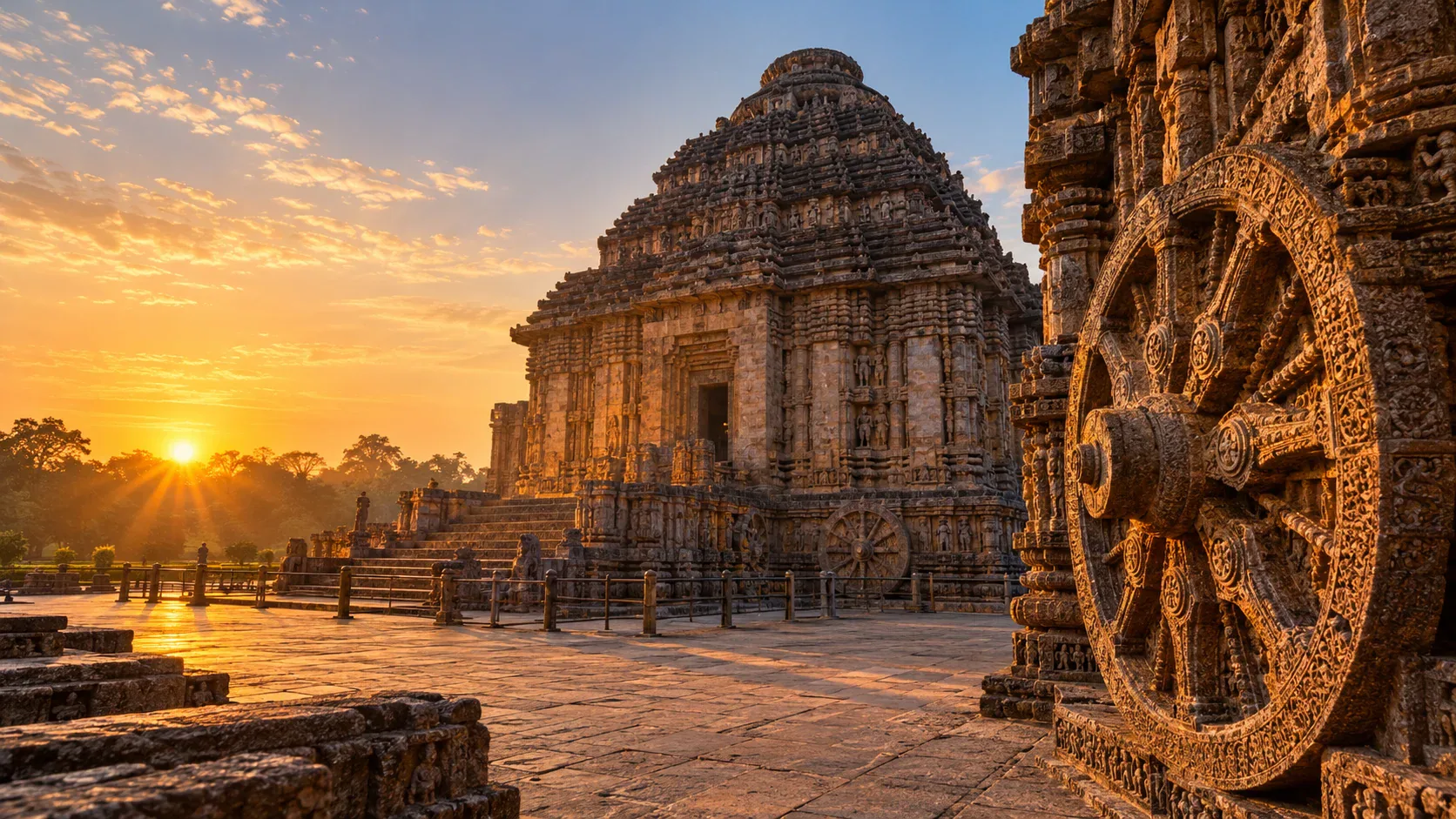
Konark Sun Temple
A UNESCO World Heritage Site built in the 13th century, designed as a monumental stone chariot of the sun god with intricately carved wheels and horses.
Best forHeritage and architecture enthusiasts
Visit at opening time or late afternoon to avoid midday heat; combine with Chandrabhaga Beach nearby.
- Puri
Jagannath Temple
One of the Char Dham pilgrimage sites, this major temple is the centre of the annual Rath Yatra and a key pilgrimage destination for Hindus.
Best forPilgrims and culture travellers
Non-Hindus cannot enter the temple complex; use the Raghunandan Library viewing platform for an exterior view.
- Purba Medinipur and Khordha districts
Chilika Lake
Asia's largest brackish-water lagoon, known for migratory birds from November to February and Irrawaddy dolphins near Satapada.
Best forWildlife and nature lovers
Choose your boating point by interest: Satapada for dolphins, Mangalajodi for birding.
- Bhubaneswar
Lingaraj Temple
The largest temple in Bhubaneswar, dedicated to Shiva and representing the peak of Kalinga architecture.
Best forTemple architecture and history
Visit early morning to avoid heat and crowds; non-Hindus may not enter the main sanctum.
- Mayurbhanj district
Similipal National Park
A large forest reserve known for elephants, tigers, waterfalls, and sal woodland, forming part of the Similipal Biosphere Reserve.
Best forWildlife safaris and nature stays
Park access and safari zones can change with weather and permissions; confirm entry before promising a specific route.
- Near Bhubaneswar
Dhauli
A peace pagoda and Ashokan rock-edict landscape associated with the Kalinga War, marking a turning point in Emperor Ashoka's reign.
Best forHistory and Buddhist heritage
Pair it with nearby Udayagiri and Khandagiri caves rather than allocating a full day.
- Near Bhubaneswar
Udayagiri and Khandagiri Caves
Ancient rock-cut caves with intricate carvings, some dating back to the 2nd century BCE, used by Jain monks.
Best forArchaeology and rock-cut architecture
Wear comfortable shoes for the climb; go early to avoid heat.
- Ganjam district
Gopalpur-on-Sea
A quieter southern Odisha beach base with a relaxed seafront and access to nearby heritage sites.
Best forBeach relaxation and quiet stays
Better for a calm coastal overnight than a packed sightseeing list; avoid monsoon surf conditions.
- Near Puri
Raghurajpur Artist Village
A heritage crafts village where residents practise Pattachitra painting and other traditional arts.
Best forArt, crafts, and cultural immersion
Visit during daylight hours; buy directly from artisans to support the community.
- Near Konark
Chandrabhaga Beach
A beach near the Konark Sun Temple, known for its sunrise views and relatively quieter atmosphere compared to Puri's main beach.
Best forSunrise views and coastal walks
Combine with your Konark temple visit; the beach is a short drive away.
- Puri
Puri Beach
A broad seafront along the Bay of Bengal, popular for walks and local snacks, though swimming is not recommended due to currents.
Best forEvening strolls and local food
Visit in the evening for the atmosphere; keep valuables secure and avoid isolated stretches after dark.
- Kendrapara district
Bhitarkanika National Park
A mangrove ecosystem known for saltwater crocodiles, birds, and boat safaris through creeks.
Best forMangrove wildlife and boat safaris
Boat safaris are the main way to explore; book in advance and follow park guidelines.
Underrated Places in Odisha Most Tourists Miss
Beyond the main circuit, Odisha has lesser-known places that reward travellers with extra time. These include Mangalajodi for birding, the heritage village of Raghurajpur, and the quiet beaches of Gopalpur-on-Sea. Each offers a specific experience without the crowds of Puri or Konark.
- Chilika Lake, Khordha district
Mangalajodi
A village on the northern edge of Chilika Lake, known for community-led birding tours that support local conservation.
Best forBirdwatching and community tourism
Go early morning from November to February for migratory birds; book a local guide.
- Near Puri
Raghurajpur Artist Village
A heritage crafts village where residents practise Pattachitra painting and other traditional arts.
Best forArt, crafts, and cultural immersion
Visit during daylight hours; buy directly from artisans to support the community.
- Ganjam district
Gopalpur-on-Sea
A quieter southern Odisha beach base with a relaxed seafront and access to nearby heritage sites.
Best forBeach relaxation and quiet stays
Better for a calm coastal overnight than a packed sightseeing list; avoid monsoon surf conditions.
- Kandhamal district
Daringbadi
A hill station often called the 'Kashmir of Odisha', with pine forests, coffee plantations, and cooler temperatures.
Best forHill views and nature walks
Best visited from October to February; carry warm clothing for evenings.
- Ganjam district
Taptapani
A hot spring site with religious significance, surrounded by forest and a temple.
Best forHot springs and offbeat stops
The water is hot; test before entering. Combine with a visit to Gopalpur-on-Sea.
Places by Type of Experience
Odisha suits different travellers in different ways. Families gravitate to Bhubaneswar, Puri, and Chilika for manageable distances and varied interests. Couples often prefer quieter beaches like Gopalpur-on-Sea. Adventure travellers head to Similipal or Bhitarkanika, while culture seekers focus on the temple circuit and craft villages.
Families
Best forBhubaneswar, Puri, Konark, Chilika Lake
StrengthsShort driving distances between key sites; mix of temples, beaches, and wildlife; plenty of food and stay options.
Trade-offsLong road transfers to Similipal or southern beaches; heat in summer; temple access rules for non-Hindus.
Couples
Best forGopalpur-on-Sea, Chandrabhaga Beach, Daringbadi
StrengthsQuieter beaches and hill stations; romantic sunsets; less crowded than Puri.
Trade-offsFewer luxury stay options outside Bhubaneswar and Puri; limited nightlife.
Adventure travellers
Best forSimilipal National Park, Bhitarkanika National Park, Chilika Lake
StrengthsWildlife safaris, boat rides, mangrove creeks; chance to see elephants, crocodiles, and dolphins.
Trade-offsPark access can be restricted by weather or permissions; safaris require advance booking; basic facilities in some areas.
Culture travellers
Best forBhubaneswar, Puri, Konark, Raghurajpur
StrengthsUNESCO World Heritage Site at Konark; living temple traditions; Pattachitra art villages; classical dance and music.
Trade-offsNon-Hindus cannot enter Jagannath Temple and some other temples; some sites lack detailed signage in English.
Suggested Order for Your Odisha Itinerary
A practical three-day route covers Bhubaneswar, Puri, and Konark, with Chilika Lake as an optional extension. Start in Bhubaneswar for arrival and temple sightseeing, move to Puri for the Jagannath Temple and beach, then visit Konark Sun Temple on the way back or as a day trip. Add a day for Chilika if time allows.
Day01 Stop 1 of 3Arrive in Bhubaneswar and explore the temple city
Start with Bhubaneswar's temple clusters and caves, then prepare for the coastal circuit.
MorningVisit Lingaraj Temple early to avoid heat and crowds. Non-Hindus can view from outside.
AfternoonExplore Udayagiri and Khandagiri caves, then Dhauli peace pagoda and Ashokan edict site.
EveningWalk around Ekamra Haat for Odisha handicrafts, or rest for the next day's drive.
Day02 Stop 2 of 3Drive to Puri via Konark Sun Temple
Cover the UNESCO-listed Sun Temple en route to Puri, then settle into the coastal town.
MorningDepart Bhubaneswar for Konark. Visit the Sun Temple at opening time.
AfternoonContinue to Chandrabhaga Beach, then drive to Puri. Check in and visit Jagannath Temple exterior if non-Hindu, or enter if permitted.
EveningWalk along Puri Beach and try local snacks.
Day03 Stop 3 of 3Puri to Chilika Lake or return to Bhubaneswar
Choose a Chilika Lake day trip for dolphins and birds, or return to Bhubaneswar for departure.
MorningIf visiting Chilika, drive to Satapada for a boat ride to see Irrawaddy dolphins.
AfternoonLunch at a lakeside spot, then either return to Puri or head back to Bhubaneswar.
EveningIf in Bhubaneswar, do any last-minute shopping or sightseeing.
Visiting Tips for Odisha
Practical tips for Odisha include booking ASI monument tickets online where possible, carrying cash for small entry fees, and using hired cars for the Bhubaneswar–Puri–Konark circuit. Temple dress codes require modest clothing, and non-Hindus should respect entry restrictions. Confirm park and safari permissions in advance for wildlife areas.
- Book ASI monument tickets online
For Konark Sun Temple and other ASI sites, check the official ASI website for e-tickets to skip queues. Carry ID for verification.
Tickets - Carry cash for small fees
Some temples and smaller sites may not accept digital payments. Keep small notes for entry fees, shoe storage, and guides.
Money - Hire a car for the coastal circuit
A private car with driver is the most efficient way to cover Bhubaneswar, Puri, and Konark. Shared taxis and buses exist but add time.
Transport - Dress modestly for temples
Cover shoulders and knees. Some temples require removing footwear and leather items before entering.
Etiquette - Respect temple entry rules
Non-Hindus cannot enter Jagannath Temple in Puri and some other temples. Use designated viewing points and follow local guidance.
Etiquette - Confirm wildlife park access
Similipal and Bhitarkanika safaris depend on weather and permissions. Check with the forest department or a local operator before planning.
Wildlife - Start early to avoid heat
Odisha can be hot from March onwards. Plan outdoor sites like Konark and caves for early morning or late afternoon.
Timing - Use Satapada for dolphins, Mangalajodi for birds
Chilika Lake experiences differ by boating point. Satapada is known for Irrawaddy dolphins; Mangalajodi for migratory birds from November to February.
Wildlife
Holiday ideas to start from
Reviewed itineraries for this destination — personalise with a specialist, never an instant booking.
Bhubaneswar Konark Puri 4 Nights: Heritage Tour Package 2026
From₹22,000per adult, twin sharing, land only
From idea to itinerary, with a real person.
- Share your plan
Dates, departure city, travellers and the moments you’d love. It only takes a minute.
- Shape it with a specialist
A real person refines the route, stays and pace with you. Change anything.
- Review your quote
A clear, personalised quote with confirmed inclusions. No payment to enquire.
From our travel specialists
What our team sees when planning these trips, beyond what the guidebooks say.
Confirmed 11 Oct 2026
A common planning mistake is squeezing Bhubaneswar, Puri, Konark and Chilika into only three or four days. Travellers report that Chilika deserves at least half a day, so adding it to the coastal temple circuit is more practical with roughly five to six days; public transport to smaller boating points can also consume much of a day.
Bhubaneswar is the most practical initial base because it provides access to the major temple circuit and convenient day trips to Puri, Konark and Chilika; travellers can then move to Puri for the beach portion. For a first visit, a Bhubaneswar-to-Puri coastal loop is considered manageable without excessive rushing.
Families benefit from allowing more time than a tightly packed temple itinerary, especially when adding Chilika or craft villages; public transport and long road transfers can be tiring. Couples often value quieter experiences such as a Chilika boat ride, a sunset at Konark or a slower Puri beach day rather than treating every stop as a rushed excursion.
Local transport is the clearest practical difficulty: buses and other public transport become sparse away from the main routes, so reaching places such as smaller Chilika boating points or Daringbadi can require several connections and take a full day. Travellers often find a hired car or taxi more convenient for the Puri–Konark–Chilika circuit, particularly during monsoon conditions.
Before you go
Straight answers to help you plan — then personalise the trip with a specialist.
8 answered belowAsk a specialist anything about this trip — there’s no obligation.
Ask a specialistWhat is the best time to visit Odisha?
October to March is generally best for comfortable sightseeing, pilgrimage, beaches, and wildlife. November to February is the most reliable core season, with cooler temperatures and clear skies. Summer months can be very hot, and the monsoon from June to September brings heavy rain and rough seas.
How many days are enough for an Odisha tour?
Five to seven days covers Bhubaneswar, Puri, Konark, and Chilika Lake at a comfortable pace. Ten days allows you to add either Similipal National Park or the southern coast around Gopalpur-on-Sea without rushing the main temple circuit.
What is Odisha famous for?
Odisha is known for the Jagannath Temple in Puri, the Konark Sun Temple, Kalinga architecture, classical dance, handicrafts, Chilika Lake, and wildlife reserves like Similipal. The state also has a rich tradition of Pattachitra painting and silver filigree work.
Is Odisha safe for tourists?
The main tourist circuit is generally manageable with normal precautions. Use registered transport, avoid isolated beaches after dark, and follow park and coastal warnings. As with any destination, keep valuables secure and stay aware of your surroundings.
How do I travel from Bhubaneswar to Puri and Konark?
Use rail or road to Puri, then a hired car or taxi for Konark. A private vehicle is the most efficient option for the combined circuit. Buses and shared taxis are available but take longer and may require changes.
Can non-Hindus enter Jagannath Temple in Puri?
No. Non-Hindus are not permitted inside the temple complex. However, exterior viewing is available from designated nearby locations such as the Raghunandan Library viewing platform. Respect all signage and local guidance.
Is Chilika Lake worth visiting?
Yes, particularly from November to February for migratory birds. Satapada is commonly used for dolphin trips, and Mangalajodi is known for community-led birding. The lake is Asia's largest brackish-water lagoon and offers a distinct ecosystem.
What wildlife can I see in Odisha?
Depending on season and site, visitors may see Irrawaddy dolphins, migratory birds, elephants, deer, crocodiles, turtles, and, with luck, tigers. Similipal and Bhitarkanika are key wildlife areas, while Chilika is known for dolphins and birds.