
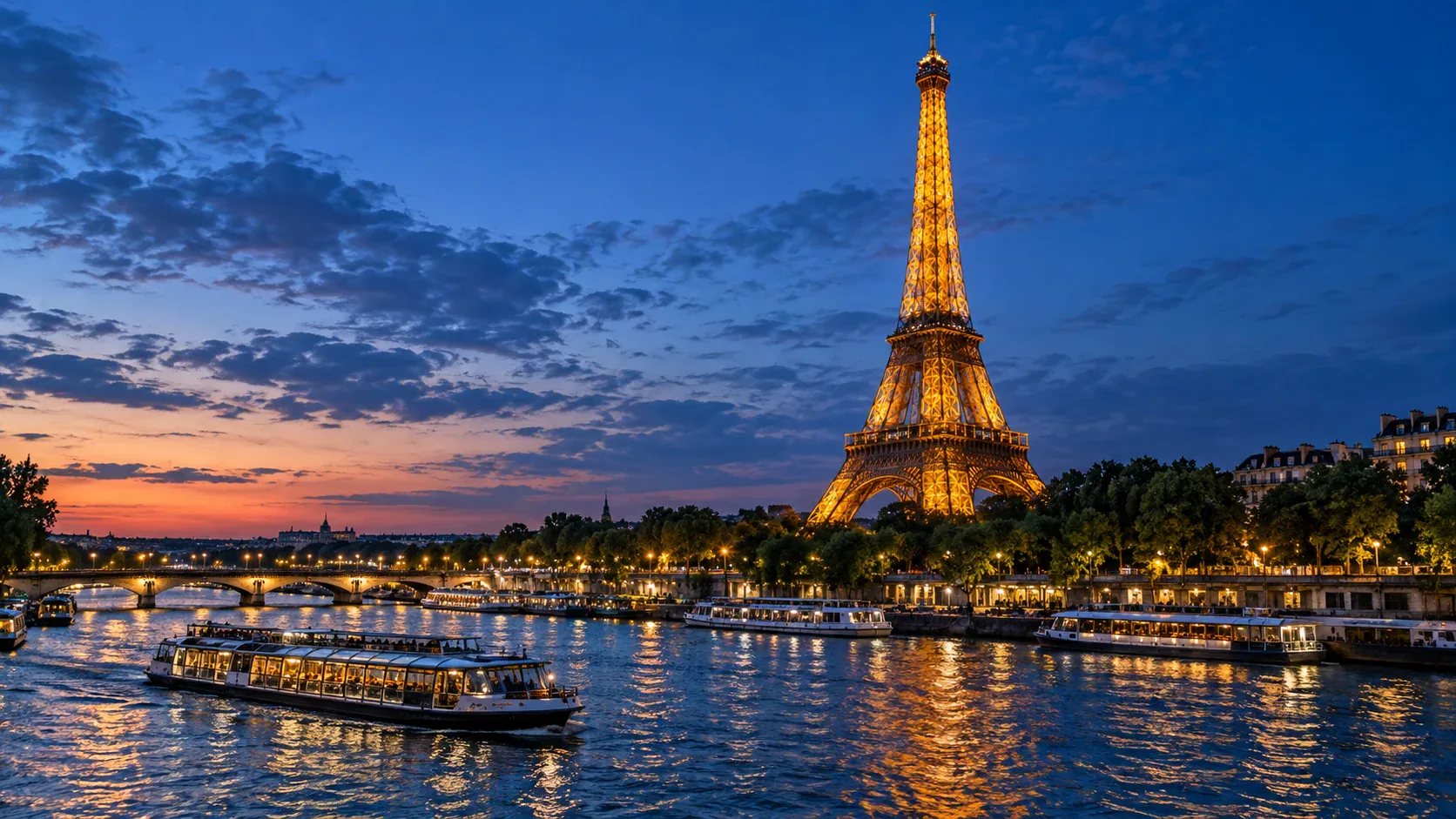
Guides for this destination
Practical reads before you plan — timing, places, costs, visas and tips.
Showing 7 of 7 guides
 France Travel Tips for Indian Tourists: A Practical 2026 GuideRead the guide
- France Travel Guide for Indians: Your Complete 2026 Planning ResourceRead the guide
- Places to Visit in FranceRead the guide
- France Trip Cost from India: Complete 2026 Budget GuideRead the guide
 France Visa for Indians 2026: Complete Requirements & Application GuideRead the guide
- France Itinerary — How Many Days and What to CoverRead the guide
- France Travel Guide for Indians: Complete 2026 Planning ResourceRead the guide
What France Travel Means for Indian Travellers
France is a Western European country with Atlantic, English Channel, Mediterranean and Alpine regions, and Paris as its main gateway. The signature attraction is the Eiffel Tower in Paris. Best season is April-June and September-October. Distinctive experiences include Paris museum days, French Riviera coastal time and Alpine mountain views. It suits first-time Europe travellers, families, couples and food-focused visitors.
France sits in Western Europe at UTC+1 in winter and UTC+2 during daylight-saving time. The country spans multiple climate zones, from the Atlantic coast to the Mediterranean and the Alps, with the highest point at 4,810 m. The currency is the Euro (EUR), roughly ₹95-100 per EUR though the rate fluctuates. French is the national language.
For Indian travellers, France works as a single-country trip or as the anchor of a multi-country Europe itinerary. The main international gateway is Paris Charles de Gaulle Airport (CDG).
At a glance
France, in brief
France is in Western Europe, uses the Euro and French, and is best visited from April to June or September to October. A 7-10 day trip covers Paris plus one region. Indians need a Schengen short-stay visa. Paris Charles de Gaulle Airport (CDG) is the primary gateway.
France.
7-10 days
- Region
- Western EuropeAtlantic, English Channel, Mediterranean and Alpine zones
- Best season
- April-June and September-OctoberMild weather, lower crowds than July-August
- Ideal trip length
- 7-10 daysParis plus one region such as the French Riviera or the Alps
- Gateway airport
- Paris Charles de Gaulle Airport (CDG)Main international arrival point for Indian travellers
- Currency
- Euro (EUR)Approximately ₹95-100 per EUR; rate fluctuates
- Language
- FrenchEnglish is common in tourist areas but basic French helps
Why Indians Love France
Indians choose France for three concrete reasons: Paris delivers world-famous landmarks and museums in a compact metro network; the French Riviera offers Mediterranean beach time; and direct flights from Indian cities make the journey practical. Air France and Air India both connect India to Paris, and the Schengen visa allows multi-country Europe trips.
- Paris landmarks and museums in one city
The Eiffel Tower, the Louvre and the Seine sit within a compact area served by the Paris Metro. Book timed entries for major museums to avoid long queues.
Sightseeing - French Riviera for Mediterranean beach time
The Riviera gives Indian travellers a coastal break with Mediterranean weather, a contrast to Paris. It works well as a second stop after Paris.
Beach - Direct flights from Indian cities
Air France and Air India connect Indian cities to Paris. Direct flights reduce travel time and jet lag compared with multi-stop routings.
Flights
Paris concentrates the Eiffel Tower, the Louvre and the Seine within a walkable and metro-connected core. The French Riviera adds a coastal contrast with Mediterranean weather. Direct flights from Indian cities reduce travel fatigue, and the Schengen visa lets you combine France with neighbouring countries on one trip.
Top 10 Places to Visit in France
The top places in France for Indian travellers include the Eiffel Tower, the Louvre, the Palace of Versailles, Mont Saint-Michel, the French Riviera, the Alps, the Loire Valley, Strasbourg, Lyon and the Provence region. Each offers a distinct mix of heritage, landscape and food, and most connect easily by train from Paris.
- Paris
Eiffel Tower
Iconic iron tower and the signature attraction of France, located in Paris.
Best forFirst-time visitors, photography
Book timed tickets in advance and choose a weekday morning for fewer crowds.
- Paris
Louvre Museum
Major art museum in Paris housing thousands of works including the Mona Lisa.
Best forArt lovers, culture
Enter via the Carrousel du Louvre entrance to reduce queue time.
- Versailles, near Paris
Palace of Versailles
Former royal residence with extensive gardens, reachable as a day trip from Paris.
Best forHistory, architecture
Go on a weekday and arrive early; the gardens need separate time.
- Normandy
Mont Saint-Michel
Tidal island commune with a historic abbey, a UNESCO World Heritage site.
Best forHeritage, photography
Check tide times before visiting; the causeway can be affected.
- Mediterranean coast
French Riviera
Coastal region with Mediterranean beaches and resort towns.
Best forBeach, relaxation
Base in Nice or Cannes and use trains to explore nearby towns.
- Alpine region
French Alps
Mountain range with the highest point in France at 4,810 m.
Best forMountains, adventure
Summer suits hiking; winter suits skiing. Check seasonal access.
- Central France
Loire Valley
Region known for châteaux and vineyards, popular as a day trip or short stay.
Best forCastles, wine
Rent a car or join a small-group tour to cover multiple châteaux.
- Alsace
Strasbourg
City with a historic centre and European institutions, near the German border.
Best forArchitecture, Christmas markets
Visit the Christmas market if travelling in December.
- Auvergne-Rhône-Alpes
Lyon
France's gastronomic capital with a UNESCO-listed old town.
Best forFood, culture
Try a bouchon for traditional Lyonnaise food.
- Southern France
Provence
Region known for lavender fields, Roman ruins and hilltop villages.
Best forLandscapes, photography
Lavender blooms around June-July; check local conditions.
These ten places cover the main highlights. Distances and travel times vary, so plan two to three bases rather than trying to see everything from Paris.
Best Time to Visit France from India
The best time to visit France from India is April to June and September to October, when weather is mild and crowds are lower than the July-August peak. July and August are warmest and busiest. December has Christmas markets but cold weather. January and February are quietest and cheapest.
January
Shoulder seasonCold; short daylight
Quiet and cheap, but cold for outdoor sightseeing.
February
Shoulder seasonCold; occasional snow in some regions
Good for budget travel if you pack for cold.
March
Good time to goCool; improving daylight
Shoulder season begins; fewer crowds than summer.
April
Best time to goMild; spring conditions
One of the best months for sightseeing.
May
Best time to goMild to warm; long days
Excellent balance of weather and crowds.
June
Best time to goWarm; long days
Great weather but prices rise as summer starts.
July
Good time to goWarm to hot; peak summer
Busiest and warmest; book everything early.
August
Good time to goWarm to hot; peak summer
Peak holiday month; expect crowds at major sites.
September
Best time to goMild; pleasant
Another top month for weather and lower crowds.
October
Best time to goCool; autumn colours
Good for city breaks and wine regions.
November
Shoulder seasonCool; shorter days
Quiet and cheaper, but less daylight.
December
Good time to goCold; festive markets
Christmas markets draw crowds; pack warm layers.
- BestApr, May, Jun, Sep, Oct
- GoodMar, Jul, Aug, Dec
- FairJan, Feb, Nov
Use this month-by-month table to match your travel dates with weather, crowd and price levels. Ratings are indicative for general sightseeing, not for specific events.
Trip Cost from India (2026)
A France trip from India in 2026 costs roughly ₹1.2-1.8 lakh per person for a 7-day budget trip, ₹2-3 lakh for mid-range, and ₹4.5 lakh and above for luxury, based on double sharing and economy flights. These are travel-budget estimates, not Tripstor package offers. Flights typically make up 40-50% of the total.
Budget
Students, backpackers, first-time Europe travellers
- Economy return flights from Indian cities
- Hostels or 2-star hotels on the outskirts
- Public transport and self-guided sightseeing
Mid-range
Couples, families, comfortable sightseeing
- 3-4 star hotels in central areas
- Some guided tours and museum entries
- Train travel between cities
Luxury
Honeymoons, special occasions, premium comfort
- 4-5 star hotels and central locations
- Private transfers and guided experiences
- Fine dining and premium train classes
The tiers below split estimated costs by travel style. Flight and land costs vary by season, city and how early you book. Treat all figures as indicative planning estimates, not confirmed quotes.
How to Reach France from India
Indians reach France by direct flights from Delhi, Mumbai and Bengaluru to Paris Charles de Gaulle Airport (CDG) with Air France and Air India. Flight time is roughly 9-10 hours. Indirect options via the Middle East add a stop. Within France, trains connect Paris to major cities.
Delhi
Direct
Air France and Air India operate direct services to Paris CDG.
Mumbai
Direct
Air France operates direct services to Paris CDG.
Bengaluru
Direct or one stop
Check current schedules; some services may be seasonal.
Paris
TGV
TGV connects Paris to Lyon, Marseille, Strasbourg and other cities.
Travelling from your city?
Tell us where you start. A specialist can plan connections around your stay.
Plan my journeyDirect flights are the fastest option. Indirect routings can be cheaper but add transit time. Once in France, the TGV train network links Paris to Lyon, Marseille, Strasbourg and other cities.
Where to Stay in France
Where you stay in France depends on your budget and itinerary. Paris suits first-time visitors, the French Riviera suits beach time, and the Alps suit mountain stays. Budget travellers can use hostels or 2-star hotels, mid-range travellers 3-4 star hotels, and luxury travellers 4-5 star properties. Indicative rates vary by season and city.
Budget
Solo travellers, students, budget-conscious visitors
- Hostels and 2-star hotels
- Often on the outskirts or near transport hubs
- Shared facilities may apply
Mid-range
Couples, families, comfortable city stays
- 3-4 star hotels
- Central locations or good transport links
- Breakfast often included
Luxury
Honeymoons, special occasions, premium comfort
- 4-5 star hotels and palaces
- Prime locations and premium amenities
- Concierge and fine dining options
Choose a base that matches your transport plan. In Paris, staying near a Metro station saves time. On the Riviera, Nice and Cannes are common bases. In the Alps, pick a town with access to your chosen activities. Rates below are indicative and not contracted inventory.
Local Food and Cuisine in France
French cuisine includes dishes such as croissants, baguettes, coq au vin, ratatouille and crème brûlée. Vegetarians can find options in most cities, though traditional menus are meat-heavy. Indian travellers should look for restaurants with vegetarian labels or ask clearly about ingredients. Lyon is known for traditional bouchons.
- Paris and across France
Croissant
Flaky pastry commonly eaten at breakfast.
Best forBreakfast, snacks
Look for bakeries with high turnover for freshness.
- Across France
Baguette
Long crusty bread, a daily staple.
Best forPicnics, sandwiches
Buy from a boulangerie and eat the same day.
- Across France, especially Burgundy
Coq au vin
Chicken braised in wine with mushrooms and onions.
Best forTraditional dinner
Ask if the sauce contains alcohol if you avoid it.
- Provence and the Riviera
Ratatouille
Vegetable stew of tomatoes, courgettes, aubergines and peppers.
Best forVegetarian main
A good vegetarian option in many restaurants.
- Across France
Crème brûlée
Baked custard dessert with a caramelised sugar top.
Best forDessert
Often served cold; check if it contains eggs.
Use this list to plan what to try and where. Restaurant names are not listed in the research data, so area guidance is provided instead.
France Travel Tips for Indians
Indians travelling to France need a Schengen short-stay visa, a valid passport, travel insurance and proof of funds. The currency is the Euro. Buy a local SIM or eSIM for data. Keep copies of documents. Learn basic French phrases. Confirm current entry rules on the official France-Visas portal before booking.
- Apply for a Schengen short-stay visa early
Indians need a Schengen short-stay visa for France. Apply through the official France-Visas portal and allow time for processing. Do not book non-refundable travel before visa approval.
Visa - Carry Euro cash and cards
The currency is the Euro (EUR). Cards are widely accepted, but keep some cash for small purchases. Inform your bank before travelling.
Money - Get a local SIM or eSIM
Buy a French SIM or an eSIM for data. This helps with maps, translation and bookings. Check your phone is unlocked before you travel.
Connectivity - Keep document copies
Carry photocopies or digital copies of your passport, visa and insurance. Store them separately from the originals.
Safety - Learn basic French phrases
Bonjour, merci and au revoir go a long way. English is common in tourist areas but basic French is appreciated.
Etiquette
These tips cover the practical points Indian travellers ask about most. Visa rules can change, so verify before you apply.
Honest Comparison: France vs Other Europe Options
France competes with Switzerland, Italy and Spain for Indian travellers. France offers Paris landmarks, Riviera beaches and Alpine scenery in one country. Switzerland is costlier but more compact for mountains. Italy offers similar heritage with different food and cities. Spain is often cheaper for beach and city breaks.
France
Best forFirst-time Europe travellers wanting Paris plus a second region
StrengthsDirect flights from India, diverse regions, strong train network
Trade-offsPeak summer crowds and high prices in July-August
Switzerland
Best forMountain-focused trips and scenic rail journeys
StrengthsCompact, efficient transport, dramatic Alpine scenery
Trade-offsHigher daily costs than France for food and stays
Italy
Best forHeritage, food and city-hopping
StrengthsRich history, varied regional cuisine, many UNESCO sites
Trade-offsPopular cities can be crowded; internal transport varies
Compare these options based on your priorities: budget, travel time, and the mix of city and nature you want.
Holiday ideas to start from
Reviewed itineraries for this destination — personalise with a specialist, never an instant booking.
Paris City Break Premium 4 Nights: France 4N5D Tour Package 2026
From₹1,36,600per adult, twin sharing, land only
From idea to itinerary, with a real person.
- Share your plan
Dates, departure city, travellers and the moments you’d love. It only takes a minute.
- Shape it with a specialist
A real person refines the route, stays and pace with you. Change anything.
- Review your quote
A clear, personalised quote with confirmed inclusions. No payment to enquire.
From our travel specialists
What our team sees when planning these trips, beyond what the guidebooks say.
Confirmed 11 Oct 2026
Travellers commonly add short regional trips after arriving, particularly from Nice to Èze, Antibes, Monaco or Cannes by local train. They also tend to shift time away from central Paris toward the French Riviera or less familiar regions after discovering how much variety France offers.
Travellers commonly wish they had allowed more time instead of trying to combine Paris, the Riviera and other European countries quickly. Indian travellers also report that France’s countryside and smaller towns can be more rewarding than concentrating only on crowded hubs such as Paris and Nice.
The recurring mistake is packing too many regions into a short trip and losing time in transit. Travellers recommend roughly three to four days in Paris, then using one base such as Nice for Riviera day trips, and booking long-distance SNCF trains ahead rather than leaving them until departure.
For a first visit combining major sights with manageable day trips, travellers commonly use Paris as the main base for about three to four days, then Nice as a Riviera base. Nice works well because regional trains connect it with Èze, Antibes, Monaco and Cannes without requiring a new hotel for every stop.
Before you go
Straight answers to help you plan — then personalise the trip with a specialist.
8 answered belowAsk a specialist anything about this trip — there’s no obligation.
Ask a specialistDo Indian citizens need a visa for France?
Yes, Indian citizens need a Schengen short-stay visa for tourism in France. Apply through the official France-Visas portal before booking travel. Requirements and processing times can change, so confirm current rules on the official site. Do not book non-refundable flights until your visa is approved.
What is the best time to visit France from India?
April to June and September to October generally offer the best balance of mild weather, sightseeing conditions and lower crowds than July-August. July and August are warmest but busiest and priciest. December has Christmas markets but cold weather. January and February are quietest and cheapest.
How much does a France trip cost from India?
Indicative travel-budget estimates for 2026 are roughly ₹1.2-1.8 lakh per person for a 7-day budget trip, ₹2-3 lakh for mid-range, and ₹4.5 lakh and above for luxury, based on double sharing and economy flights. These are estimates, not Tripstor package offers. Flights often make up 40-50% of the total.
Which airlines fly direct from India to France?
Air France and Air India operate direct flights from Indian cities such as Delhi and Mumbai to Paris Charles de Gaulle Airport (CDG). Flight time is roughly 9-10 hours. Indirect options via the Middle East may be cheaper but add transit time. Check current schedules before booking.
Is France safe for Indian travellers?
France is generally safe for tourists, but pickpocketing can occur in crowded areas such as metro stations and major attractions. Keep valuables secure, avoid isolated areas at night, and carry document copies. Safety conditions vary by location, so stay aware of your surroundings and follow local advice.
What should I pack for a France trip?
Pack layers for mild to cold weather depending on season, comfortable walking shoes, a universal adapter, and any prescription medicines with documentation. Summer needs light clothing and sun protection; winter needs a warm coat, gloves and a scarf. Carry a reusable water bottle and a small day bag.
Can I use Indian debit or credit cards in France?
Indian debit and credit cards are widely accepted in France, but inform your bank before travelling to avoid blocks. Carry some Euro cash for small purchases and markets. Check card fees and exchange rates. ATMs are available in cities and towns, though fees may apply.
How many days do I need for a France trip?
A 7-10 day trip covers Paris plus one region such as the French Riviera or the Alps. If you want to add more regions, plan 12-14 days. Trying to cover too much in a short trip leads to rushed travel. Base yourself in two or three places for a comfortable pace.