
Guides for this destination
Practical reads before you plan — timing, places, costs, visas and tips.
What Is Karnataka?
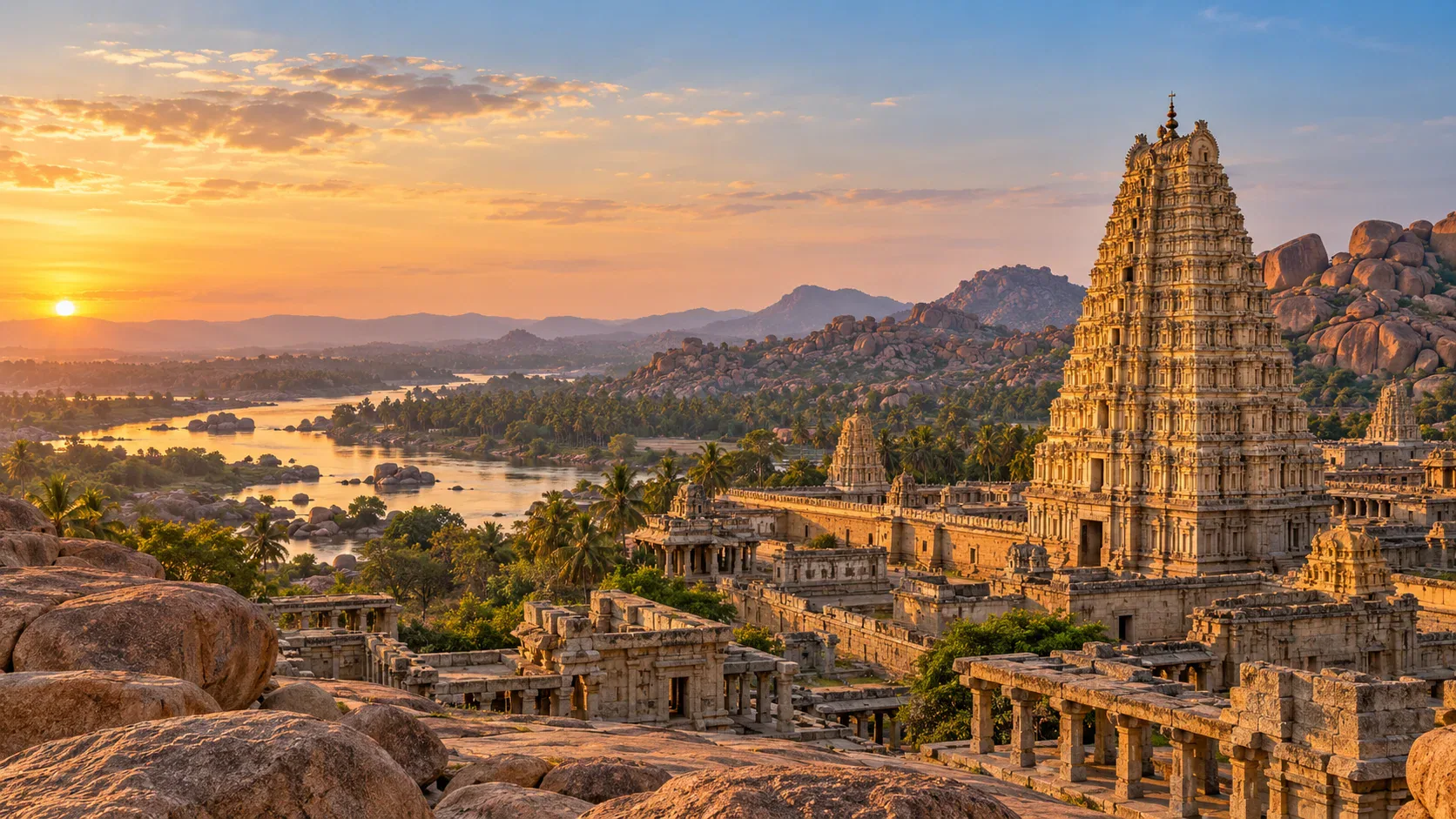
Karnataka is a South Indian state spanning a coastal strip, the Western Ghats, a heritage plateau and forested landscapes. Signature draws include Hampi's ruins, Mysuru's palace and the temples of Belur and Halebidu. Best season is October to February. Three distinctive experiences are exploring Hampi's boulder-strewn ruins, cruising the backwaters of the Western Ghats, and tasting Mysuru's silk and sandalwood crafts. Traveller types range from heritage seekers and wildlife enthusiasts to beachgoers and food explorers.
Karnataka sits in South India with a geography that moves from the Arabian Sea coast through the Western Ghats to a plateau at around 914 metres. The state's tourism board lists destinations across these zones, from the ruins of Hampi to the palaces of Mysuru and the temples of Belur and Halebidu.
Kannada is the official language, while English and Hindi are widely used in tourism. The Indian rupee is the currency, and Indian citizens do not need a visa. The best time for multi-region sightseeing is October to February, when the plateau and heritage sites are cooler and more comfortable. Coastal and Western Ghats areas are wet from June to September, so plan accordingly.
At a glance
Karnataka, in brief
Karnataka is a South Indian state with a coast, Western Ghats, plateau and heritage sites. Best season is October to February. Ideal trip length is 7 to 10 days for multi-region coverage. Gateway is Kempegowda International Airport, Bengaluru (BLR). Currency is Indian rupee; Kannada, English and Hindi are used. No visa for Indian citizens; some heritage sites may require entry tickets.
Karnataka.
7 to 10 days
- Region
- South IndiaCoast, Western Ghats, plateau and heritage landscapes
- Best season
- October to FebruaryCooler and busier November to February; coastal and Ghats wet June to September
- Ideal trip length
- 7 to 10 daysFor multi-region coverage; shorter trips can focus on one zone
- Gateway
- Kempegowda International Airport, Bengaluru (BLR)Main air entry; rail and road networks connect other cities
- Currency
- Indian rupee (INR)Cards accepted in cities; carry cash for smaller towns
- Language
- Kannada; English and Hindi widely used in tourismUseful in Bengaluru, Mysuru and major sites
Why Travellers Love Karnataka
Travellers love Karnataka for its mix of heritage, nature and coast. Hampi's ruins, Mysuru's palace and the beaches of Gokarna and Mangaluru offer varied experiences. Airlines like IndiGo, Air India and Vistara connect Bengaluru to other Indian cities. Hotels such as The Leela Palace Bengaluru and Taj West End provide luxury bases. The state's cuisine, from Mysuru Pak to Mangalorean fish curry, adds to its appeal.
- Heritage and history
Hampi's UNESCO-listed ruins and Mysuru's palace offer deep dives into Karnataka's past. Allow at least two days for Hampi and one for Mysuru.
Culture - Beaches and coast
Gokarna and Mangaluru provide beach time with options from quiet coves to lively shores. Best visited from October to February.
Nature - Wildlife and nature
Coorg and the Western Ghats offer forests, coffee estates and wildlife sanctuaries. Plan for cooler, wetter conditions June to September.
Nature
Karnataka's diversity means you can pair a heritage circuit with a coastal break. The state tourism board highlights destinations like Hampi, Mysuru, Coorg and Gokarna, each with a distinct character.
For Indian travellers, the ease of domestic travel, no visa requirement and widespread use of English make planning straightforward. Airlines such as IndiGo, Air India and Vistara operate frequent flights to Bengaluru, while trains and buses connect other regions. Luxury stays like The Leela Palace Bengaluru and Taj West End cater to comfort seekers, while homestays in Coorg and beach huts in Gokarna suit budget and mid-range travellers.
Top 10 Places to Visit in Karnataka
Karnataka's top places span Hampi's ruins, Mysuru's palace, Coorg's coffee estates, Gokarna's beaches and Bengaluru's gardens. Each offers a distinct experience, from heritage walks to coastal relaxation. Use this list to prioritise your Karnataka travel guide itinerary based on season and interests.
- Ballari district
Hampi
UNESCO World Heritage Site with ruins of the Vijayanagara Empire, including the Virupaksha Temple and Vittala Temple with its stone chariot.
Best forHeritage and photography
Start early to avoid heat; hire a local guide for context.
- Mysuru
Mysuru Palace
Indo-Saracenic palace and former royal residence, known for its Dasara celebrations and intricate interiors.
Best forArchitecture and culture
Visit on weekdays to avoid crowds; check timings for the light show.
- Kodagu district
Coorg (Kodagu)
Hill region with coffee plantations, waterfalls and misty landscapes, often called the Scotland of India.
Best forNature and relaxation
Book estate stays in advance during peak season October to February.
- Uttara Kannada district
Gokarna
Coastal town with beaches like Om Beach and Kudle Beach, plus the Mahabaleshwar Temple.
Best forBeaches and backpacking
Beach trek between Om and Kudle is popular; carry water.
- Bengaluru Urban district
Bengaluru
State capital with gardens like Lalbagh and Cubbon Park, plus a vibrant food and craft beer scene.
Best forCity life and gardens
Use Namma Metro to avoid traffic; visit Lalbagh on weekdays.
- Bagalkot district
Badami
Rock-cut cave temples from the 6th century, set around a sandstone gorge and Agastya Lake.
Best forHistory and geology
Combine with Aihole and Pattadakal for a heritage circuit.
- Bagalkot district
Pattadakal
UNESCO World Heritage Site with 8th-century Chalukyan temples, showcasing early South Indian architecture.
Best forHeritage
Hire a guide to understand the temple styles.
- Hassan district
Belur and Halebidu
Chennakeshava Temple in Belur and Hoysaleswara Temple in Halebidu, known for intricate Hoysala carvings.
Best forTemple architecture
Visit both in one day; they are about 16 km apart.
- Shivamogga district
Jog Falls
One of India's highest waterfalls, formed by the Sharavathi River, best seen during monsoon.
Best forNature and photography
Monsoon views are powerful but slippery; stay on designated paths.
- Chamarajanagar district
Bandipur National Park
Tiger reserve in the Nilgiri Biosphere, with safaris for spotting elephants, tigers and deer.
Best forWildlife
Book safari slots in advance; morning safaris have better sightings.
These ten places cover the state's key regions. Distances and travel times vary, so group nearby sites to reduce transit.
Best Time to Visit Karnataka
The best time to visit Karnataka is October to February, when the plateau and heritage sites are cooler and drier. Coastal and Western Ghats areas are wet from June to September. November to February is cooler and busier, with higher prices. Use this month-by-month guide to plan your Karnataka holiday guide around weather, crowds and cost.
January
Best time to goCool and dry on plateau; pleasant coast
Ideal for heritage and coast
February
Best time to goWarming up; still comfortable
Good for all regions
March
Good time to goHot inland; coast humid
Manageable with early starts
April
Shoulder seasonHot and dry; pre-monsoon showers possible
Limit outdoor activity midday
May
Shoulder seasonHot; humidity rises
Focus on hill stations
June
Not recommendedMonsoon begins; heavy rain in Ghats and coast
Not ideal for sightseeing
July
Not recommendedPeak monsoon; wet and cool in hills
Waterfalls are dramatic but travel is tough
August
Shoulder seasonContinued monsoon; lush landscapes
For monsoon lovers only
September
Good time to goMonsoon retreats; intermittent rain
Green scenery, fewer crowds
October
Best time to goPost-monsoon; pleasant
Start of best season
November
Best time to goCool and dry
Excellent for all regions
December
Best time to goCool; peak season
Book ahead for hotels and transport
- BestJan, Feb, Oct, Nov, Dec
- GoodMar, Sep
- FairApr, May, Aug
- AvoidJun, Jul
Weather patterns vary by region. The table below gives a general overview; check forecasts closer to travel.
Trip Cost for Karnataka in 2026
A 7-day Karnataka trip in 2026 costs roughly ₹25,000–₹40,000 per person for budget travel, ₹50,000–₹80,000 for mid-range, and ₹1,20,000+ for luxury, based on double sharing and excluding flights. These are indicative travel-budget estimates, not Tripstor package offers. Flight and land costs vary by season and route.
Budget
Backpackers and solo travellers
- Guesthouses and homestays
- Public buses and trains
- Local eateries
Mid-range
Families and couples
- 3-star hotels
- Private car with driver
- Some guided tours
Luxury
Comfort seekers
- 5-star hotels like The Leela Palace Bengaluru
- Private transfers
- Curated experiences
Budget estimates assume standard hotels, local transport and some paid attractions. Mid-range includes 3-star stays and private transport. Luxury covers 5-star hotels and curated experiences.
Flights from Delhi, Mumbai or Chennai to Bengaluru typically cost ₹4,000–₹8,000 one-way, depending on season. Land costs include accommodation, meals, transport and entry fees.
How to Reach Karnataka
Karnataka is reached by air, train or road. Kempegowda International Airport (BLR) near Bengaluru is the main gateway, with flights from Delhi, Mumbai, Chennai and other Indian cities. Trains connect Bengaluru to major cities, and buses serve regional routes. Within the state, domestic flights, trains and hired cars link key destinations.
Delhi
Direct to Bengaluru (BLR)
Typical fare₹4,000–₹8,000 one-way
Airlines: IndiGo, Air India, Vistara
Mumbai
Direct to Bengaluru (BLR)
Typical fare₹3,500–₹7,000 one-way
Frequent daily flights
Chennai
Direct to Bengaluru (BLR)
Typical fare₹2,500–₹5,000 one-way
Short hop; also train options
Delhi
Bengaluru City Junction
Typical fare₹1,500–₹4,000
Book sleeper or AC classes in advance
Mumbai
Bengaluru City Junction
Typical fare₹1,200–₹3,500
Overnight trains available
Chennai
Bengaluru City Junction
Typical fare₹500–₹1,500
Day trains convenient
Travelling from your city?
Tell us where you start. A specialist can plan connections around your stay.
Plan my journeyFlight durations vary: Delhi to Bengaluru is about 2 hours 45 minutes, Mumbai about 1 hour 40 minutes, and Chennai about 1 hour. Trains from Delhi take around 30–36 hours, from Mumbai 24 hours, and from Chennai 6–8 hours.
Buses are available for shorter routes. For coastal areas, Mangaluru International Airport (IXE) is an alternative gateway.
Where to Stay in Karnataka
Karnataka offers stays from budget guesthouses to luxury hotels. In Bengaluru, areas like MG Road and Indiranagar have mid-range and luxury options. Mysuru's city centre suits heritage visits. Coorg and Gokarna have homestays and beach huts. Named properties include The Leela Palace Bengaluru and Taj West End. Indicative rates vary by season and basis.
Budget
Solo travellers and backpackers
- Guesthouses in Gokarna
- Homestays in Coorg
- Budget hotels near Bengaluru City Junction
Mid-range
Families and couples
- 3-star hotels in Mysuru
- Boutique stays in Bengaluru
- Beach resorts in Gokarna
Luxury
Comfort seekers
- The Leela Palace Bengaluru
- Taj West End, Bengaluru
- Luxury resorts in Coorg
Choose your base by region: Bengaluru for city access, Mysuru for heritage, Coorg for nature, and Gokarna for beaches.
Budget stays cost ₹1,000–₹2,500 per night; mid-range ₹3,000–₹6,000; luxury ₹10,000+ per night, double sharing. These are indicative and not contracted inventory.
Local Food and Cuisine in Karnataka
Karnataka's cuisine varies by region, from Mysuru's vegetarian fare to Mangaluru's coastal seafood. Five dishes to try include Mysuru Pak, Bisi Bele Bath, Ragi Mudde, Neer Dosa and Mangalorean Fish Curry. Vegetarian options are plentiful, and Indian dietary preferences are easily accommodated. Try local eateries in Bengaluru, Mysuru and Mangaluru for authentic flavours.
- Mysuru
Mysuru Pak
A sweet made from gram flour, ghee and sugar, often garnished with nuts.
Best forDessert
Buy from established sweet shops in Mysuru for freshness.
- Statewide
Bisi Bele Bath
A rice and lentil dish cooked with tamarind, vegetables and a special spice mix.
Best forBreakfast or lunch
Try it with boondi or papad for texture.
- Southern Karnataka
Ragi Mudde
A finger millet ball, a staple in rural areas, eaten with saaru (rasam) or curry.
Best forWholesome meal
Eat with your hands; it's traditionally swallowed without chewing.
- Coastal Karnataka
Neer Dosa
A thin, soft rice crepe served with coconut chutney or fish curry.
Best forLight meal
Pair with chicken or fish curry for a coastal experience.
- Mangaluru
Mangalorean Fish Curry
A coconut-based curry with red chillies, tamarind and fresh fish.
Best forSeafood lovers
Ask for less spice if preferred; goes well with rice.
Mysuru Pak is a sweet made from gram flour, ghee and sugar. Bisi Bele Bath is a rice and lentil dish with tamarind and spices. Ragi Mudde is a finger millet ball eaten with saaru.
Neer Dosa is a thin rice crepe from the coastal region. Mangalorean Fish Curry uses coconut and red chillies. Vegetarians can find ample options; Jain food may require advance notice.
Karnataka Travel Tips
For a smooth Karnataka trip, carry a valid ID for permits and hotel check-ins, use eSIM or local SIM for connectivity, and respect local customs at temples. Domestic travel requires no visa. Some national parks and heritage sites have entry fees. Book transport and stays in advance during peak season October to February.
- ID and permits
Carry a government-issued photo ID for hotel check-ins and entry to some sites. No visa needed for Indian citizens.
Documentation - Connectivity
Purchase a local SIM or eSIM for data. Major cities have good 4G/5G coverage; remote areas may be limited.
Technology - Safety
Use registered taxis or app-based cabs. Avoid isolated areas after dark. Keep emergency contacts saved.
Safety - Etiquette
Remove footwear before entering temples. Dress modestly at religious sites. Ask before photographing people.
Culture - Health
Drink bottled water. Carry basic medications. For wildlife areas, follow health advisories.
Health
Karnataka is generally safe for travellers, but take standard precautions. Use reputable transport, avoid isolated areas at night, and keep emergency numbers handy.
Temple visits may require removing footwear and covering shoulders. For wildlife safaris, follow guide instructions. Connectivity is good in cities; remote areas may have patchy signals.
Karnataka vs Other South Indian Destinations
Karnataka offers a mix of heritage, coast and hills that differs from Kerala's backwaters or Tamil Nadu's temple circuits. Kerala is better for houseboats and tropical greenery, while Tamil Nadu has larger temple complexes. Karnataka suits travellers wanting variety within one state, from Hampi's ruins to Gokarna's beaches. Choose based on your interest in history, nature or coast.
Karnataka
Best forVariety: heritage, coast, hills
StrengthsDiverse experiences, good connectivity, range of budgets
Trade-offsDistances between regions can be long
Kerala
Best forBackwaters and tropical relaxation
StrengthsHouseboats, Ayurveda, compact size
Trade-offsLess heritage-focused, higher monsoon impact
Tamil Nadu
Best forTemple circuits and culture
StrengthsGrand temples, Chettinad cuisine, hill stations
Trade-offsHotter plains, longer travel between sites
Karnataka's advantage is its diversity: you can experience ruins, palaces, coffee estates and beaches in a single trip. Kerala is more focused on backwaters and Ayurveda, while Tamil Nadu is known for its temple towns like Madurai and Thanjavur.
For Indian travellers, Karnataka's connectivity and range of budgets make it a flexible choice.
Holiday ideas to start from
Reviewed itineraries for this destination — personalise with a specialist, never an instant booking.
Chikmagalur Hill Retreat 3 Nights: Karnataka Nature Tour Package 2026
From₹18,000per adult, twin sharing, land only
From idea to itinerary, with a real person.
- Share your plan
Dates, departure city, travellers and the moments you’d love. It only takes a minute.
- Shape it with a specialist
A real person refines the route, stays and pace with you. Change anything.
- Review your quote
A clear, personalised quote with confirmed inclusions. No payment to enquire.
From our travel specialists
What our team sees when planning these trips, beyond what the guidebooks say.
Confirmed 11 Oct 2026
Travellers commonly wish they had planned Karnataka by region rather than trying to cover Bengaluru, Mysuru, Coorg, Hampi and the coast in one rushed circuit. They also report that Hampi and other heritage sites require substantial walking, while hill routes can be tiring, so comfortable footwear, weather protection and realistic travel days matter.
June to September is often underestimated: the Western Ghats become exceptionally green and waterfalls are impressive, but heavy rain can make ghat roads slippery, cause temporary landslides and restrict activities such as coastal swimming or coracle rides. April is another poor choice for Hampi and Badami because the exposed ruins and rocky landscapes become very hot.
Families often value the easy contrast between Mysuru’s palace and Coorg’s plantations, but need an itinerary with slower transfers rather than many stops. Couples commonly add Gokarna for its relaxed atmosphere, while monsoon trips require flexible plans, waterproof gear and daylight travel on hill roads.
Travellers frequently add Gokarna when they want beaches and a slower coastal break, or add nature stops such as Nagarhole, Bandipur, bird sanctuaries and waterfalls around a Mysuru itinerary. Those additions are usually made after deciding they want more relaxation or wildlife rather than only palace and temple sightseeing.
Before you go
Straight answers to help you plan — then personalise the trip with a specialist.
8 answered belowAsk a specialist anything about this trip — there’s no obligation.
Ask a specialistWhat is the best time to visit Karnataka?
October to February is the best time for most of Karnataka, with cooler, drier weather on the plateau and pleasant conditions on the coast. November to February is busier and pricier. Avoid June to September if you plan to visit coastal and Western Ghats areas, as they receive heavy monsoon rain.
How many days are enough for a Karnataka trip?
Seven to ten days allow you to cover key regions like Bengaluru, Mysuru, Hampi and Coorg without rushing. A shorter 4–5 day trip can focus on one or two areas, such as Mysuru and Coorg, or Bengaluru and Hampi. Travel times between regions are significant, so plan accordingly.
Is Karnataka safe for solo travellers?
Karnataka is generally safe for solo travellers, including women, with standard precautions. Use reputable transport, avoid isolated areas at night, and stay in well-reviewed accommodations. Cities like Bengaluru, Mysuru and Mangaluru have good tourist infrastructure. Remote areas may have limited connectivity, so inform someone of your plans.
What is the cost of a Karnataka trip?
A 7-day Karnataka trip in 2026 costs roughly ₹25,000–₹40,000 per person for budget travel, ₹50,000–₹80,000 for mid-range, and ₹1,20,000+ for luxury, based on double sharing and excluding flights. These are indicative estimates; actual costs vary by season, route and preferences.
Do I need a visa to visit Karnataka?
No, Indian citizens do not need a visa to visit Karnataka. Carry a government-issued photo ID for hotel check-ins and entry to some sites. Some national parks and heritage monuments may require separate permits or tickets, which can be purchased on arrival or online.
What are the must-try foods in Karnataka?
Must-try dishes include Mysuru Pak, Bisi Bele Bath, Ragi Mudde, Neer Dosa and Mangalorean Fish Curry. Vegetarian options are abundant, and Jain food can be arranged with advance notice. Try local eateries in Mysuru, Bengaluru and Mangaluru for authentic flavours.
How do I travel between cities in Karnataka?
Domestic flights connect Bengaluru to Mangaluru and other cities. Trains are extensive and affordable, with major junctions at Bengaluru, Mysuru and Hubballi. Buses and hired cars are good for regional routes. For Hampi, the nearest railhead is Hosapete, about 13 km away.
What should I pack for a Karnataka trip?
Pack light cotton clothes for most of the year, a light jacket for hill stations like Coorg, and rain gear if travelling June to September. Comfortable walking shoes are essential for heritage sites. Carry sunscreen, a hat, and insect repellent for wildlife areas. Modest clothing is recommended for temple visits.