
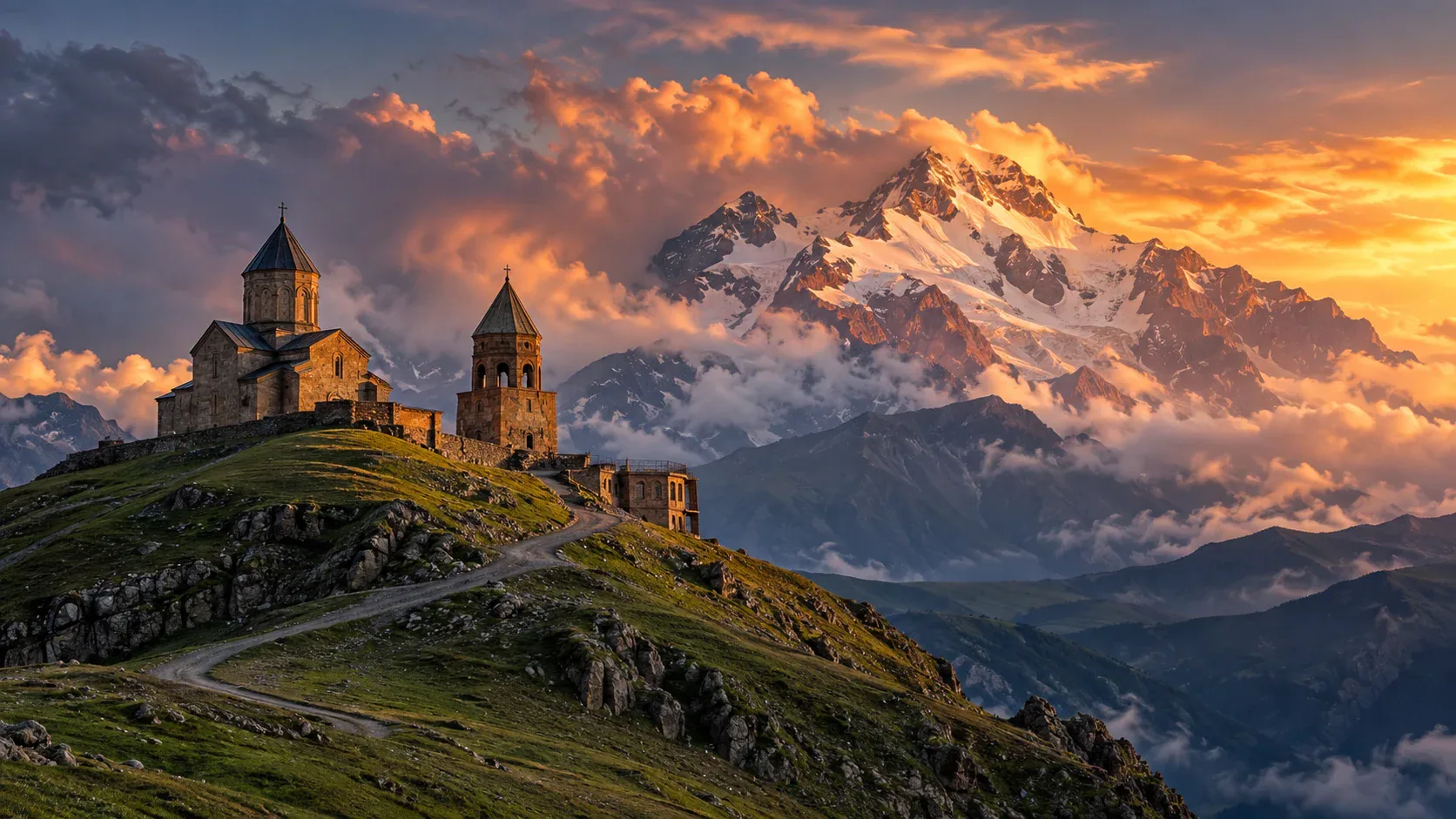
What Every Indian Traveller Should Know About Georgia
Five practical factors shape most Georgia trips for Indian travellers: visa-free short-stay entry with supporting documents, the GEL cash economy outside Tbilisi, one-stop flights of 8–12.5 hours from Indian cities, mountain-road travel to Kazbegi, and a food culture where vegetarian dishes are easy to find. Understanding each one before departure prevents the most common problems.
Georgia rewards travellers who prepare for its contrasts. Tbilisi has an inexpensive metro and app-based taxis, with indicative urban fares of about GEL 1 for a standard public-transport journey and GEL 5–15 for short app-taxi rides. Outside the capital, intercity travel is commonly by private car, shared marshrutka or train, and a private vehicle is preferable for Kazbegi, Kakheti and remote mountain routes.
Entry rules matter more than most first-timers expect. Indian passport holders can generally enter Georgia visa-free for short visits when meeting current border conditions, but rules can change, so verify eligibility immediately before departure. Carry a passport valid for the stay, accommodation proof, a return or onward ticket, travel insurance and evidence of sufficient funds.
Budget planning is straightforward once you separate land costs from flights. A typical land-only package is approximately ₹55,000–₹1,25,000 per person, depending on duration, hotel category, transport and inclusions. That is an indicative planning range, not a Tripstor offer. Flights from Indian cities are usually one-stop and priced separately, so add airfare when comparing quotes.
At a glance
Georgia, in brief
Georgia uses the Georgian lari (GEL), Georgian is the official language with Russian and English spoken in tourist areas, plugs are Type C and F at 220V, and the time difference from India is 1 hour 30 minutes behind IST. Emergency number is 112. Indian passport holders generally qualify for visa-free short visits, making Georgia one of the more accessible European destinations for Indian passport holders.
Georgia.
Planned around you.
- Currency
- Georgian lari (GEL)Cards widely accepted in cities; cash useful in villages and mountain areas.
- Language
- Georgian (official)English and Russian common in Tbilisi hotels, restaurants and tourist areas.
- Plug type
- Type C and F, 220VCarry a universal adapter; Indian 3-pin plugs need one.
- SIM or eSIM
- Local SIM or eSIM availableBuy at Tbilisi airport or city outlets; eSIM can be activated before departure.
- Time difference
- 1 hour 30 minutes behind ISTGeorgia does not observe daylight saving.
- Emergency number
- 112Works for police, ambulance and fire across Georgia.
Before You Go to Georgia
Before flying to Georgia, Indian travellers should confirm visa-free eligibility, book accommodation with a printable confirmation, arrange travel insurance covering medical evacuation, carry a forex card or some GEL cash, and download offline maps and translation apps. The most common mistake is assuming entry rules will not change between booking and travel date.
Passport valid for the stay
Carry a passport valid for the full duration of your Georgia trip, with at least two blank pages for entry stamps.
Where to get it: Indian passport office or regional Passport Seva KendraCommon mistake: Travelling on a passport expiring within the trip window.
Visa-free eligibility check
Indian passport holders can generally enter Georgia visa-free for short visits when meeting current border conditions; verify immediately before departure as rules can change.
Where to get it: Georgian Ministry of Foreign Affairs or your airline's travel document deskCommon mistake: Assuming the rule from a blog post written in a previous year.
Accommodation proof
Carry printed and digital hotel confirmations for every night of the stay, including mountain guesthouses in Kazbegi or Svaneti.
Where to get it: Your booking platform or Tripstor itinerary documentsCommon mistake: Showing only a screenshot without the booking reference number.
Return or onward ticket
Border officers may ask for proof of departure; keep the ticket accessible offline in case of poor connectivity at the border.
Where to get it: Airline website or travel agentCommon mistake: Booking an open-ended ticket with no confirmed return date.
Travel insurance
Choose a policy covering medical treatment, evacuation and trip interruption; mountain roads and winter sports raise the risk profile significantly.
Where to get it: Indian insurers offering international travel coverCommon mistake: Buying the cheapest policy without checking mountain or winter-sports exclusions.
Forex and cards
Carry some GEL cash for villages and a Visa or Mastercard enabled for international transactions for city hotels and restaurants. UPI is not accepted in Georgia.
Where to get it: Bank or authorised forex dealer in India; ATMs in TbilisiCommon mistake: Relying entirely on one card that may be blocked for international use.
Useful apps
Download offline maps of Tbilisi, Kazbegi and Kakheti, a translation app with Georgian offline pack, and your ride-hailing app before leaving India.
Where to get it: Google Play or Apple App StoreCommon mistake: Waiting until arrival when airport Wi-Fi may be slow or congested.
Medicines and prescriptions
Carry prescription medicines in original packaging with a doctor's note for controlled substances; specific Indian brands may not be available in Georgia.
Where to get it: Your doctor or pharmacy in IndiaCommon mistake: Packing loose tablets without documentation for border checks.
Work through this checklist at least three weeks before departure. Each item names where to get it and the error that most commonly causes problems at the border or on arrival in Georgia.
Best Time to Visit Georgia from India
May–June and September–October are the best all-round months for Tbilisi, Kakheti and Kazbegi, with mild weather and manageable crowds. July–August suit mountains and the Black Sea coast at Batumi, while December–March suit skiing at Gudauri. Choosing the right window depends on whether you want wine-region weather, coastal time or snow sports.
January
Good time to goCold in Tbilisi; heavy snow at Gudauri and mountain routes
Best for skiing at Gudauri; pack insulated layers and waterproof boots.
February
Good time to goCold with snow at altitude; Tbilisi cool but manageable
Ski season continues; low prices and fewer tourists in Tbilisi.
March
Shoulder seasonWarming in Tbilisi; mountain roads begin to open
Early spring; Tbilisi pleasant but Kazbegi roads may still be restricted.
April
Good time to goMild in Tbilisi and Kakheti; some rain; mountains still cool
Good for Tbilisi and Mtskheta; Kakheti vineyards green and photogenic.
May
Best time to goWarm and dry in Tbilisi; mountain routes fully open
Ideal for Tbilisi, Kazbegi and Kakheti; comfortable temperatures throughout.
June
Best time to goWarm to hot in Tbilisi; pleasant in mountains
One of the best months; Kazbegi and Kakheti both accessible and scenic.
July
Good time to goHot in Tbilisi and Batumi; cool at altitude
Peak season; book ahead. Best for Black Sea coast and mountain trekking.
August
Good time to goHot in lowlands; Batumi beach season at peak
Busy and expensive; good for Batumi and Kazbegi if booked early.
September
Best time to goWarm and dry; Kakheti grape harvest begins
Excellent for wine tourism in Kakheti and comfortable Tbilisi sightseeing.
October
Best time to goMild with autumn colour in Kakheti and mountains
Harvest festivals in Kakheti; one of the most rewarding months overall.
November
Shoulder seasonCooling; some rain; mountain routes may close late month
Quieter and cheaper; Tbilisi still pleasant but mountain access uncertain.
December
Good time to goCold in Tbilisi; ski season opens at Gudauri
Good for Gudauri skiing and festive Tbilisi; pack warm layers.
- BestMay, Jun, Sep, Oct
- GoodJan, Feb, Apr, Jul, Aug, Dec
- FairMar, Nov
Georgia has four distinct seasons and the right month depends on your planned regions. Kakheti's grape harvest runs through September and October, making that window particularly rewarding for wine-region visits. Gudauri ski season typically runs December through March, while the Georgian Military Highway to Kazbegi is fully open May through October.
Money and Payments in Georgia
Georgia runs on the Georgian lari (GEL). Cards are widely accepted in Tbilisi, Batumi and larger hotels, while cash is useful in villages and mountain areas. ATMs are common in cities, UPI is not accepted anywhere in Georgia, and a local SIM or eSIM keeps data costs predictable for Indian travellers on longer itineraries.
- Carry GEL cash for mountain and village days
Cards work in Tbilisi hotels and restaurants, but Kazbegi guesthouses, small Kakheti wineries and roadside stops often prefer cash. Withdraw GEL from city ATMs before heading to remote routes.
Money - Use bank ATMs in Tbilisi and Batumi
Major bank ATMs in city centres are the most reliable for international cards. Check your bank's foreign withdrawal fee before relying on ATMs for all spending across the trip.
Money - UPI is not accepted in Georgia
Indian UPI apps do not work at Georgian merchants. Carry a Visa or Mastercard credit or debit card enabled for international transactions, plus a forex card as backup.
Money - Buy a local SIM or activate an eSIM
A Georgian SIM bought at Tbilisi airport or a city outlet gives local data at lower cost than Indian international roaming. An eSIM activated before departure is simpler if your phone supports dual SIM.
Connectivity - Download offline maps before mountain drives
Mobile coverage can drop on the Georgian Military Highway toward Kazbegi. Download offline maps of Tbilisi, Kazbegi and Kakheti before leaving the capital.
Connectivity - Keep a small GEL float for taxis and tips
Short app-taxi rides in Tbilisi cost an indicative GEL 5–15, and a standard public-transport journey is about GEL 1. Small notes help when card machines are unavailable at smaller venues.
Money
Plan money and connectivity together because both affect how freely you move outside Tbilisi. The tips above cover cash versus cards, ATMs, UPI acceptance and data options for the full Georgia itinerary.
Cultural Tips for Georgia
Georgian culture rewards modest dress at churches, a willingness to accept a toast at meals, and patience with a slower service pace outside Tbilisi. Tipping is appreciated but not mandatory. Removing hats and covering shoulders at religious sites such as those in Mtskheta is expected, and women often cover their heads with a scarf provided at the entrance.
- Dress modestly at churches and monasteries
Cover shoulders and knees at Georgian Orthodox sites including Svetitskhoveli Cathedral in Mtskheta and Tbilisi's old-town churches. Women can use a scarf at the entrance where provided. Shorts and sleeveless tops may be refused entry.
Etiquette - Accept a toast if you are comfortable
Georgian supra meals often include toasts led by a tamada. You can join with wine or a soft drink; refusing politely is acceptable. Do not start drinking before the first toast if you want to follow local custom.
Etiquette - Tip around 5–10% in restaurants
Tipping is not mandatory but is appreciated in Tbilisi and Batumi restaurants. Check whether a service charge is already included on the bill before adding a tip.
Etiquette - Ask before photographing people
In markets, churches and mountain villages, ask before taking portraits. Some Georgian Orthodox churches prohibit photography inside entirely; look for posted signs.
Etiquette - Expect a slower pace outside Tbilisi
Service in Kakheti and mountain guesthouses can be relaxed. Build buffer time into travel days rather than scheduling tightly, especially on routes to Kazbegi or Svaneti.
Etiquette - Learn a few Georgian phrases
Gamarjoba (hello) and madloba (thank you) are appreciated. English is common in Tbilisi hotels and restaurants but less so in villages and rural guesthouses.
Etiquette
These georgia tips for indian tourists help travellers move comfortably through Georgian churches, homes and restaurants. Georgian hospitality is generous, and small gestures of respect go a long way in both urban and rural settings.
Food Tips for Indian Travellers in Georgia
Georgian food suits Indian palates well: khachapuri, khinkali, lobio, mtsvadi and walnut-based dishes such as pkhali and satsivi are the signatures to try. Vegetarian options are widely available across the country, and Tbilisi has Indian restaurants if you want a familiar meal. Georgian cooking uses walnuts, herbs and garlic in ways many Indian travellers find familiar.
- Nationwide
Khachapuri
Georgia's signature cheese bread, served in several regional styles. The Adjaran boat-shaped version with egg and butter is the richest and most filling, and is a reliable vegetarian main course.
Best forVegetarians and first-time visitors
Order one to share; portions are large and cheese-heavy. The Adjaran version is served in Batumi and widely across Tbilisi.
- Nationwide
Khinkali
Large soup-filled dumplings, usually stuffed with spiced meat or potato and mushroom. Eat them by hand, holding the topknot, and sip the broth before biting through the dough.
Best forMeat eaters and vegetarians alike
The potato and mushroom filling is the standard vegetarian option; confirm with your server as fillings vary by restaurant.
- Nationwide
Lobio
A slow-cooked bean stew served in a clay pot with pickles and cornbread (mchadi). One of the most reliable vegetarian mains in the country and widely available in Tbilisi and Kakheti.
Best forVegetarians and anyone wanting a lighter meal
Ask for it with mchadi rather than bread if you want the traditional pairing.
- Nationwide
Mtsvadi
Grilled skewered meat, usually pork or chicken, cooked over vine wood. Arrives with raw onion and pomegranate seeds and is a staple at Georgian family gatherings and roadside restaurants.
Best forNon-vegetarians
Ask for it well done if you prefer firmer meat; Georgian grills can be pink in the centre.
- Nationwide
Walnut-based dishes (pkhali and satsivi)
Walnut sauces and pastes appear throughout Georgian cooking. Pkhali, made from spinach, beetroot or aubergine with walnut, is a common cold vegetarian starter. Satsivi is a walnut sauce served with poultry.
Best forVegetarians and nut lovers
Pkhali is served cold and works well as a shared starter before a main course.
- Tbilisi
Indian restaurants in Tbilisi
Tbilisi has Indian restaurants for travellers who want a familiar meal during a longer stay. The research data does not name specific outlets, so ask your hotel for current recommendations or check listings on arrival.
Best forTravellers missing home food or needing a break from Georgian cuisine
Confirm opening hours during Georgian public holidays, when some restaurants adjust their schedules.
Georgian cuisine shares some flavour logic with Indian cooking, using walnuts, herbs, garlic and slow-cooked vegetables. The dishes above are the ones most Indian travellers try first, and all are available in Tbilisi's old town and in Kakheti restaurants during the September–October harvest season.
Safety in Georgia for Indian Tourists
Georgia's principal tourist routes are generally suitable for visitors, but normal precautions apply. Watch for taxi overcharging in Tbilisi, take extra care on mountain roads toward Kazbegi, monitor demonstrations, and carry travel insurance that covers medical evacuation. No destination is risk-free, so plan for weather and road conditions before every mountain day.
- Taxi overcharging at airports and tourist areas
How to avoid itUse app-based taxis with a fixed fare where possible. Indicative short rides in Tbilisi cost GEL 5–15. Agree the fare before entering an unmetered taxi, especially at Tbilisi International Airport.
- Mountain-road accidents on the Georgian Military Highway
How to avoid itHire a driver experienced on the Kazbegi route rather than self-driving in winter. Check road conditions before departure and avoid night driving on the Georgian Military Highway.
- Demonstrations and road closures in central Tbilisi
How to avoid itMonitor local news during your stay and avoid large gatherings. Keep your hotel address and the Indian Embassy contact saved offline.
- Winter cold and snow at altitude
How to avoid itPack insulated layers, waterproof boots and gloves for December–March mountain travel. Check guesthouse heating before booking stays in Kazbegi or Gudauri.
- Limited medical facilities outside major cities
How to avoid itCarry travel insurance covering medical evacuation. For remote mountain areas, identify the nearest hospital before you go; Tbilisi has the most comprehensive medical facilities in the country.
- Petty theft in crowded areas
How to avoid itKeep phones and wallets secure in Tbilisi's old town and markets. Use a hotel safe for passports and spare cash.
- Altitude and weather changes on mountain routes
How to avoid itAllow acclimatisation time and build buffer days into Kazbegi and Svaneti itineraries. Weather can close routes with little notice, particularly October through April.
The warnings above cover the issues Indian travellers most often encounter in Georgia, with a prevention step for each. The Indian Embassy in Tbilisi is the first point of contact for serious emergencies; save the number before departure.
Packing by Season for Georgia
Georgia's seasons demand different packing. May–June and September–October need light layers and a rain jacket for Tbilisi and Kakheti. July–August suits mountains and the Black Sea coast at Batumi with breathable clothing. December–March requires insulated layers, waterproof boots and gloves for skiing at Gudauri and mountain stays. Church visits need covered shoulders and knees year-round.
Spring (March–May): light layers and rain jacket
Tbilisi warms up but mountain routes remain cool. Pack a waterproof outer layer, comfortable walking shoes and a compact umbrella for Tbilisi and Mtskheta visits.
Where to get it: Your existing wardrobe plus a travel adapter for Type C and F plugsCommon mistake: Packing only summer clothing for an April trip that includes Kazbegi.
Summer (June–August): breathable clothing and sun protection
Tbilisi and Batumi can be hot. Pack light cotton, sunscreen, a hat and swimwear for the Black Sea coast. Mountain evenings in Kazbegi still need a light fleece even in July.
Where to get it: Local pharmacy or supermarket in IndiaCommon mistake: Forgetting a warm layer for Kazbegi nights even in peak summer.
Autumn (September–November): layers and a warm jacket
September–October is one of the best all-round windows. Pack a mid-weight jacket, long trousers and closed shoes for Kakheti wine-region visits and Tbilisi sightseeing.
Where to get it: Your existing wardrobeCommon mistake: Underestimating rain in Kakheti during October harvest season.
Winter (December–February): insulated layers and waterproof boots
Skiing at Gudauri and mountain stays need thermal base layers, a down or insulated jacket, gloves, a hat and waterproof boots with grip for icy paths.
Where to get it: Outdoor gear shop in India or rental at Georgian ski resortsCommon mistake: Arriving in Tbilisi in December with only a light jacket for a Gudauri ski add-on.
Church-appropriate clothing year-round
Carry a scarf or shawl and a pair of long trousers or a long skirt for monastery visits in Mtskheta and Tbilisi. Shoulders and knees should be covered at all Georgian Orthodox sites.
Where to get it: Your existing wardrobeCommon mistake: Planning a Mtskheta church visit in shorts and a sleeveless top.
Universal power adapter
Georgia uses Type C and F plugs at 220V. Indian 3-pin plugs need an adapter; a universal adapter covers all your devices including cameras and laptops.
Where to get it: Electronics shop or airport in IndiaCommon mistake: Assuming Indian plugs fit Georgian sockets without an adapter.
Medicines and a basic first-aid kit
Carry prescription medicines in original packaging, plus rehydration salts, painkillers and any regular medication for the full trip. Specific Indian brands may not be available in Georgia.
Where to get it: Your doctor or pharmacy in IndiaCommon mistake: Relying on buying specific Indian brands in Georgian pharmacies.
Printed document folder
Keep printed copies of your passport, visa-free eligibility evidence, hotel bookings, insurance and return ticket in a single folder. Useful if your phone battery dies at the border.
Where to get it: Home printer or local print shopCommon mistake: Storing everything only on a phone with no offline backup.
Pack for the season you are travelling and the regions you plan to visit. Mountain areas such as Kazbegi are cooler than Tbilisi at the same time of year, so layers matter more than a single heavy coat. A universal adapter and a printed document folder are the two items most often forgotten.
Getting to Georgia from India: Flights and Airports
Tbilisi International Airport is the most practical gateway for most first-time itineraries from India. Kutaisi suits budget carriers and western-Georgia routes, while Batumi is useful for the Black Sea coast. Most Indian cities connect through a Gulf or Caucasus hub, with total journey times of roughly 8–12.5 hours depending on origin city.
Delhi (DEL)
Gulf or Caucasus hub
Shortest connection from India to Tbilisi; one stop typical.
Mumbai (BOM)
Gulf hub
One stop; multiple Gulf carriers serve this route.
Bengaluru (BLR)
Gulf hub
One stop; check layover duration when comparing fares.
Kolkata (CCU)
Gulf or Caucasus hub
Longest connection from major Indian cities; one stop typical.
Tbilisi (TBS)
Georgian Military Highway
Road to Kazbegi; hire an experienced driver; road may close in winter.
Tbilisi (TBS)
Kakheti Highway
Road to Kakheti wine region; accessible year-round by car or marshrutka.
Tbilisi (TBS)
Borjomi–Batumi highway
Road to Batumi on the Black Sea coast; also served by overnight train.
Travelling from your city?
Tell us where you start. A specialist can plan connections around your stay.
Plan my journeyMost Indian travellers fly into Tbilisi International Airport and use it as the base for onward road travel. The Georgian Military Highway to Kazbegi is one of the most scenic drives in the Caucasus but requires an experienced driver and is weather-dependent from November through April. Kutaisi International Airport is an alternative for travellers starting in western Georgia or combining with a Batumi itinerary.
Holiday ideas to start from
Reviewed itineraries for this destination — personalise with a specialist, never an instant booking.
Tbilisi and Kazbegi Premium 5 Nights: Georgia 5N6D Tour Package 2026
From₹1,05,500per adult, twin sharing, land only
From idea to itinerary, with a real person.
- Share your plan
Dates, departure city, travellers and the moments you’d love. It only takes a minute.
- Shape it with a specialist
A real person refines the route, stays and pace with you. Change anything.
- Review your quote
A clear, personalised quote with confirmed inclusions. No payment to enquire.
From our travel specialists
What our team sees when planning these trips, beyond what the guidebooks say.
Confirmed 11 Oct 2026
Travellers commonly wish they had checked Georgia’s visa requirements and entry-document rules earlier, rather than assuming another country’s visa would automatically qualify them. They also report that refundable or pay-at-hotel bookings, travel insurance covering the whole stay, and a local SIM arranged on arrival make the trip easier.
The recurring mistake is booking Kazbegi as a fixed day trip with no weather or road-work buffer. Travellers also caution against buying non-refundable flights before the e-Visa decision and against packing too many long road transfers into a short itinerary.
Travellers often add flexibility around Kazbegi after seeing how changeable mountain weather and road conditions are, including an extra morning or night in Stepantsminda. Common additions to the basic Tbilisi plan are Kakheti or Sighnaghi, and some couples add Batumi for a coastal change of pace.
Families find that Tbilisi’s Old Town, relaxed Kakheti visits and Batumi downtime work better than filling every day with long mountain drives; Kazbegi is manageable when activities and walking are kept light. Couples report that Georgia’s strongest appeal is scenery and atmosphere—Tbilisi, mountain-view stays around Kazbegi, Sighnaghi and Batumi—rather than treating the trip as only a checklist of sights.
Before you go
Straight answers to help you plan — then personalise the trip with a specialist.
8 answered belowAsk a specialist anything about this trip — there’s no obligation.
Ask a specialistDo Indians need a visa for Georgia?
Indian passport holders generally qualify for visa-free short visits under Georgia's current entry policy, subject to passport, border and supporting-document requirements. Carry accommodation proof, a return ticket, travel insurance and evidence of funds. Verify eligibility immediately before departure because rules can change, and note that airline and border authorities have final discretion.
What is the best time to visit Georgia from India?
May–June and September–October are the best all-round months for Tbilisi, Kakheti and Kazbegi, with mild weather and manageable crowds. July–August suit mountains and the Black Sea coast at Batumi, while December–March suit skiing at Gudauri. Choose based on whether you want wine-region weather, coastal time or snow sports.
How much does a Georgia tour package cost from India?
A typical land-only package is approximately ₹55,000–₹1,25,000 per person, depending on duration, hotel category, transport and inclusions. This is an indicative planning range, not a confirmed Tripstor offer. Flights from Indian cities are usually one-stop and priced separately, so add airfare when comparing quotes from different operators.
How many days are enough for a Georgia trip from India?
Five to seven days cover Tbilisi, Mtskheta, Kazbegi and Kakheti at a comfortable pace. Ten days allow Batumi, Borjomi or additional mountain time. If you want both the Black Sea coast and the Caucasus mountains, plan at least eight to ten days to avoid spending most of the trip in transit between regions.
Is Georgia safe for Indian tourists?
The principal tourist routes are generally suitable for visitors, but travellers should use normal precautions, monitor demonstrations and take extra care on mountain roads. Use app-based taxis to avoid overcharging, carry travel insurance covering medical evacuation, and check weather and road conditions before Kazbegi or Svaneti drives.
What currency is used in Georgia and can Indians use UPI?
The Georgian lari (GEL) is the local currency. Cards are widely accepted in Tbilisi, Batumi and larger hotels, while cash is useful in villages and mountain areas. UPI is not accepted in Georgia, so carry an internationally enabled Visa or Mastercard and withdraw GEL from city ATMs before heading to remote routes.
What food is Georgia famous for and is it suitable for Indian vegetarians?
Signature dishes include khachapuri, khinkali, lobio, mtsvadi and walnut-based preparations such as pkhali and satsivi. Vegetarian options are widely available, and Tbilisi has Indian restaurants for travellers wanting familiar food. Georgian cooking uses walnuts, herbs and garlic, which many Indian travellers find familiar in flavour profile.
Which airport should Indians fly into for Georgia?
Tbilisi International Airport is the most practical gateway for most first-time itineraries. Kutaisi suits budget carriers and western-Georgia routes, while Batumi is useful for the Black Sea coast. Most Indian cities connect through a Gulf or Caucasus hub, with total journey times of roughly 8–12.5 hours depending on origin.