
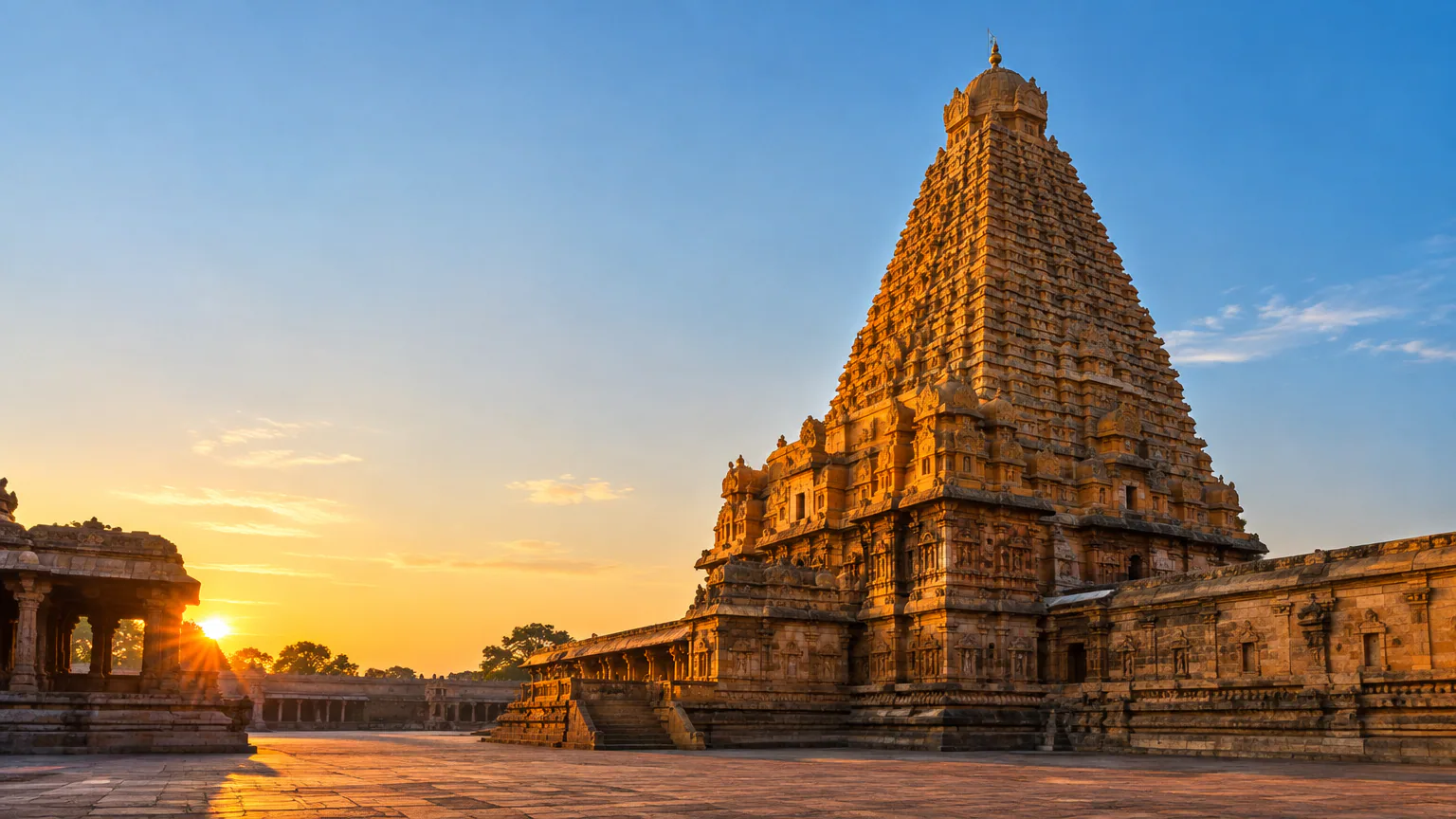
Why Tamil Nadu for Heritage
Tamil Nadu suits heritage travel because it holds living Dravidian temples, UNESCO-listed Chola and Pallava monuments, and colonial-era quarters within one rail-connected state. Signature experiences include the Brihadeeswarar Temple at Thanjavur, the Shore Temple at Mahabalipuram and the Meenakshi Amman Temple at Madurai. It fits travellers who want architecture, ritual and history in a single route.
The state's heritage strength is continuity rather than ruins alone. Chola-period temples such as Brihadeeswarar at Thanjavur still host daily worship, while the Pallava shore and cave shrines at Mahabalipuram sit beside a working coastal town. Chennai adds colonial-era buildings and museum collections, and Madurai's temple complex anchors a historic urban core.
A Tamil Nadu heritage trip works for first-time domestic travellers, families with older children, photographers and anyone comfortable with early temple mornings and multi-city train or car transfers.
At a glance
Tamil Nadu, in brief
A heritage-focused Tamil Nadu trip usually needs 5–7 nights to cover Chennai, Mahabalipuram, Thanjavur and Madurai without rushing. The best season for temple and monument circuits is November to February. Chennai is the main gateway, and indicative land-only budgets start around ₹16,000 per person on twin sharing, excluding flights.
Tamil Nadu.
5–7 nights for the core heritage circuit
- Ideal trip length
- 5–7 nights for the core heritage circuit10–14 nights allows hill stations, Rameswaram and southern extensions
- Best season for heritage
- November to FebruaryApril–May is hot; October–November is wetter on the northeast coast
- Main gateway
- ChennaiChennai is the usual arrival point for Mahabalipuram, Thanjavur and Madurai routes
- Indicative budget basis
- From ₹16,000 per personLand-only, twin sharing, excluding flights; exact basis differs by package
- Who it suits
- History-focused travellers, families with older children, photographersExpect early temple mornings and multi-city transfers
- Core heritage sites
- Brihadeeswarar Temple, Shore Temple, Meenakshi Amman TempleChola and Pallava monuments plus living temple towns
Signature Experiences and Places
Tamil Nadu's heritage circuit is built around named monuments and living temple towns rather than a single site. The strongest experiences combine Chola architecture at Thanjavur, Pallava rock-cut shrines at Mahabalipuram, the Meenakshi Amman Temple at Madurai and colonial-era Chennai. Each works best with a timed visit, a local guide and realistic travel between cities.
- Thanjavur
Brihadeeswarar Temple
A Chola-period temple and UNESCO-listed monument, central to any Tamil Nadu heritage itinerary.
Best forChola architecture and living temple ritual
Visit in the early morning to avoid heat and crowd pressure; dress modestly and expect footwear removal.
- Mahabalipuram
Shore Temple
A Pallava-era structural temple on the coast, part of the Mahabalipuram monument group.
Best forPallava architecture and coastal photography
Combine with the nearby rock-cut cave shrines and Krishna's Butterball in one half-day.
- Madurai
Meenakshi Amman Temple
A large living temple complex with gopurams and pillared halls in the historic city core.
Best forDravidian temple scale and ritual atmosphere
Go early or late; the surrounding streets are busy and the temple has separate entry queues.
- Rameswaram
Ramanathaswamy Temple
A pilgrimage temple with long corridors, usually added on longer southern heritage routes.
Best forPilgrimage heritage and corridor architecture
Plan a full day if coming from Madurai; the route is long and temple timings matter.
- Chennai
Fort St. George and Chennai colonial quarter
Colonial-era administrative and museum area that anchors the city's heritage layer.
Best forColonial history and museum collections
Pair with a Chennai museum visit and use the metro or app cabs to avoid traffic.
- Mahabalipuram
Mahabalipuram monument group
Rock-cut caves, monolithic rathas and reliefs spread across a compact archaeological zone.
Best forPallava rock-cut art and sculpture
Hire a licensed local guide at the site for context; the area is walkable but hot by midday.
- Thanjavur
Thanjavur Maratha and Chola heritage circuit
The city pairs the Brihadeeswarar Temple with palace and art collections in the same heritage day.
Best forChola history and South Indian art
Keep one full day for Thanjavur; day-tripping from another city wastes travel time.
- Puducherry
Puducherry heritage quarter
A former French colonial town with grid streets and heritage buildings, often added to coastal routes.
Best forColonial streetscapes and slower pacing
Best as a relaxed final stop after temple-heavy days; walk the heritage quarter in the evening.
Routes and Durations Compared
Heritage routes in Tamil Nadu differ mainly by how many cities you add and how much transfer time you accept. A 5-night Chennai–Mahabalipuram–Thanjavur–Madurai circuit covers the core monuments. A 7-night version adds Rameswaram or Puducherry. Longer 10–14 night trips bring in hill stations and southern extensions.
5-night core heritage circuit
Best forFirst-time visitors who want Chennai, Mahabalipuram, Thanjavur and Madurai
StrengthsCovers the main Chola and Pallava sites with manageable transfers
Trade-offsLittle time for hill stations or Rameswaram; temple days are full
7-night heritage and coast circuit
Best forTravellers who want the core route plus Puducherry or a coastal stop
StrengthsAdds colonial streetscapes and a slower final leg
Trade-offsMore hotel changes; requires accepting one long transfer day
10–14 night heritage and hills circuit
Best forFamilies and repeat visitors adding Ooty, Kodaikanal or Rameswaram
StrengthsAllows deeper temple time and a hill-station break from the heat
Trade-offsHigher cost and more planning; avoid excessive one-night stops
Indicative Budgets and Hotels
Indicative starting prices for Tamil Nadu heritage packages on this page range from ₹16,000 to ₹27,000 per person, based on the Tripstor catalogue. These are land-only starting prices on twin sharing and exclude flights. The exact basis differs by package, so treat them as indicative rather than confirmed offers.
Budget
Travellers using trains and shared transfers with simpler hotels
- Core temple and monument circuit
- Train or shared transfer between cities
- Basic to mid-category hotels
Mid-range
Families and couples wanting private transfers and better-located hotels
- Private vehicle with driver on some legs
- Better hotel categories near temple towns
- Guided heritage walks or temple specialists
Premium
Travellers prioritising comfort, private touring and premium experiences
- Premium hotels and upgraded meals
- Private guided touring
- More flexible pacing across cities
What's Included in Our Heritage Packages
A well-scoped Tamil Nadu heritage package should cover accommodation, inter-city transport, key monument visits and a guide where temple context matters. Proposed inclusions and exclusions below require confirmation at quote stage. Flights, personal expenses and festival supplements are usually excluded unless a package states otherwise.
What’s included
7 itemsProposedaccommodation on twin sharing at selected hotels
Proposeddaily breakfast and selected meals as per package
Proposedprivate vehicle with driver or train travel between cities
Proposedairport or railway station transfers
Proposedmonument and temple visits listed in the itinerary
Proposedlocal guide for key heritage sites such as Mahabalipuram and Thanjavur
Proposedall applicable taxes bundled by the operator
Not included
6 itemsProposed exclusiondomestic flights and airport transfers unless stated
Proposed exclusionmonument entry fees not bundled by the operator
Proposed exclusionpersonal expenses, shopping and laundry
Proposed exclusionmajor festival supplements and peak-season surcharges
Proposed exclusiontravel insurance and medical costs
Proposed exclusioncamera fees and special darshan charges
Best Time for This Theme
November to February is the best window for Tamil Nadu heritage travel, with cooler plains weather for temple and monument circuits. December and January are peak season, so book early. April and May are hot, and October–November is wetter on the northeast coast. Hill-station extensions suit March to June.
January
Best time to goCool and dry on the plains; comfortable for temple circuits
Peak heritage season; book hotels and guides early
February
Best time to goWarm days, pleasant evenings; good for Chennai and Thanjavur
Excellent for the full core circuit
March
Good time to goHeating up on the plains; hill stations remain comfortable
Pair temple towns with Ooty or Kodaikanal
April
Shoulder seasonHot on the plains; hill stations are pleasant
Limit midday monument visits; favour hills
May
Shoulder seasonHot and humid on the plains; hill stations busy
Hill-station focused trips work better than temple circuits
June
Shoulder seasonHot on the plains; southwest monsoon affects some hill areas
Possible for hills; check rain before booking
July
Shoulder seasonMonsoon influence in parts; plains remain warm
Fewer crowds but wetter conditions in some regions
August
Shoulder seasonMixed monsoon conditions; temple towns still visitable
Budget-friendly if you accept rain risk
September
Shoulder seasonTransitional; rain risk continues in parts
Plan indoor and temple visits with flexible timing
October
Shoulder seasonNortheast monsoon begins; wetter on the coast
Check coastal forecasts; inland temples are still possible
November
Good time to goRain easing; cooler conditions return to the plains
Good early-season window for heritage routes
December
Best time to goCool and dry; peak travel period
Best weather but highest demand; book well ahead
- BestJan, Feb, Dec
- GoodMar, Nov
- FairApr, May, Jun, Jul, Aug, Sep, Oct
Traveller Tips
Heritage travel in Tamil Nadu rewards planning around temple timings, heat and transport. Start monument visits early, keep one full day for Thanjavur and Madurai each, and use trains between major cities where possible. Dress modestly for temples, carry socks for footwear removal and keep ID handy for hotel check-ins.
- Start temple visits at opening time
Brihadeeswarar Temple and Meenakshi Amman Temple are cooler and less crowded in the early morning. Midday heat on the plains makes long monument walks uncomfortable, especially in April and May.
Timing - Use trains between major cities
Chennai, Thanjavur and Madurai are connected by rail, which is often faster and more comfortable than long road transfers. Use private cars for multi-stop circuits and local sightseeing.
Transport - Keep one full day per heritage city
Thanjavur and Madurai each need a full day for the main temple, surrounding heritage and local food. Day-tripping from another city wastes travel time and limits what you can see.
Planning - Dress and prepare for temple etiquette
Cover shoulders and knees, remove footwear before entering temple premises and carry socks for hot stone. Some temples restrict photography or phones inside certain areas.
Etiquette - Carry ID and confirm entry rules
Hotels require government-issued photo ID at check-in. Monument entry fees and special darshan charges are usually not bundled in packages, so keep some cash or a payment app ready.
Documents
From idea to itinerary, with a real person.
- Share your plan
Dates, departure city, travellers and the moments you’d love. It only takes a minute.
- Shape it with a specialist
A real person refines the route, stays and pace with you. Change anything.
- Review your quote
A clear, personalised quote with confirmed inclusions. No payment to enquire.
From our travel specialists
What our team sees when planning these trips, beyond what the guidebooks say.
Confirmed 11 Oct 2026
- Itinerary
A common mistake is trying to cover too many separated places in a short trip, rather than allowing proper time for the Chennai–Mahabalipuram–Pondicherry and central or southern temple routes. Popular experiences such as the Nilgiri Mountain Railway also sell out, so travellers report needing to book early or use a nearby station such as Coonoor instead of Ooty.
- Places
For a first Tamil Nadu trip, Chennai is the most practical arrival base because it has strong air connections and easy access to Mahabalipuram, while Pondicherry works well as a slower coastal and heritage base. A broader route can then continue south through Thanjavur or Tiruchirappalli to Madurai, rather than treating one city as a base for the entire state.
- Itinerary
Travellers often add or rearrange stops when transport or weather makes the original plan impractical—for example, using Coonoor when Ooty railway tickets are unavailable, or adding an extra day around Tiruchirappalli and Thanjavur. They also commonly add a local guide at Mahabalipuram to explain the sculptures.
- Families & couples
Families learn that a comfortable private car, dependable driver and realistic pacing matter more than maximizing the number of temples; hotel quality and room size can materially affect the experience. Couples often combine Pondicherry’s French Quarter with Ooty or Kodaikanal for contrasting coastal and hill scenery, but should allow for long road journeys rather than planning every day as a short excursion.
Before you go
Straight answers to help you plan — then personalise the trip with a specialist.
8 answered belowAsk a specialist anything about this trip — there’s no obligation.
Ask a specialistWhat is the best time to visit Tamil Nadu for heritage sites?
November to February is generally best for plains, temples and heritage sites, with cooler and drier conditions. April and May are hot, and October–November is wetter on the northeast coast. December and January are peak season, so book hotels and guides early for the main temple circuit.
How many days are enough for a Tamil Nadu heritage tour?
Five to seven days covers Chennai, Mahabalipuram, Thanjavur and Madurai at a reasonable pace. Ten to fourteen days allows hill stations, Rameswaram and southern extensions. Avoid excessive one-night transfers, which reduce time at the monuments that make the heritage route worthwhile.
What is the average cost of a Tamil Nadu heritage package?
Indicative starting prices for Tamil Nadu heritage packages on this page range from ₹16,000 to ₹27,000 per person, land-only on twin sharing and excluding flights. The exact basis differs by package, so treat these as indicative starting prices rather than confirmed offers.
Which heritage places should I include in a Tamil Nadu itinerary?
Include the Brihadeeswarar Temple at Thanjavur, the Shore Temple and rock-cut shrines at Mahabalipuram, and the Meenakshi Amman Temple at Madurai. Chennai's colonial quarter and museum collections add context. Longer routes can add Rameswaram and Puducherry's heritage quarter.
Is Tamil Nadu suitable for a family heritage holiday?
Yes, especially with a slower route combining Chennai, Mahabalipuram, a hill station and Madurai. Families with older children manage temple circuits well if you avoid excessive one-night transfers. Hill stations such as Ooty and Kodaikanal give a cooler break from the plains.
What is Tamil Nadu famous for in terms of heritage?
Tamil Nadu is known for Dravidian temples, Chola and Pallava monuments, Bharatanatyam and Carnatic culture, pilgrimage towns, hill stations and coastal landscapes. The Brihadeeswarar Temple, Shore Temple and Meenakshi Amman Temple are among the most recognised heritage sites.
How can I travel around Tamil Nadu for a heritage trip?
Use trains between major cities such as Chennai, Thanjavur and Madurai, private cars for multi-stop circuits, and app cabs or the metro within Chennai. Rail is often faster and more comfortable than long road transfers, while a private vehicle helps with temple-town sightseeing.
Is Tamil Nadu safe for heritage tourists?
Main tourist circuits are commonly visited safely, but use normal precautions involving traffic, heat, valuables, crowded temples and monsoon disruption. Keep ID with you, follow temple etiquette, and check local weather before coastal or hill segments. No destination is risk-free, so plan transfers sensibly.