
Is 8 Days Enough for Kerala?
Eight days is enough for Kerala's central circuit: Kochi, Munnar, Thekkady and the Alappuzha backwaters, plus one beach or hill add-on. Two-night stays in the hill and wildlife sectors keep daily driving moderate and give each destination room to breathe, making this the most popular format for first-time visitors and families.
A kerala 7 nights package gives roughly two nights in Munnar, two in Thekkady, one on an Alappuzha houseboat and two in Kochi or at a beach. That shape is the standard core of most 8 days kerala tour packages and it avoids the fatigue of one-night hops across hill roads.
The format does not cover Wayanad, Bekal or the far north in the same trip. Adding those destinations would mean dropping Munnar or Thekkady, or spending most of the holiday in a vehicle rather than at the destination.
- Covers: Kochi, Munnar, Thekkady, Alappuzha or Kumarakom, plus one extension such as Kovalam or Varkala
- Best for: first-time visitors, families, couples and slow-paced travellers
- Not ideal for: travellers wanting Wayanad plus the backwaters in a single week
At a glance
Kerala, in brief
A kerala 7 nights package runs across Kochi, Munnar, Thekkady and the Alappuzha backwaters, with October to March as the most comfortable season for sightseeing, wildlife and beach days. Kochi is the standard gateway for the central circuit, and indicative land-only costs start around INR 18,000 per person on twin sharing.
Kerala.
Planned around you.
- Duration
- 8 days / 7 nightsStandard central Kerala circuit
- Best season
- October to MarchComfortable for sightseeing, backwaters and wildlife
- Monsoon window
- June to SeptemberWetter; suited to Ayurveda and monsoon travel
- Northeast monsoon
- October to NovemberShowers possible; pack rain protection
- Gateway airport
- Kochi (COK)Most convenient for central circuits; Thiruvananthapuram suits south Kerala
- Pace
- Moderate — two-night stays throughoutReduces driving fatigue for families and elders
What You Can Do in 8 Days in Kerala
Eight days in Kerala allows a heritage city walk in Fort Kochi, two full days in Munnar's tea estates, a Periyar Lake boat safari in Thekkady, an overnight houseboat cruise on the Alappuzha backwaters and a final beach day at Kovalam or Varkala. Each sector offers a distinct landscape and activity type within a single kerala 8 days trip.
- Kochi
Fort Kochi and Mattancherry
The heritage waterfront covers Chinese fishing nets, St Francis Church, the Dutch Cemetery, Mattancherry Palace and Jew Town's spice market within a walkable area.
Best forHistory, photography and evening dining
Arrive by midday on Day 1 to use the afternoon for sightseeing; a late-night arrival effectively loses the day.
- Munnar, Western Ghats
Munnar tea estates and Tea Museum
Working tea gardens in the Western Ghats allow visitors to observe leaf processing; the Tea Museum explains the full production cycle from plucking to packaging.
Best forNature, photography and slow travel
Visit a working estate in the morning when activity is highest; combine with Mattupetty Dam in the afternoon.
- Munnar
Mattupetty Dam and Echo Point
A reservoir drive from Munnar town with optional boat rides on the water and views across the surrounding hills.
Best forFamilies and couples
Echo Point is busiest on weekends; a weekday visit is quieter.
- Thekkady
Periyar Wildlife Sanctuary and Periyar Lake
A lake boat safari or guided nature walk gives access to the sanctuary buffer zone; elephant camps and bamboo rafting trails are available nearby.
Best forWildlife, nature and active travellers
Book the morning boat safari slot; afternoon slots can be crowded during peak season.
- Thekkady
Thekkady spice plantations
Cardamom, pepper and vanilla grow in the hills around Thekkady; guided plantation walks explain cultivation and processing.
Best forFood lovers and curious travellers
Combine a plantation visit with the afternoon after check-in on Day 4 to make efficient use of the transfer day.
- Alappuzha (Alleppey)
Alappuzha backwaters and houseboat
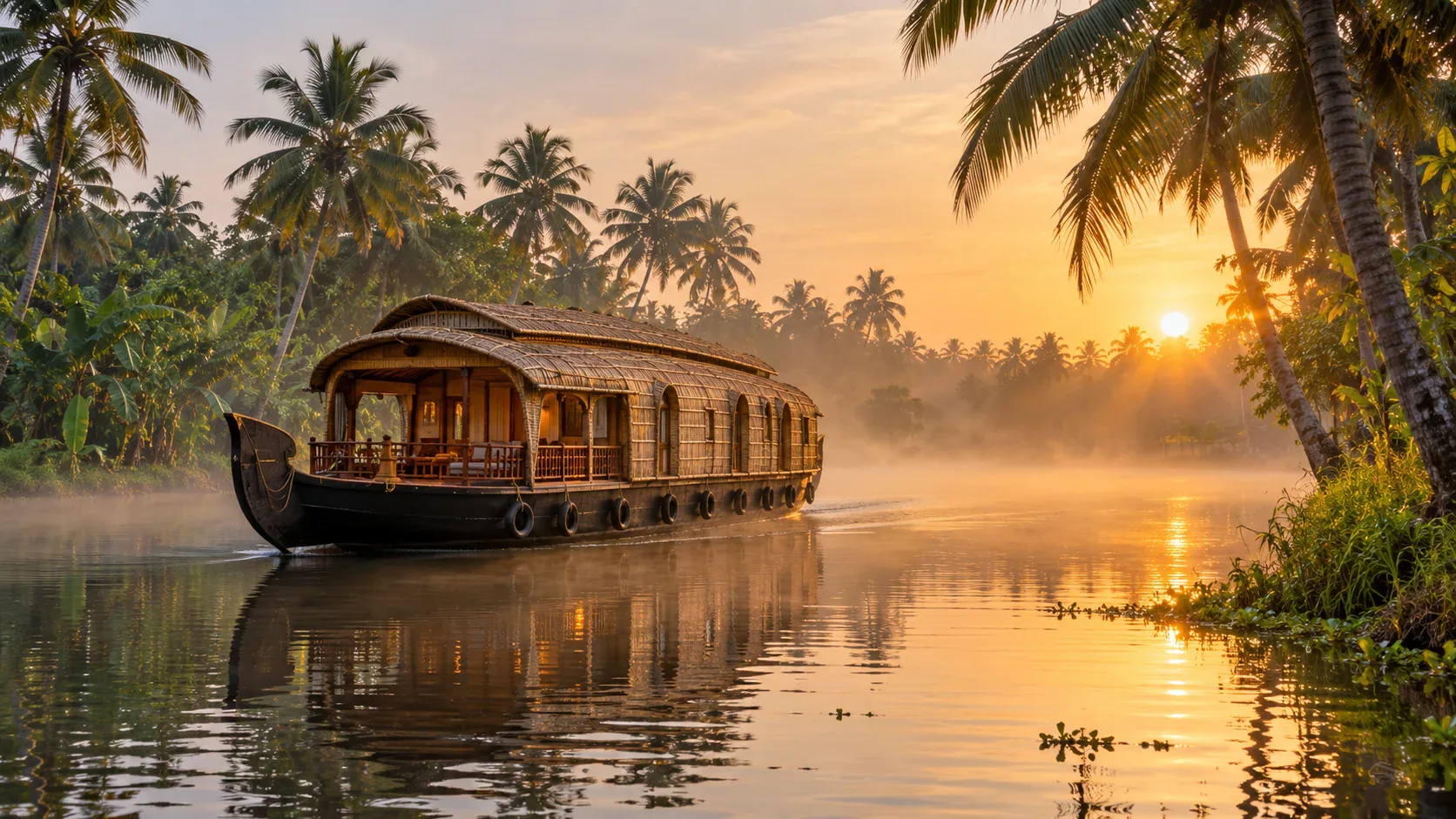
Overnight houseboats cruise the Punnamada and Vembanad backwater channels; meals are cooked on board and the upper deck offers sunset views.
Best forCouples, honeymooners and families
Verify sanitation, AC hours, safety equipment and licensing before booking; one night is standard, two suits slower travellers.
- Kovalam, near Thiruvananthapuram
Kovalam Lighthouse Beach
A crescent beach with a working lighthouse at the southern end; the promenade has cafes and Ayurveda centres within walking distance.
Best forBeach relaxation and Ayurveda
Stay here on the final night if flying out of Thiruvananthapuram to avoid a long departure-day drive.
- Varkala
Varkala cliffside walkway
A clifftop strip above a long beach with cafes, yoga studios and Ayurveda centres; the beach below is accessible by steps.
Best forSlow travel, yoga and beach days
Varkala suits travellers who prefer a quieter, less commercial beach than Kovalam.
Fort Kochi's Chinese fishing nets, St Francis Church, Mattancherry Palace and Jew Town can be covered in one afternoon and one morning, making Kochi a natural arrival and departure base. The heritage quarter is compact and walkable.
Munnar's tea estates include working gardens where leaf processing can be observed at the Tea Museum. Mattupetty Dam and Echo Point are within easy reach for an afternoon drive, and the reservoir offers optional boat rides.
Thekkady sits beside Periyar Wildlife Sanctuary, where a lake boat safari or guided nature walk gives access to the sanctuary buffer zone. Spice plantations in the surrounding cardamom and pepper country are a short drive from the main town, and evening Kalaripayattu or Kathakali performances are available locally.
The Alappuzha backwaters are best experienced on an overnight houseboat cruising the Punnamada and Vembanad channels. One night is the standard inclusion; two nights suits slower travellers. Verify sanitation, air-conditioning hours, safety equipment, meal plan and licensing before booking any private boat.
Kovalam's Lighthouse Beach and Varkala's cliffside walkway are the two most practical beach extensions for an 8-day trip ending in the south. Both are within transfer distance of Thiruvananthapuram airport, which avoids a long return drive to Kochi on departure day.
Sample 8-Day Kerala Itinerary
This 8 day kerala itinerary runs from Kochi to Munnar, Thekkady and the Alappuzha backwaters, ending at a beach base before departure. Each day pairs a morning activity with an afternoon transfer or sightseeing block, keeping driving realistic on the hill and backwater sectors.
Day01 Stop 1 of 8Arrive in Kochi — Fort Kochi and Mattancherry
Land at Cochin International Airport, transfer to Fort Kochi, and spend the afternoon on the heritage waterfront.
MorningArrive at Cochin International Airport and transfer to your Fort Kochi hotel; check in and rest.
AfternoonWalk Fort Kochi's lanes: Chinese fishing nets, St Francis Church and the Dutch Cemetery area.
EveningVisit Mattancherry Palace and Jew Town, then dinner at a Fort Kochi cafe.
Day02 Stop 2 of 8Kochi to Munnar via Cheeyappara Waterfalls
Drive from the coast into the Western Ghats, with a waterfall stop and tea-country views on arrival in Munnar.
MorningDepart Kochi after breakfast and drive towards Munnar.
AfternoonStop at Cheeyappara and Valara waterfalls en route; continue uphill to Munnar.
EveningCheck in at a Munnar plantation or hill-view hotel; walk the local market.
Day03 Stop 3 of 8Munnar — Tea Estates, Tea Museum and Mattupetty Dam
A full day in Munnar covering a working tea estate, the Tea Museum and the main hill viewpoints.
MorningVisit a working tea estate and the Tea Museum to see leaf processing.
AfternoonDrive to Mattupetty Dam and Echo Point; optional boat ride on the reservoir.
EveningReturn to Munnar town for shopping and dinner at the hotel.
Day04 Stop 4 of 8Munnar to Thekkady through Cardamom Hills
Transfer to Thekkady, the spice and wildlife base beside Periyar, with a spice plantation visit on arrival.
MorningCheck out and drive to Thekkady through cardamom and pepper country.
AfternoonCheck in, then visit a spice plantation to see cardamom, pepper and vanilla growing.
EveningOptional Kalaripayattu or Kathakali performance in Thekkady town.
Day05 Stop 5 of 8Periyar Wildlife Sanctuary and Thekkady
A wildlife-focused day around Periyar Lake and the sanctuary buffer zone, with an optional elephant camp or bamboo rafting trail.
MorningTake a Periyar Lake boat safari or a guided nature walk inside the sanctuary area.
AfternoonVisit an elephant camp or take a short bamboo rafting or plantation trail.
EveningBrowse Thekkady's spice shops and have dinner at the resort.
Day06 Stop 6 of 8Thekkady to Alappuzha — Backwater Check-in
Descend to the backwaters and board an overnight houseboat at Alappuzha for a cruise on the Punnamada and Vembanad channels.
MorningDrive from Thekkady to Alappuzha, stopping for lunch en route.
AfternoonBoard your houseboat at Alappuzha and cruise the Punnamada and Vembanad backwater channels.
EveningSunset on the upper deck; dinner cooked on board and overnight on the boat.
Day07 Stop 7 of 8Alappuzha to Kovalam or Varkala Beach
Disembark after breakfast and transfer south to a beach base for the final full day.
MorningDisembark at Alappuzha after breakfast and drive south towards the coast.
AfternoonCheck in at Kovalam or Varkala; relax on the beach or at the hotel pool.
EveningSunset at Kovalam's Lighthouse Beach or Varkala's cliffside walkway; dinner nearby.
Day08 Stop 8 of 8Beach Morning and Departure
A relaxed final morning before your flight from Thiruvananthapuram or Kochi.
MorningOptional Ayurveda massage or a short beach walk before check-out.
AfternoonTransfer to Thiruvananthapuram airport for departure, or return to Kochi if your flight leaves from there.
EveningDeparture.
Day 1 is arrival and Kochi sightseeing; Day 8 is departure. Adjust the order if your flight lands at Thiruvananthapuram rather than Kochi — in that case, reverse the route and begin at the beach.
How to Reach Kerala for an 8-Day Trip
Kochi is the most practical entry point for the central 8-day circuit, with direct flights from Delhi, Mumbai, Chennai and Kolkata. Thiruvananthapuram suits travellers starting at the beach end of the route. Both airports have pre-paid taxi counters and app-based cab services for onward transfers.
Delhi
Cochin International Airport (COK)
Direct flights available; check current schedules for journey time
Mumbai
Cochin International Airport (COK)
Direct flights available; one of the busiest routes into Kerala
Chennai
Cochin International Airport (COK) or Thiruvananthapuram (TRV)
Both airports served; choose based on your first stop
Kolkata
Cochin International Airport (COK)
Direct and connecting services available
Chennai
Ernakulam Junction (Kochi) or Thiruvananthapuram Central
Longer journey than flying; useful if you prefer overnight trains to save a hotel night
Kochi (COK)
NH 544 through Aluva and Adimali
Main road route to Munnar; Cheeyappara and Valara waterfalls are en route
Munnar
Kumily Road through cardamom estates
Route to Thekkady through spice country
Thekkady
Kottayam or Changanacherry
Route to Alappuzha backwaters; lunch stop possible en route
Alappuzha
NH 66 south
Route to Kovalam or Varkala for the beach extension; connects to Thiruvananthapuram airport
Travelling from your city?
Tell us where you start. A specialist can plan connections around your stay.
Plan my journeyCochin International Airport (COK) at Nedumbassery handles the highest volume of domestic arrivals for the central Kerala circuit. Direct flights operate from Delhi, Mumbai, Chennai, Kolkata, Bengaluru and Hyderabad, with journey times varying by origin city.
Thiruvananthapuram International Airport (TRV) is the better choice if you plan to reverse the itinerary and begin at Kovalam or Varkala before heading north to Alappuzha, Thekkady and Munnar. Flying into one airport and out of the other avoids backtracking on the final day.
Train travel is an option from Chennai and other southern cities to Ernakulam Junction (Kochi) or Thiruvananthapuram Central, though journey times are longer than flights. For the hill sectors — Munnar and Thekkady — private road transfers are the only practical option as neither town has a rail connection.
Connectivity within Kerala relies on private cars and drivers for the hill and backwater sectors. Mobile networks cover the main towns; hill areas around Munnar can have patchy signal. Download offline maps before departure and carry a local SIM or ensure your existing plan covers Kerala data roaming.
Best Time to Visit Kerala on an 8-Day Package
October to March is the most comfortable window for an 8-day Kerala trip covering sightseeing, backwaters, wildlife and beaches. June to September brings the southwest monsoon, which suits Ayurveda travel and green landscape photography but makes hill roads and outdoor activities less predictable.
January
Best time to goCool and dry; peak season across all sectors
Ideal conditions; book well ahead
February
Best time to goWarm and dry; slightly less crowded than January
Excellent for all sectors
March
Good time to goWarming up; dry and clear
Good value and comfortable weather
April
Shoulder seasonHot and humid on the coast; cooler in Munnar and Thekkady
Hill-focused itineraries work well; beach less comfortable
May
Shoulder seasonHot and pre-monsoon humidity building
Low prices; better for hills than coast or backwaters
June
Shoulder seasonSouthwest monsoon begins; heavy rain on the coast and hills
Monsoon travel and Ayurveda packages; outdoor activities limited
July
Shoulder seasonPeak southwest monsoon; lush green landscapes
Ayurveda and green photography; hill roads need care
August
Shoulder seasonMonsoon continues; Onam festival period
Onam celebrations add cultural interest; rain remains heavy
September
Good time to goMonsoon easing; landscapes still green
Good for Ayurveda; weather improving toward month end
October
Good time to goNortheast monsoon begins; showers in backwater and east-facing areas
Pack rain protection; good value and improving conditions
November
Good time to goNortheast monsoon showers; clearing toward month end
Showers possible; conditions improve in the second half
December
Best time to goCool and dry; peak season begins
Popular month; book two to three months ahead
- BestJan, Feb, Dec
- GoodMar, Sep, Oct, Nov
- FairApr, May, Jun, Jul, Aug
The northeast monsoon brings showers mainly in October and November, particularly on the east-facing slopes and the backwater region. Pack rain protection for those months even if the forecast looks clear.
December and January are peak season across Kerala: hotels and houseboats fill quickly, prices are at their highest and Kochi's heritage quarter is busiest. Book at least two to three months ahead for travel in this window.
April and May are hot and humid on the coast and in the backwaters, though Munnar and Thekkady remain cooler at elevation. These months suit hill-focused itineraries more than beach or backwater trips.
June to September is the southwest monsoon period. Houseboat operators on the Alappuzha backwaters continue through the monsoon, and some travellers specifically choose this season for the green landscape and Ayurveda packages. Hill roads need extra care, and some wildlife activities in Thekkady may be restricted.
8 Days vs Shorter and Longer Kerala Trips
Eight days sits between a rushed 5-day sampler and a slower 10-day circuit. The shorter version drops Thekkady or the beach; the longer version adds Kovalam, Varkala or a Kumarakom resort night without increasing daily driving pressure.
5 days / 4 nights
Best forShort breaks and long-weekend travellers
StrengthsLower cost, fewer hotel changes, works around limited leave
Trade-offsDrops Thekkady or the beach; more driving per day; houseboat night feels rushed
8 days / 7 nights (this plan)
Best forFirst-time visitors, families and couples wanting the full central circuit
StrengthsTwo-night stays in Munnar and Thekkady, one houseboat night, one beach day; moderate daily driving
Trade-offsStill excludes Wayanad and north Kerala; peak-season hotels need early booking
10 days / 9 nights
Best forSlow travellers, honeymooners and repeat visitors
StrengthsAdds a second beach night, a Kumarakom resort stay or a northern extension; less daily driving pressure
Trade-offsHigher cost and more leave required; marginal gain if you only want the central highlights
Use this comparison to decide whether to trim or extend your trip. Each option assumes Kochi as the gateway and private road transfers between sectors.
Indicative 8-Day Kerala Trip Cost
Indicative land-only costs for a kerala 7 nights package run from about INR 18,000 per person at budget level to INR 95,000 at luxury, on twin sharing and excluding flights. These are market benchmarks, not Tripstor package prices; actual quotes vary by season, hotel category, vehicle size and route.
Budget
Value-focused travellers and students
- Budget hotels and homestays throughout
- Shared or standard houseboat at Alappuzha
- Private car with basic vehicle category
Mid-range
Families and first-time visitors
- 3-star hotels and plantation resorts
- Private houseboat with AC hours at Alappuzha
- Private car and driver throughout the circuit
Premium
Couples and comfort-focused travellers
- 4-star resorts and premium houseboats
- Guided plantation and wildlife activities included
- Larger private vehicle for the hill sectors
Luxury
Honeymooners and special occasions
- 5-star and boutique properties throughout
- Private sunset cruise or spa inclusions
- Premium vehicle and personalised routing
Airfare, personal expenses, major attraction entry tickets and optional activities such as bamboo rafting or Ayurveda sessions are not included in the land-only benchmark. Houseboat category — standard, deluxe or premium — is one of the largest variables in the overall cost.
Pace, Arrival Tips and What to Skip
Kerala's hill roads between Kochi, Munnar and Thekkady are slow and winding, so an 8-day plan works best with two-night stays at each base and no more than one long transfer day at a time. Arriving by midday on Day 1 and keeping the final day free of long drives are the two most practical adjustments.
- Book a midday or earlier arrival
A morning or midday landing at Kochi gives you a full Fort Kochi afternoon. A late-night arrival effectively costs you Day 1 of sightseeing.
Arrival - Cap driving at one long sector per day
Kochi to Munnar and Thekkady to Alappuzha are the two long drives on this circuit. Keep the days between them to local sightseeing only.
Pace - Skip Wayanad on an 8-day trip
Wayanad sits far north of the central circuit and forces you to drop Munnar or Thekkady. Plan it as a separate northern Kerala trip instead.
Route - Add Kumarakom if you gain a day
A resort night at Kumarakom between Thekkady and Alappuzha breaks the longest transfer and adds a Vembanad Lake backwater experience.
Extension - Stay near the departure airport on the final night
If flying out of Kochi, stay in Kochi on the final night rather than driving from Varkala on departure day. If flying from Thiruvananthapuram, Kovalam is the better final base.
Departure - Verify houseboat details before booking
Confirm sanitation standards, air-conditioning hours, safety equipment, meal plan and licensing for any private Alappuzha boat before paying a deposit.
Houseboat - Carry a local SIM or check data coverage
Hill areas around Munnar can have patchy mobile signal. Download offline maps before the Munnar and Thekkady sectors and carry a power bank.
Connectivity - Pack one warm layer for Munnar evenings
Munnar sits at elevation in the Western Ghats and evenings are noticeably cooler than the coast. A light jacket or fleece is useful even in the October to March window.
Packing
If your flight lands late on Day 1, shift Kochi sightseeing to the morning of Day 2 and leave for Munnar after lunch. The Fort Kochi heritage quarter is compact enough to cover in a half-day.
If you gain an extra day, add a resort night at Kumarakom between Thekkady and Alappuzha rather than another hill station. Kumarakom breaks the longest transfer and adds a second backwater experience on the Vembanad Lake shore.
Wayanad sits far to the north and would require dropping either Munnar or Thekkady to fit within 8 days. Save it for a separate 5 to 6-day trip focused on the northern districts.
Permits, ID and Practical Entry Requirements
Kerala requires no special permit for most domestic travellers visiting Kochi, Munnar, Thekkady and Alappuzha. A government-issued photo ID — Aadhaar card, voter ID or driving licence — is sufficient for hotel check-in, houseboat boarding and most attraction entry across the circuit.
Periyar Wildlife Sanctuary at Thekkady charges an entry fee for the lake boat safari and guided nature walks; tickets are purchased at the sanctuary gate or through authorised counters in Thekkady town. Carry cash for smaller entry points as card machines are not universal in the hill areas.
Houseboat operators at Alappuzha are required to hold a licence from the Kerala Tourism Department. Ask to see the boat's licence and safety certificate before boarding; this is a standard check and reputable operators will provide it without hesitation.
Mobile connectivity is generally reliable in Kochi, Alappuzha and Thekkady town. Munnar's higher elevations and some stretches of the Kochi–Munnar road can have reduced signal. Inform your group of likely dead zones and agree on a meeting point at each base.
What to Pack for 8 Days in Kerala
Kerala's 8-day circuit moves between a coastal city, hill stations in the Western Ghats and backwater channels, so packing needs to cover warm evenings in Munnar, humid afternoons in Alappuzha and beach days at Kovalam or Varkala. Light layers, rain protection and modest clothing for temples cover most situations.
Government-issued photo ID
Aadhaar card, voter ID or driving licence required for hotel check-in and houseboat boarding throughout the circuit.
Where to get it: Carry the original; a digital copy on your phone is a useful backup.Common mistake: Relying solely on a digital copy — some properties require the physical document.
Light cotton clothing
Breathable fabrics for Kochi, Alappuzha and the beach sectors where humidity is high.
Common mistake: Packing heavy fabrics that take long to dry in humid coastal conditions.
One warm layer for Munnar
A light jacket or fleece for Munnar evenings; temperatures drop noticeably at elevation compared to the coast.
Common mistake: Assuming Kerala is uniformly hot — Munnar evenings can be cool even in December.
Rain protection
A compact umbrella or packable rain jacket; essential June to September and useful October to November.
Common mistake: Skipping rain gear for an October trip because the forecast looks clear.
Comfortable walking shoes
Closed shoes for plantation and sanctuary walks; sandals for beach days and Fort Kochi lanes.
Common mistake: Wearing only sandals for the Periyar nature walk — uneven forest paths need closed footwear.
Sunscreen and insect repellent
Sunscreen for beach and backwater days; insect repellent for Thekkady and the houseboat evening deck.
Common mistake: Forgetting repellent for the houseboat — the backwater channels have mosquitoes at dusk.
Modest clothing for temples
Shoulders and knees covered for entry to temples in Kochi and along the route; a light scarf or sarong works.
Where to get it: Check individual temple dress codes; some require specific colours or styles.Power bank and charging cables
Hill areas around Munnar can have patchy power supply; a power bank keeps phones and cameras charged between hotel stops.
Common mistake: Assuming all houseboat cabins have reliable power sockets throughout the night.
Prescription medicines and basic first aid
Carry a sufficient supply of any prescription medication; pharmacies are available in Kochi, Munnar town and Thekkady but may not stock specialist drugs.
Common mistake: Assuming a specific brand will be available in smaller hill towns.
Cash for smaller entry points
Card machines are not universal at sanctuary gates, smaller temples and rural spice plantations; carry sufficient cash for entry fees and tips.
Where to get it: ATMs are available in Kochi, Munnar town, Thekkady and Alappuzha.Common mistake: Relying on cards alone in the Thekkady and Munnar hill sectors.
The checklist below covers the main categories. Adjust quantities for the season: the October to March window needs minimal rain gear but a warm layer for Munnar; the monsoon window needs waterproof footwear and a compact umbrella throughout.
From idea to itinerary, with a real person.
- Share your plan
Dates, departure city, travellers and the moments you’d love. It only takes a minute.
- Shape it with a specialist
A real person refines the route, stays and pace with you. Change anything.
- Review your quote
A clear, personalised quote with confirmed inclusions. No payment to enquire.
Before you go
Straight answers to help you plan — then personalise the trip with a specialist.
10 answered belowAsk a specialist anything about this trip — there’s no obligation.
Ask a specialistWhat is the best time to visit Kerala for an 8-day trip?
October to March is generally best for comfortable sightseeing, beaches, backwaters and wildlife on an 8-day trip. June to September is wetter but suits monsoon and Ayurveda travel. The northeast monsoon can bring showers mainly in October and November, so pack rain protection in those months.
How much do 8 days Kerala tour packages cost?
Indicative land-only twin-sharing costs for a kerala 7 nights package are about INR 18,000 budget, INR 32,000 standard, INR 55,000 premium and INR 95,000 luxury per person, excluding flights. These are market benchmarks, not Tripstor offers; actual quotes vary by season, hotels and route.
Which places are covered in an 8 day Kerala itinerary?
A standard 8 day kerala itinerary covers Kochi, Munnar, Thekkady and Alappuzha or Kumarakom, with one beach or hill extension such as Kovalam or Varkala. Wayanad and north Kerala are usually excluded because they would stretch the driving beyond a comfortable week.
Is 8 days enough for Kerala or should I book 10 days?
Eight days is enough for the central circuit at a moderate pace with two-night stays in Munnar and Thekkady. Ten days adds a second beach night or a Kumarakom resort stay and reduces daily driving. Choose 8 days for the highlights, 10 days for a slower holiday.
Which airport is best for an 8-day Kerala tour?
Kochi is the most convenient all-purpose gateway for central circuits covering Munnar, Thekkady and Alappuzha. Thiruvananthapuram suits Kovalam and south Kerala, while Kannur and Kozhikode suit northern itineraries. Pick the airport that matches your first and last stops to avoid backtracking.
Is a houseboat stay in Kerala worth it on an 8-day trip?
For a well-selected private boat and route, an Alappuzha houseboat night is a highlight of a kerala 8 days trip. Verify sanitation, air-conditioning hours, safety equipment, meal plan and licensing before booking. One night is usually enough; two nights suits slower travellers.
Is Kerala safe for family travel on an 8-day package?
Kerala suits families well, especially with private transfers, moderate daily driving and hotels near medical and transport facilities. Hill roads need care in the monsoon, and houseboat safety equipment should be checked. Two-night stays reduce travel fatigue for children and elders.
What should I pack for 8 days in Kerala?
Pack light cotton clothing, rain protection, comfortable walking shoes, sunscreen, insect repellent, modest clothing for temples and a light layer for Munnar evenings. Add a power bank, cash for smaller entry points and any prescription medicines. A government-issued photo ID is required for hotel check-in throughout.
Do I need any permits for a Kerala trip?
Most domestic travellers need no special permit for Kochi, Munnar, Thekkady and Alappuzha. A government-issued photo ID covers hotel check-in and houseboat boarding. Periyar Wildlife Sanctuary charges an entry fee at the gate. Ask houseboat operators for their Kerala Tourism Department licence before boarding.
How do I get from Kochi to Munnar?
The Kochi to Munnar route runs via NH 544 through Aluva and Adimali, with Cheeyappara and Valara waterfalls as a natural stop en route. There is no rail connection to Munnar; a private car and driver is the standard and most practical option for this sector.